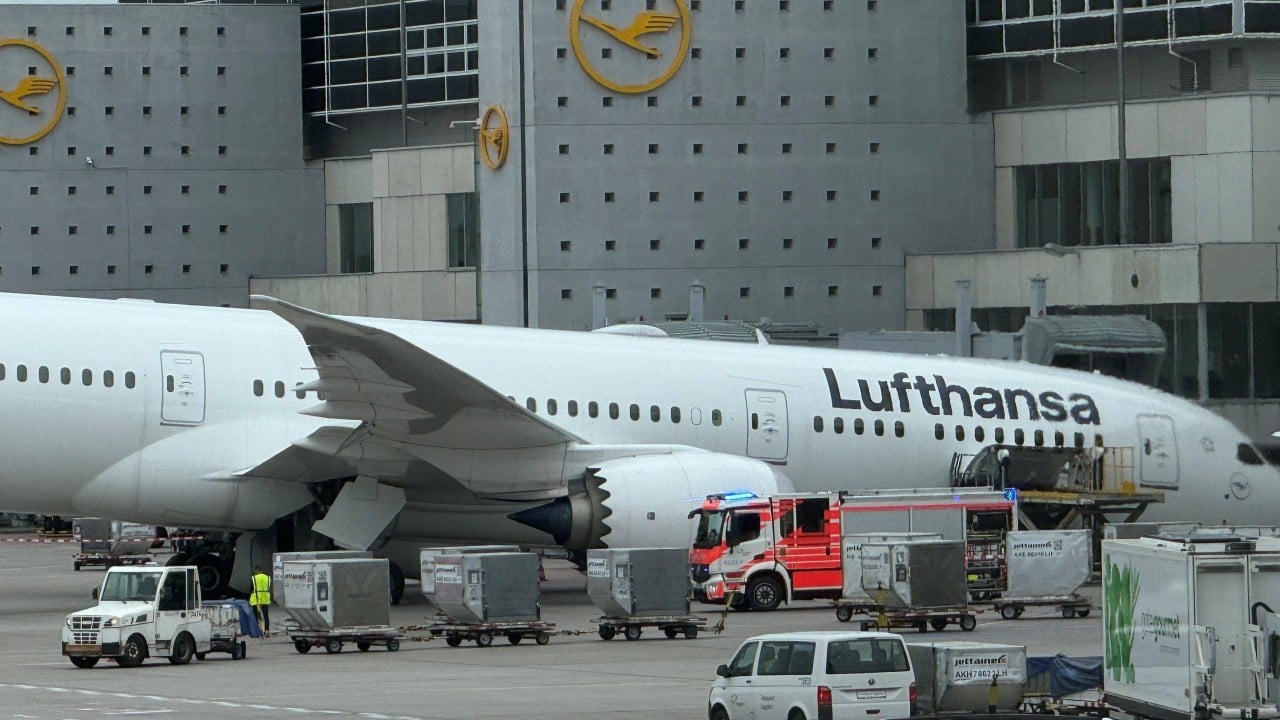
The media has its script, and it loves to stick to it. On June 4, 2026, a nearly brand-new Lufthansa Boeing 787-9 Dreamliner parked at a Frankfurt Airport gate suddenly dropped onto its nose, injuring several crew and ground staff members. Immediately, the internet exploded with the predictable, lazy consensus: Another day, another Boeing failure.
It is easy to paint this as a structural defect or a manufacturing nightmare from an aerospace giant under siege. But if you actually understand how modern aircraft work, you know the narrative is broken. Planes do not just decide to retract their landing gear while sitting at a gate because of a factory glitch. If you enjoyed this piece, you should look at: this related article.
The knee-jerk reaction to blame Boeing ignores the fundamental engineering of modern widebody jets and the brutal reality of ground operations. When a parked aircraft experiences a nose gear collapse, you should not be looking at the assembly line in South Carolina. You need to look at the tarmac.
The Myth of the Spontaneous Collapse
Every mainstream article covering the Frankfurt incident treats the landing gear as if it simply snapped under the weight of an empty plane. This reveals a massive misunderstanding of commercial aviation engineering. For another perspective on this story, refer to the recent coverage from The Next Web.
Landing gear assemblies, engineered by aerospace titans like Safran Landing Systems, are overbuilt to withstand massive dynamic forces during high-impact landings. When a plane is static at a gate, the forces acting on the gear are fractions of what it handles on a daily basis. The hardware does not just give up while the plane is parked.
More importantly, modern passenger jets are equipped with redundant mechanical and hydraulic safeguards specifically designed to prevent the landing gear from retracting on the ground. The system requires an intentional hydraulic command to pull the gear up.
For the nose gear to fold forward into the bay while parked, one of two things happened: a catastrophic hydraulic bypass due to maintenance interference, or someone forgot to insert the mechanical ground locking pin.
The Downside of Ground Control
I have spent years watching airlines rush turnaround times to keep utilization rates high. When a widebody jet is sitting at a gate being prepped for a long-haul flight like LH450 to Los Angeles, it is a chaotic ecosystem of ground handlers, cargo loaders, and maintenance technicians working simultaneously.
Video footage of the Frankfurt incident shows a service vehicle actively loading cargo into the forward right cargo hold right as the nose dropped. Ground crew members were working directly underneath the cockpit. This was not a dormant aircraft; it was an active workspace.
In almost every historical case of an inadvertent landing gear retraction on the ground, the root cause traces back to human error during servicing, not a failure of the aluminum or composite structure.
Take the 2021 British Airways 787 incident at London Heathrow—a case that every journalist is citing as proof of a design flaw. What the lazy reports omit is the final accident investigation finding. The Heathrow collapse occurred because maintenance personnel inadvertently cycled the landing gear lever while the mechanical ground lock pins were inserted incorrectly. The hydraulic system did exactly what it was told to do, fighting against a misplaced pin until the hardware gave way.
The High Cost of the Composite Era
While Boeing shouldn't bear the blame for the initial drop, the real problem for Lufthansa is what happens next. The Dreamliner is built largely from carbon-fiber reinforced polymers rather than traditional aluminum.
When an aluminum nose hits the tarmac, it bends. It deforms. It provides highly visible, predictable structural feedback. Engineers can cut out the damaged metal skin, rivet a new section in place, and get the bird back in the air.
Carbon fiber is a different beast entirely. It does not bend; it absorbs energy until it delaminates internally. When the front section of D-ABPQ slammed into the Frankfurt concrete, the composite fuselage suffered severe impact stresses. Both engines reportedly made contact with the ground.
Lufthansa's technicians cannot just look at the outside of this hull and declare it safe. They will have to deploy non-destructive testing methods, such as ultrasound scanning and thermography, to check for micro-cracks and internal layer separation within the composite matrix. If the structural core of the forward fuselage is compromised, the repair bill will be astronomical, and this one-year-old aircraft will be sitting in a hangar for months.
Stop Asking the Wrong Question
The public keeps asking, "Is the 787 safe to fly?"
That is completely the wrong question. The 787 is an incredibly safe, highly resilient machine. The real question we should be asking is: "Are airline ground operations keeping pace with the complexity of modern fleet technology?"
As airlines introduce highly complex, digitally integrated aircraft to replace legacy fleets, the room for error on the ramp shrinks to zero. A simple mistake during a pre-flight check or cargo loading sequence that might have caused a minor dent on an old Boeing 727 can now ground a $250 million widebody composite jet permanently.
Do not get blinded by the anti-Boeing headlines. Wait for the flight data recorder analysis and the ground crew interviews. The truth will be found on the Frankfurt tarmac, not the design blueprints.