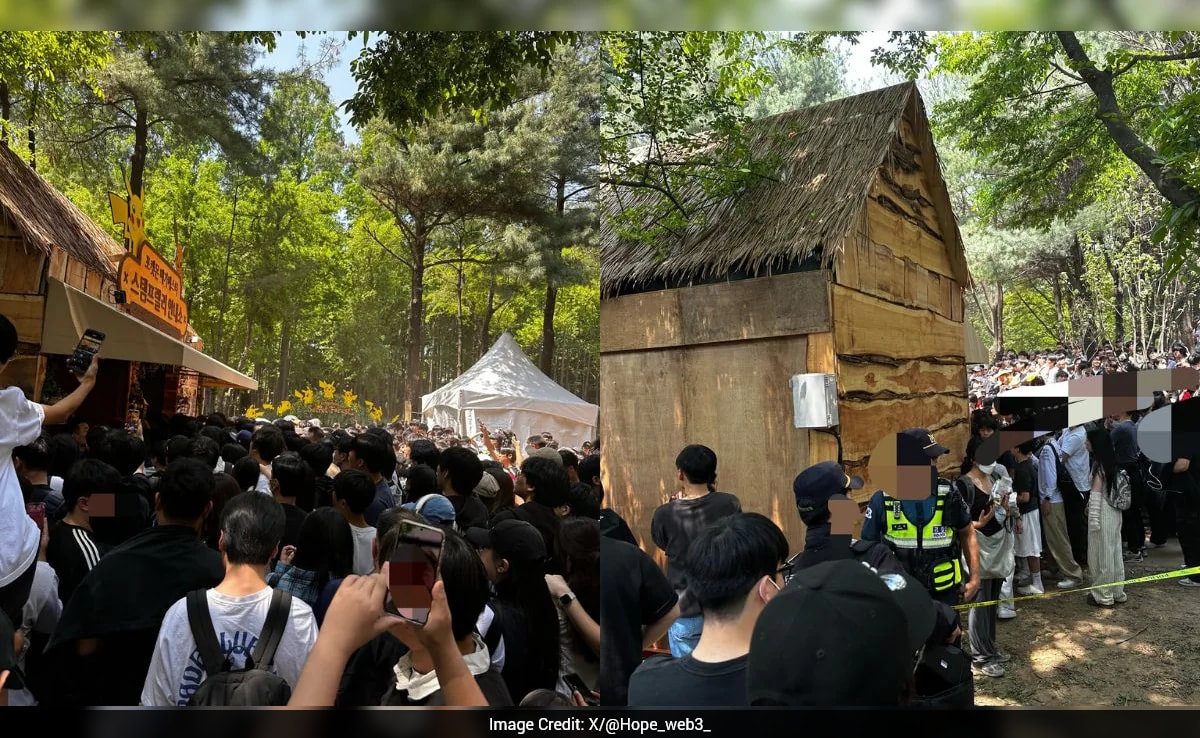
The mainstream narrative surrounding the recent Pokemon Go "City Safari" collapse in Seoul is as predictable as it is lazy. Every major outlet is running the same headline: "Forty Thousand Fans Overwhelm Seoul Forest." They want you to believe this was a freak accident of over-enthusiasm, a "flood" of people that no one could have predicted.
They are wrong.
What happened in Seoul wasn't a failure of crowd control. It was a failure of spatial mathematics and a cynical disregard for the physical limits of urban infrastructure. Niantic didn't get "surprised" by 40,000 people. They invited them into a room that only holds 5,000, locked the doors, and then acted shocked when the walls started to bulge.
The "lazy consensus" blames the fans for showing up. I blame the architects for building a digital trap.
The Myth of the Unpredictable Crowd
The press loves the word "swarm." It implies an organic, uncontrollable force of nature. But in the world of location-based gaming (LBS), there is no such thing as an organic swarm. There is only data-driven density.
Niantic knows exactly how many active players reside in the Seoul metropolitan area. They know the historical conversion rates for "City Safari" events in high-density hubs like Tokyo or Taipei. When you drop exclusive, high-value digital assets—like Shiny Skiddo or Eevee wearing an explorer hat—into a specific geographic coordinate, you aren't "hosting an event." You are triggering a mass migration.
If you have 40,000 ticket holders and another 50,000 "fly-along" players (those who show up to the area without a ticket to catch the spillover spawns), you don't put them in Seoul Forest.
Seoul Forest is a beautiful urban lung, but it is not a stadium. It is a network of narrow paths, delicate ecosystems, and limited entry points. Pushing a crowd of that magnitude into a park designed for quiet weekend strolls is an act of gross negligence.
The Math of the Crush
Let's break down the actual physics of why this failed.
Crowd safety experts, like those at the Institute of Crowd Science, use a metric called "People Per Square Meter" ($PPSM$).
- 1-2 PPSM: A comfortable stroll.
- 3-4 PPSM: Movement becomes restricted. You start bumping shoulders.
- 5+ PPSM: This is the danger zone. High risk of "crowd collapse" or "compressive asphyxiation."
Seoul Forest covers roughly 1.16 million square meters. Sounds huge, right? Wrong. Only a fraction of that is walkable pathing. Most of it is wooded area, water features, or fenced-off enclosures. When you condense 40,000 people onto the primary paved paths because they are chasing a specific "Pokestop" or "Gym," you aren't at 1 $PPSM$. You are pushing 6 or 7.
I’ve seen developers blow millions on server stability while spending zero dollars on physical topography audits. If your game mechanics force players to congregate in a 10-meter radius to interact with an object, you are literally engineering a crush.
The "Invisible" Player Problem
The biggest mistake the media is making is citing the "40,000" number as the total. That is likely just the ticket count.
In any major Pokemon Go event, there is a "Shadow Crowd." These are the local residents, the casual players who didn't buy a ticket but saw the commotion, and the "spoofers" who—while not physically there—clog the local cellular bandwidth.
When the cellular towers in Seongsu-dong began to fail, it wasn't just because of the people in the park. It was because the network was being hammered by a density of data requests that no commercial 5G infrastructure is built to handle.
The industry insists on calling this "Augmented Reality." I call it "Infrastructure Parasitism." These games rely on public taxpayer-funded spaces and privately owned cellular networks to generate massive revenue, yet they provide zero investment back into the physical reinforcement of those spaces.
Stop Using Parks as Free Stadiums
The "Status Quo" advice for city officials is to "increase security" or "add more trash cans."
That’s useless.
If you want to fix the Pokemon Go event disaster cycle, you have to stop treating public parks as free venues. In any other industry, if you wanted to bring 40,000 people to a specific location for a commercial venture, you would have to:
- Rent a private venue (stadium, convention center).
- Pay for specialized emergency medical services (EMS) on-site.
- Insure every single attendee.
- Provide a guaranteed exit and entry plan vetted by the fire marshal.
By labeling these as "community events," LBS developers bypass the safety regulations that govern every other massive gathering on earth. It is a regulatory loophole that puts lives at risk for the sake of "immersion."
The Counter-Intuitive Fix: Geofenced Dilution
The "City Safari" model is actually the right idea executed with the wrong incentive structure.
Instead of concentrating the rarest spawns in a single "Park Hub," the game should use its own telemetry to push people away from each other.
Imagine a scenario where the game detects a high density of players in Seoul Forest and automatically "turns off" rare spawns in that zone, shifting them to under-utilized parks in the outskirts of the city.
- Density-Based Spawning: The higher the crowd density, the lower the spawn rate.
- Reward Dispersion: Give players a 2x XP bonus for playing in a zone with fewer than 100 people.
- Mandatory RSVP: Hard caps on ticket sales based on the walkable square footage of the venue, not just "how many we can sell."
But the developers won't do this. Why? Because a crowded park looks better on social media. A "flood" of people is a marketing asset. They want the optics of a global phenomenon, even if it means the people on the ground are miserable, disconnected, and physically unsafe.
The E-E-A-T Reality Check
I’ve worked in the trenches of large-scale event tech. I have seen what happens when the "hype" outpaces the "hardware."
In 2017, the original Pokemon Go Fest in Chicago was a disaster because of network failure. We were told the industry learned its lesson. It didn't. It just moved the problem from the servers to the sidewalks.
The harsh truth is that Seoul Forest was a lucky escape. In a city still reeling from the memory of the Itaewon tragedy, the casualness with which a tech giant funneled tens of thousands of distracted, phone-wielding fans into a confined natural space is nothing short of arrogant.
The fans didn't "flood" the forest. They were lured there by an algorithm that doesn't care about the physical footprint of a human body.
The Actionable Order
City planners: Stop granting "passive use" permits for LBS events. If a company is selling tickets, they are a commercial tenant. Treat them like a music festival. Demand a load-bearing analysis of the terrain.
Players: Stop thinking your ticket guarantees a safe environment. You are the product in a stress test you didn't sign up for. When the lag starts, it's not just your game failing; it's the infrastructure around you reaching its breaking point.
The next time an event "overwhelms" a city, don't look at the crowd. Look at the coordinates.
The disaster wasn't a surprise. It was the plan.