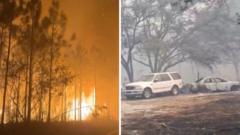
The headlines are bleeding red. Florida and Georgia are "under siege" by hundreds of wildfires. News anchors lean into the camera with practiced gravity, pointing at satellite maps of smoke plumes as if they are watching the end of days. They want you terrified. They want you to see fire as a foreign invader, a glitch in the system that needs to be scrubbed out with millions of gallons of Phos-Chek and tax-funded heroism.
They are lying to you by omission.
The "disaster" isn't that the Southeast is burning. The disaster is that it hasn't burned nearly enough. For a century, we have treated fire like a disease rather than a pulse. By suppressing every spark, we have turned our forests into tinderboxes and our ecosystems into stagnant relics. If you want to save the South, you have to let it burn.
The Fire Suppression Trap
The "lazy consensus" among mainstream media outlets is that any fire not contained within a backyard grill is a tragedy. This mindset is a relic of the 1910 Big Burn and the subsequent Smokey Bear propaganda that crippled American forestry. When we stop fires, we don't eliminate them. We just reschedule them for a later date, with interest.
Every year a forest floor doesn't burn, it accumulates "fuel loading." Dead pine needles, fallen branches, and invasive scrub pile up. In the longleaf pine ecosystems of Georgia and Florida, this buildup is a death sentence. Without regular, low-intensity fire to clear the deck, the forest floor becomes a dense mat of carbon. When the inevitable spark finally hits during a drought, you don't get a healthy ground fire. You get a crown fire—a monster that jumps to the treetops, kills the old growth, and sterilizes the soil.
The current "crisis" in Florida and Georgia is actually a symptom of systemic cowardice. We are so afraid of smoke on the highway that we invite the total destruction of the timber industry and residential zones ten years down the line.
Ecology Doesn't Care About Your Property Value
The Southeastern United States is home to some of the most fire-dependent species on the planet. The longleaf pine, once the king of the Southern woods, literally cannot reproduce without fire. Its seeds need bare mineral soil to germinate—soil that is only exposed after a fire sweeps away the leaf litter.
The Gopher Tortoise, a keystone species, relies on the open canopy created by fire to find the low-growing herbs it eats. Without fire, the forest thickens, the sun never hits the ground, the tortoise starves, and the 300 other species that live in its burrows vanish with it.
When the media laments the "loss of habitat" in these fires, they are showing their ignorance. For a longleaf forest, fire is the habitat. It is the cleaning service. It is the reset button. The "pristine" green wall of thickets you see from your SUV window isn't nature; it's a choked, dying garden waiting for a match.
The High Cost of the "Safety" Illusion
I have seen local governments spend a fortune on "fire mitigation" that amounts to nothing more than moving brush from one pile to another. It’s theater. It’s designed to make homeowners feel safe while they build three-bedroom ranch houses in the middle of a pyrophytic ecosystem.
If you build your house in a flood plain, the insurance company eventually stops taking your calls. If you build your house in a fire-climax forest and demand that the state prevent every nearby flicker, you are asking the government to defy physics.
We need to shift the burden of risk. Instead of funneling billions into reactive suppression—planes, chemicals, and thousands of boots on the ground—we should be pouring that money into aggressive, massive-scale prescribed burns. But we don't. Why? Because a prescribed burn creates "nuisance smoke." Voters complain. Politicians blink. The fire gets canceled. Then, three years later, a lightning strike turns that "nuisance" into a hundred-thousand-acre inferno that costs ten times as much to fight.
The Data the Media Ignores
Look at the numbers from the National Interagency Fire Center (NIFC). The years with the highest acreage burned aren't always the years with the highest economic loss. The correlation isn't between "fire" and "damage"; it’s between "suppression" and "catastrophe."
In Georgia, the Okefenokee Swamp is a prime example. It is designed to burn. When we try to "save" the swamp by diking it and stopping the fire, we alter the hydrology and destroy the very peat beds we claim to protect. The fires currently making headlines are often just nature doing the work that we were too politically timid to do ourselves.
Breaking the Premise: The Wrong Questions
The public is asking: "How do we stop these fires?"
The media is asking: "Who is to blame for the smoke?"
Both are the wrong questions. The right question is: "How do we live in a landscape that requires fire to survive?"
The answer isn't more fire trucks. It's a fundamental shift in how we view the Southern landscape.
- Zoning Overhaul: Stop allowing high-density residential development in "High Fire Hazard" zones without mandatory, fire-resistant landscaping and building materials.
- Liability Protection: Georgia has made strides here, but Florida needs to catch up. We must provide near-total liability immunity for certified burn managers. If a prescribed burn puts smoke on a road, that is a small price to pay for not losing the entire county to a wildfire in July.
- Smoke Literacy: We need a public education campaign that teaches people that "smoke today means no inferno tomorrow."
The Nuance of the Burn
Don't misunderstand me. I'm not advocating for arson. I'm advocating for the recognition that fire is an apex predator of the plant world. You don't "defeat" it. You manage it. You respect its territory.
The current fires in Florida and Georgia are an indictment of our land management philosophy. We have treated the wilderness like a museum piece—static, unchanging, and fragile. It isn't. It is a dynamic, high-energy system that requires regular disturbance to remain healthy. By trying to keep it in a state of perpetual green, we are effectively suffocating it.
The Professional Negligence of Modern Journalism
The way this is being reported is a disservice to the public. By focusing entirely on the "emergency" aspect, journalists ignore the long-term biological necessity of these events. They interview the family who lost a shed—which is tragic on a micro-level—but they never interview the foresters who will tell you that the timber stand will be twice as healthy in two years because of this burn.
They provide the "what" and the "where" but completely fail on the "why." They treat fire as a freak accident of weather rather than a predictable result of a century of mismanagement.
Admit the Downside
Is my approach dangerous? Yes. Prescribed burns can get out of control. Smoke can cause respiratory issues for the elderly. Fire is a blunt instrument. But the alternative—the "status quo" of total suppression—is a guaranteed path to larger, hotter, more destructive fires that we won't be able to stop regardless of how much money we throw at them.
We are currently choosing between a series of small, manageable headaches and one massive, fatal stroke. The headlines you see today are just the first few warning signs of that stroke.
Stop looking at the smoke and wishing for rain. Start looking at the overgrown brush in your own backyard and wishing for a controlled flame. The South was born in fire, and it will only survive if we stop trying to put it out.
Get out of the way and let the woods breathe.