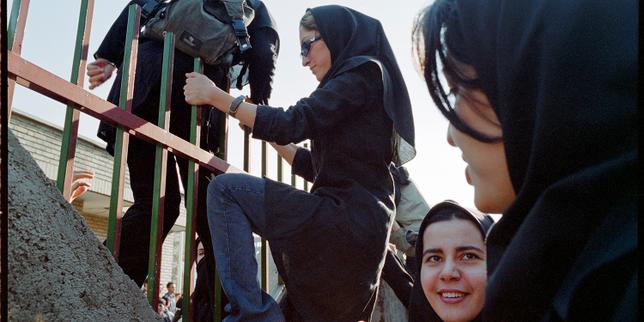
Every time a curator in Paris or London hangs a moody photograph of a Tehran teenager smoking on a rooftop against a smog-choked horizon, champagne flutes chime across Europe. The narrative is always identical. It is a comforting fable for the comfortable classes. We are told about a vibrant, rebellious generation fighting for survival, dancing on the edge of a volcano, painting their nails in defiance of theocratic gravity.
It makes for breathtaking gallery openings. It wins prestigious international grants. It offers Western liberals a clean, digestible vicarious thrill. Also making headlines in this space: The Architecture of Dynastic Transition in Tehran.
It is also a profound betrayal.
When we reduce complex political misery and crushing economic strangulation to an aestheticized mood board, we stop seeing human beings and start collecting exoticized martyrs. We consume their rebellion like an artisanal coffee blend, rich with notes of suffering and finished with a smooth veneer of resilience. Newsha Tavakolian and her peers document real lives, but the global art apparatus strips those lives of their grit, replacing messy reality with a sanitized, poetic postcard. Further details regarding the matter are explored by The New York Times.
Let us tear down the lazy consensus that frames Iranian youth solely as tragic romantics fighting an artistic war against the dark ages. The truth is far uglier, far more systemic, and entirely devoid of romantic filter.
The Luxury of Defiance
Look closer at who gets photographed. Look at who gets exhibited in European institutes and North American museums. They are rarely the kids working twelve-hour shifts in unregulated auto-repair shops in southern Tehran. They are rarely the young men and women whose families were wiped out by currency devaluation, whose medical supplies vanished behind the iron curtain of international sanctions, or whose daily existence is a grinding mathematical impossibility of basic calorie counting.
The subjects of high-art photography in Tehran often belong to a very specific demographic. They possess the cultural capital, the education, and often the familial safety nets that permit them to engage in artistic resistance. Defiance in a high-contrast black-and-white print looks effortless. In reality, it costs blood, rent money, social ostracization, and mental health that no gallery catalogue will ever insure.
When Western critics praise the "Persian breath" of young Iranians, they are projecting their own domestic political fantasies onto a foreign screen. They want Iranian youth to act as the vanguard of secular bohemianism because it validates Western lifestyle choices. It says: Look, even under totalitarianism, people just want to wear skinny jeans, listen to indie rock, and take moody portraits.
This is narcissism disguised as solidarity.
The reality on the ground does not care about your compositional rules of thirds. Inflation runs rampant at terrifying speeds. The national currency has been battered into a souvenir. Young graduates with advanced degrees drive bootleg taxis because the formal economy has calcified into a playground for corrupt insiders and sanctioned monopolies. To tell these people that they are "advancing and loving life" is a cruel joke told by someone sitting safely behind a firewall in a cafe with stable Wi-Fi.
The Complicity of the Global Art Market
Why does this romanticized gaze persist? Because misery sells, provided it is packaged with sufficient poetic distance.
The international art circuit operates on a transactional appetite for exotic trauma. A photograph of an Iranian woman removing her headscarf in an interior shot captures immediate attention at a biennale. It generates headlines. It secures funding. But what happens when the exhibition ends? Does the money flow back to fix the structural decay of the infrastructure that produced the artist? Does it help the families starving under the dual weight of domestic authoritarianism and external sanctions?
No. The capital flows into the accounts of galleries, auction houses, and institutional curators who add another checkmark to their diversity quota. The artist gains temporary mobility or international patronage, while the vast majority of their compatriots remain trapped in an economic pressure cooker.
We must confront the mechanics of this exploitation. The global North loves a good resistance story because it requires zero material sacrifice. You buy a print, you feel politically enlightened, you sleep soundly knowing you care about human rights. Meanwhile, the sanctions backed by your own governments continue to choke the very economic lifelines that could allow an independent middle class to dismantle the theocracy from within.
Economic warfare is not a neutral background radiation. It is an active catalyst for totalitarian consolidation. When a population is forced to spend eighty percent of its cognitive bandwidth simply securing daily bread, medication, and fuel, organized political resistance becomes a luxury item. Authoritarian regimes love impoverished populations because poverty eliminates civil society.
Yet the artistic gaze ignores the central bank, ignores the logistics of sanctions enforcement, ignores the structural roots of corruption, and focuses entirely on the photogenic melancholy of a young girl staring out a rainy window. It is pornography for human rights NGOs.
Dismantling the Myth of the Eternal Rebel
Let us shatter another comforting delusion: the idea that youth inherently equals progressive revolution.
History is littered with cynical reminders that young populations under severe stress can fracture in terrifying directions. Desperation does not automatically birth enlightened democrats. It breeds survivalism, radicalization, economic migration, and deep societal atomization.
When you strip away the romantic lens, the daily existence of twenty-somethings in major Iranian cities is characterized by profound exhaustion. Burnout is not a trendy Instagram hashtag there; it is a clinical epidemic. The brain drain is staggering. The best minds, the engineers, the scientists, the coders, and the artists flee the country at the first viable opportunity. They do not stay behind to stage cinematic protests for foreign cameras. They pack suitcases, liquidate assets, and vanish into the diaspora, leaving behind a hollowed-out demographic core.
To celebrate those who remain as if they are voluntarily participating in some grand, romantic existential struggle is grotesque gaslighting. They are not staying because they love the aesthetic of resistance. They are staying because they cannot afford a plane ticket, because their aging parents need care, because bureaucratic walls trap them inside an open-air prison.
Stop calling this a "fight for life" when it is actually a desperate scramble against systemic suffocation. There is a vast semantic gulf between fighting for a better political future and merely trying not to drown in raw sewage while the currency collapses by the hour.
The Economics of Despair
Let us examine the mechanics of financial isolation. Imagine a scenario where you are a twenty-five-year-old freelance graphic designer in Tehran trying to bill an international client. Your payment gateways are blocked. Your access to global software subscriptions requires navigating black markets of cryptocurrency and VPN workarounds that cost a fortune in transaction fees. Your hardware is outdated because import tariffs make a modern laptop cost six months of salary.
Now imagine a European curator looking at your portfolio and praising your "raw, unvarnished minimalism."
The disconnect is total. The minimalism is not an artistic choice; it is a hardware limitation. The stark lighting in your studio is not a deliberate chiaroscuro study; it is rolling brownouts managed by an incompetent municipal grid.
When we evaluate art from sanctioned nations through purely aesthetic criteria, we commit an act of intellectual colonialism. We strip the work of its material context and re-clothe it in our own interpretive desires. We turn systemic failure into artistic style.
This must stop. If we are going to talk about Iranian youth, we must talk about the banking system that robs them blind. We must talk about the policy decisions made in Washington and Brussels that starve their hospitals just as effectively as the mismanagement in Tehran. We must talk about the geopolitical chess match where real human beings are treated as acceptable collateral damage.
The Uncomfortable Truth About Solidarity
True solidarity is rarely photogenic. It does not look good on a glossy gallery wall. It looks like boring administrative reform, complex diplomatic negotiations, the lifting of counterproductive economic blockades, and the hard, unglamorous work of supporting labor unions, independent trade networks, and digital infrastructure rights.
It does not look like a moody portrait of a woman with expressive eyes.
If you truly care about the generation driving change in Iran, stop buying tickets to exhibitions that monetize their agony. Stop treating their political marginalization as a chic lifestyle accessory for your living room. Demand that your politicians end the economic policies that crush the middle class and leave citizens entirely dependent on state handouts for survival.
Until we are willing to look past the romantic haze of gallery lighting and face the gritty, unglamorous economics of modern authoritarianism, our appreciation of Iranian art is nothing more than voyeurism with a conscience.
Put down the champagne glass. Look at the balance sheet. Real people are starving while you admire their shadows.