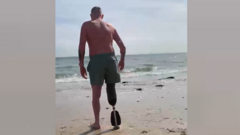
The internet loves a scrappy underdog story. A backyard engineer 3D prints a customized gadget in their garage, bypasses the "greedy" medical establishment, and solves a complex physical challenge for forty bucks and a weekend of elbow grease. It makes for great social media bait.
But when it comes to amputees building their own swimming prosthetics, the narrative isn't just deeply flawed—it’s actively holding people back from actually performing in the water.
I have spent over a decade working alongside clinical prosthetists, biomechanists, and adaptive athletes. I have seen well-meaning DIYers destroy their residual limbs, ruin expensive components, and waste months trying to solve a problem that physics solved decades ago. The romanticized idea of the "hacked" swim leg is a distraction.
If you want to swim fast, efficiently, and without destroying your body, you need to stop playing garage scientist and understand how water actually interacts with an amputee's anatomy.
The Myth of the Hydrodynamic Leg
The standard DIY swim leg article follows a predictable script: the author realizes their everyday walking prosthesis acts like a giant anchor in the pool. They notice the heavy pylon, the water-logged foot shell, and the rusting metallic components. So, they set out to build a waterproof, fin-shaped appendage to slice through the water.
This approach fails because it misunderstands basic fluid dynamics.
When an able-bodied person swims, their ankle joint allows for significant plantarflexion—the ability to point the toes straight back, aligning the top of the foot with the shin. This creates a continuous, streamlined surface.
When you attach a rigid, DIY fin to a prosthetic socket, you are essentially strapping a fixed paddle to the end of a lever arm. Unless your garage build includes a dynamic, water-activated hydraulic ankle system that can adjust resistance based on angular velocity, your custom creation is doing one of two things:
- Creating massive frontal drag during the recovery phase of your kick.
- Generating asymmetric torque that forces your hip and lower back to overcompensate, leading to chronic joint strain.
Imagine a scenario where a bilateral transtibial amputee builds two perfectly symmetrical, rigid swim fins. In the workshop, they look pristine. In the pool, because the human body does not kick with perfect, robotic symmetry, those rigid fins act as unyielding rudders. Every slight deviation in kick angle forces the residual limb to twist violently inside the socket.
You aren't swimming better; you are just turning your knee into a shock absorber for poorly engineered hydrodynamics.
Why "Waterproof" is a Trap
DIY builders frequently brag about using PVC pipes, marine-grade stainless steel, or carbon fiber filaments to ensure their creation is waterproof. They miss the bigger issue: the socket interface.
In a standard walking prosthesis, the connection between your residual limb and the socket relies on suction, elevated vacuum, or a mechanical pin-lock system. These systems are designed for vertical load-bearing and atmospheric pressure stability.
Water changes everything.
The Problem of Volume Fluctuation
When you submerge a residual limb in a pool, the hydrostatic pressure of the water compresses the tissue. At the same time, the physical exertion of swimming causes your limb volume to fluctuate. A socket that fits perfectly on dry land will lose its vacuum or suction seal within fifteen minutes of continuous swimming.
The Pumping Effect
As you kick, the force of the water pulling against the prosthetic creates a mechanical "pumping" action. Water gets drawn into the socket, mixing with your sweat. This creates a highly abrasive slurry.
Professional prosthetists spend years studying skin graft topology, scar tissue tolerance, and shear force distribution. A garage builder using a heat gun to mold a piece of plastic cannot account for the precise pressure distribution required to prevent skin breakdown under wet, high-shear conditions. A single blister on a residual limb can sideline an athlete for weeks. Saving a few hundred dollars on a DIY leg means absolutely nothing if you can't wear your primary walking prosthesis because of an infected ulcer.
The Secret Elite Swimmers Won't Tell You
Look at the starting blocks at any high-level adaptive swim meet or the Paralympics. Count how many transtibial or transfemoral amputees are wearing a prosthesis on the blocks.
The answer is almost zero.
The most efficient way for an amputee to swim is not with a better fake leg. It is without one.
The human body is naturally buoyant, but prosthetics—even lightweight, hollow carbon fiber ones—alter your center of buoyancy and your center of mass. A prosthesis adds weight to the lower half of the body, dragging your hips down. In swimming, hip position is everything. The moment your hips drop, your frontal surface area increases, and your drag coefficient skyrockets.
Elite unilateral amputee swimmers do not try to replicate a two-legged kick. They master the art of the asymmetric body roll. They use their intact leg for primary propulsion and rely on core stabilization to keep their body aligned in the water.
The desire to build a swim leg often stems from a psychological need for symmetry rather than a biomechanical need for speed. We are conditioned to think that to do an activity, we must replace the missing part. Swimming is the rare exception where the absence of the limb, when managed correctly through technique, can actually minimize drag.
When a Prosthesis Actually Matters (And How to Do It Right)
There are legitimate reasons to want a prosthesis near the water. If you are competing in a triathlon, you need to get from the water's edge to the transition zone across sand, rocks, or boat ramps. If you are scuba diving, a specialized fin option helps with depth control and navigation.
But if you genuinely need a water-ready prosthesis, the DIY route is still a losing proposition. The alternative isn't just accepting the exorbitant costs of traditional clinical manufacturing; it’s changing how you negotiate with the industry.
Many people don't realize that standard component manufacturers like Össur and Ottobock design components specifically for water submersion. The issue is rarely that the technology doesn't exist; it's that insurance companies refuse to pay for it because they deem recreation "medically unnecessary."
Instead of spending your energy fabricating a dangerous PVC leg, channel that effort into building a clinical case for a secondary device.
- Document the Risk: Work with your prosthetist to document the structural damage your everyday walking leg suffers from exposure to chlorine, salt water, and sand. Corrosion of a mechanical knee joint or pin-lock system is a safety hazard that insurance companies want to avoid replacing prematurely.
- Repurpose Old Components: When you get a new everyday socket fabricated, do not throw away the old one. The structural fit of an old socket can often be modified by a professional with relief holes and water-resistant liners. Pair that older, depreciated socket with dedicated, corrosion-resistant components.
- Prioritize the Component, Not the Frame: If you must adapt hardware, focus on the mechanical connection. Specialized components like the Össur Pro-Flex XC or waterproof mechanical knees are engineered to handle the cyclic loading of walking while resisting corrosion.
Dismantling the Garage Builder Fantasy
Let's address the inevitable pushback: "But my DIY leg works great for me."
Anecdotal success is not engineering validation. A backyard build might survive a casual dip in a backyard pool or a slow paddle lake swim. But the moment you subject that device to the high-velocity forces of a competitive flip turn, or the chaotic, unpredictable currents of an open-water swim, the structural integrity of unrated materials will fail.
If a 3D-printed PETG bracket snaps mid-kick in open water, that component instantly becomes dead weight sinking toward the bottom, dragging you down with it. The risk-to-reward ratio is fundamentally broken.
Stop treating your body like a weekend hobby project. If your goal is truly independence, performance, and athletic longevity, you must accept that water demands either specialized, professionally engineered equipment or a complete reevaluation of your swimming mechanics.
Throw away the PVC glue. Get out of the garage, get into the pool, and learn to master the water with the body you have, not the plastic one you think you need.


