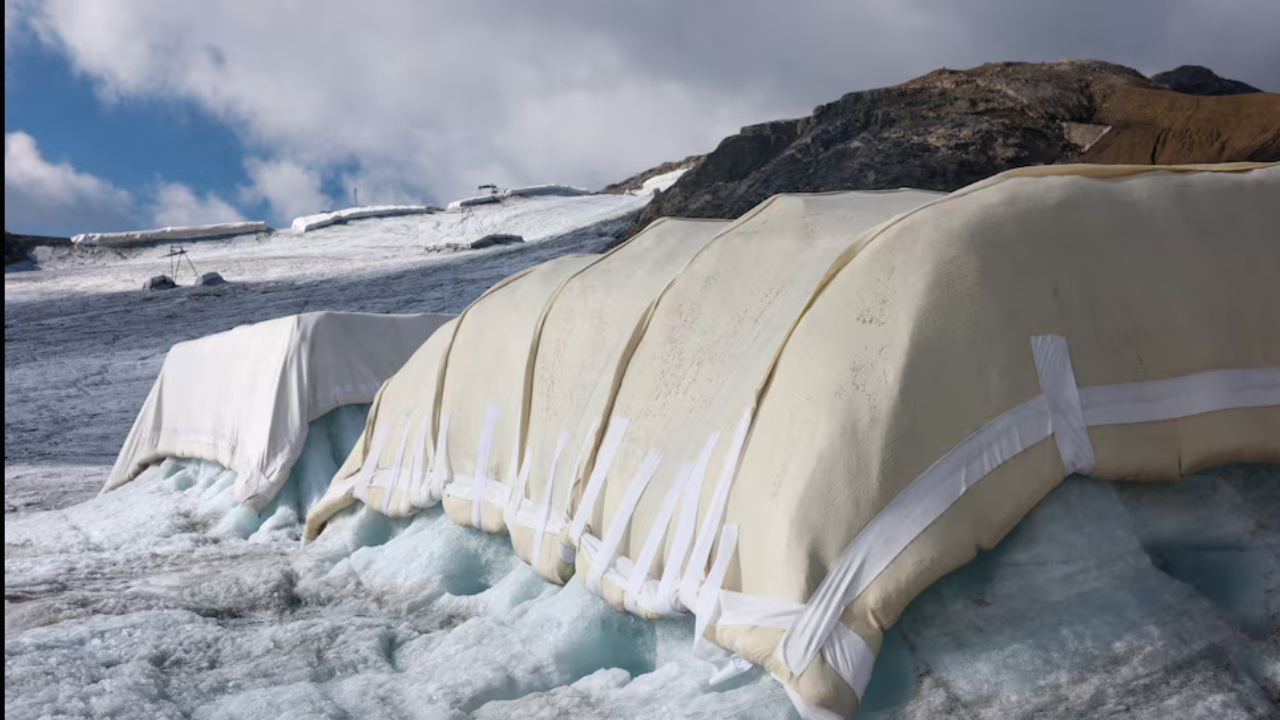
Media outlets are hyperventilating over a patch of the Swiss Alps where researchers laid down two hundred square meters of sheep fleece. The narrative writes itself. Shepherds and scientists unite on high ice. Discarded agricultural waste repurposed to fight thermal doom. Environmental media calls it an innovative adaptation.
It is theatre. Expensive, feel-good, scientifically sterile theatre. If you enjoyed this piece, you should read: this related article.
The project, dubbed Keep It Wool on the Tsanfleuron Glacier, proves that raw animal fibers can block sunlight and reduce local ice melt just as well as industrial plastic geotextiles. That part is true. Grab two hundred square meters of dense natural material, throw it over a frozen slope, and physics dictates that the underlying ice will absorb less thermal radiation during August. But celebrating this as a climate win requires a profound misunderstanding of scale, thermodynamics, and the actual mechanics of planetary mass loss.
Let us look at the math the cheerful headlines gloss over. Switzerland possesses roughly eight hundred square kilometers of glacier ice. The wool blanket trial covers two hundred square meters. That means this celebrated eco-initiative protects precisely zero point zero two percent of the country’s total ice volume. The remaining ninety-nine point nine-eight percent is entirely exposed to atmospheric heating, rising jet streams, and shifting weather patterns. For another look on this development, refer to the latest coverage from BBC News.
You are not saving a glacier by knitting a heavy winter quilt for a tennis-court-sized patch of dirt and ice. You are running an aesthetic preservation project for ski resort infrastructure and tourist photo ops.
The cheerleaders of this experiment point out that standard synthetic tarpaulins—polyethylene and PVC sheets used across the Alps for years—shed microplastics into meltwater streams as they degrade under intense ultraviolet radiation. Replacing petroleum-based plastics with biodegradable keratin fibers stops that specific pollution vector. That is a net positive for local stream chemistry. If your primary goal is keeping plastic fleece out of alpine runoff, wool wins.
However, framing this as a weapon against climate change is intellectually dishonest. Glaciers do not melt because they lack wool blankets. They melt because atmospheric enthalpy has shifted entirely out of equilibrium with historical baselines. Wrapping a dying alpine giant in local agricultural fleece is the equivalent of slapping a band-aid on a severed femoral artery and praising the adhesive quality of the bandage.
Consider the logistical absurdity of scaling this up. Switzerland discards or burns a massive share of its domestic wool annually because synthetic imports displaced the local textile economy. Proponents argue that using this waste solves a structural agricultural surplus problem while cooling the mountains.
Imagine a scenario where we attempt to cover just one percent of Switzerland’s shrinking ice fields with locally sourced sheep fleece. You would need millions of square meters of dense material, requiring the shearing of hundreds of thousands of additional sheep, industrial scouring plants, heavy transport logistics up vertical alpine terrain via helicopter or cable car, and continuous maintenance crews to rescue the blankets when winter gales tear them to shreds. The carbon footprint generated just to process, transport, and anchor thousands of tons of heavy wool across remote crevasses would offset a significant portion of the localized thermal benefit.
The glaciologists running these trials know this. In quiet moments, they admit that these physical covers are strictly localized emergency measures designed to preserve specific ice patches beneath ski lifts or maintain access routes for summer mountain tourism. They are not instruments of planetary healing. They are local triage tools keeping a business afloat.
When you read that scientists are thrilled because the wool survived heavy rain and freezing temperatures without disintegrating instantly, remember what is missing from the press release. Durability in a high-alpine environment is a baseline engineering requirement, not a triumph. High-altitude winds on the Tsanfleuron ridge routinely exceed gale force. Ultraviolet radiation at three thousand meters shreds organic polymers with terrifying efficiency. While the wool held up for a single summer season, natural keratin degrades through microbial action and mechanical fatigue far faster than engineered synthetics. A wool blanket left on a melting ice slope for five consecutive years will not just vanish gracefully; it will rot, tear, and leave behind a sodden, matted mess of organic debris that alters local melt-zone albedo in unpredictable ways.
We keep falling into the trap of fetishizing local circular economy gimmicks because they offer a palatable alternative to systemic failure. A wool blanket feels actionable. You can touch it, photograph it, and write a heartwarming feature about shepherds joining forces with university researchers. Fossil fuel emission reductions, grid decarbonization, and systemic economic restructuring do not fit neatly into a feel-good Instagram reel.
Stop pretending that agricultural scraps can out-engineer global thermodynamics. The ice is not retreating because it is cold-deficient; it is retreating because the atmosphere is saturated with thermal energy. Keep the wool on the sheep, take the plastic off the illusion, and stop confusing a PR stunt with climate action.