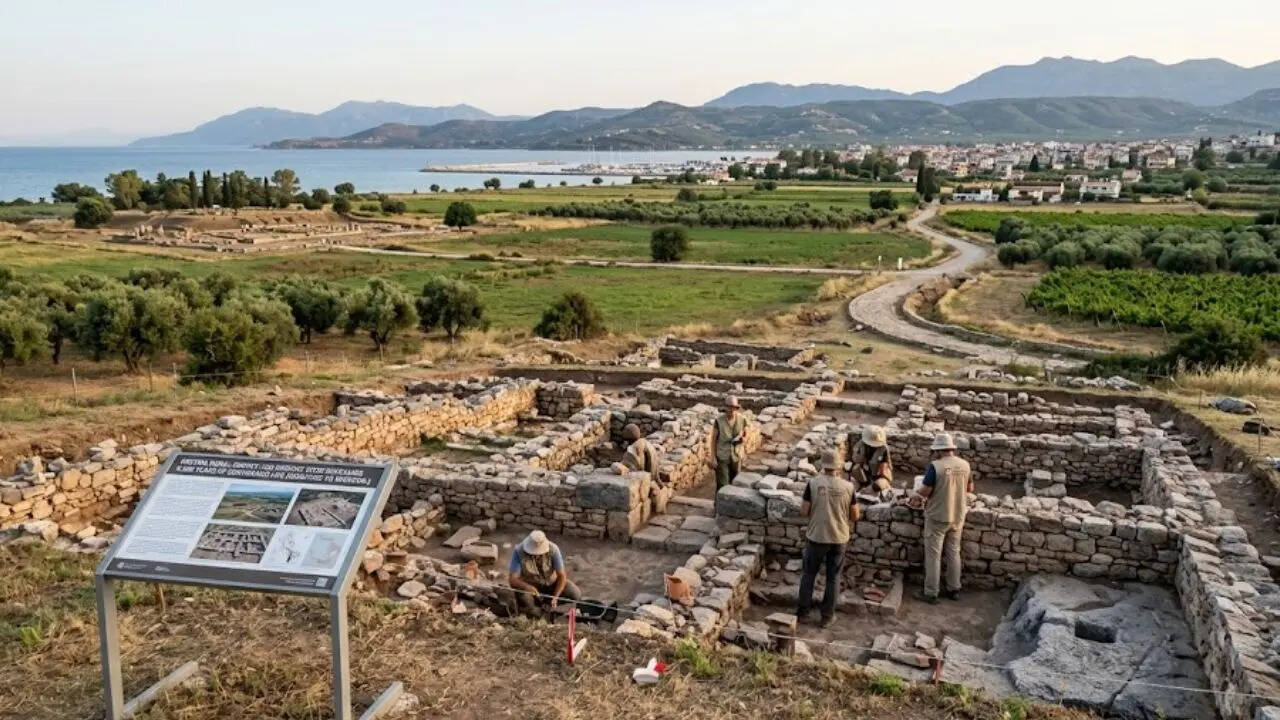
Archaeologists just "discovered" 200 ancient sites in Greece. The headlines are predictably breathless. They talk about 6,000 years of "hidden history" finally coming to light. They frame it as a victory for human knowledge. They are wrong.
This isn't a discovery. It is an admission of failure.
For decades, the archaeological establishment has sat on its hands, clinging to a romanticized, "Indiana Jones" version of history that relies on shovels and luck. These 200 sites weren't hidden; they were ignored because they didn't fit the narrative of monumental marble and heroic statuary. We are obsessed with the "great hits" of the Bronze Age while stepping over the actual data of how civilizations live and die.
If we want to understand the past, we have to stop treating every pile of rocks like a sacred relic and start treating the Earth like a hard drive that we’ve been too lazy to plug in.
The Myth of the Hidden Site
The competitor piece suggests these sites were "revealed" as if by magic. In reality, they were found using LiDAR (Light Detection and Ranging) and satellite multispectral imaging. This technology has existed for years. The reason we are only finding these sites now isn't because the technology improved—it’s because the funding and the ego of the field finally shifted.
Archaeology has a massive gatekeeping problem. If a site doesn't have a temple or a palace, it’s often deemed "low priority." This creates a skewed data set. We study the 1% of ancient elites and call it "human history." The 200 sites found recently are mostly farmsteads, small settlements, and rural infrastructure. To the traditionalist, they are boring. To anyone interested in the actual mechanics of survival, they are everything.
We have spent 150 years obsessing over the Parthenon while ignoring the thousands of square miles of agricultural terrace systems that actually fed the people who built it. This isn't "hidden" history. It’s suppressed history.
The LiDAR Trap and the Digital Mirage
Everyone is currently high on LiDAR. It’s the new toy that makes everyone feel like an explorer from their desk. But there is a massive downside to this digital-first approach that no one wants to talk about: Data Gluttony.
We are identifying sites faster than we can possibly verify them. Finding 200 sites is easy. Understanding them requires "ground-truthing"—physically going there, digging test pits, and analyzing soil chemistry.
- The Cost: A single season of excavation can cost $50,000 to $250,000 depending on the location.
- The Math: To properly investigate 200 new sites in Greece would require a budget exceeding $40 million and a workforce the Greek Ministry of Culture simply doesn't have.
- The Result: These sites are "discovered" on a map, tagged with a GPS coordinate, and then left to be looted or destroyed by modern development before a single trowel hits the dirt.
We are creating a digital graveyard of "known unknowns." We’ve mapped the ruins, but we haven’t saved them. In many ways, "discovering" a site without the resources to protect it is a death sentence. Once a site is on a public map, the looters arrive long before the PhDs.
Why We Should Stop Excavating (For Now)
This is the take that gets me kicked out of faculty lounges: We need to stop digging.
Every time we excavate a site, we destroy it. Archaeology is the only science that destroys its subject matter to study it. Once you peel back the layers of a trench, that context is gone forever.
If we truly care about the "6,000 years of history" mentioned in the headlines, we should be practicing In-Situ Preservation. We have the technology to see through the ground without breaking the seal. Ground-penetrating radar (GPR) and magnetometry can show us walls, hearths, and burials with startling clarity.
Yet, the "discovery" narrative demands a physical reveal. The public wants to see a gold mask or a bronze sword. They don't want to see a gray-scale heat map of a Neolithic trash pit. By chasing the "hidden history" high, we are burning through our cultural capital. We are the last generation that will have "untouched" sites to study, and we are ripping them open for the sake of a press release.
The "People Also Ask" Delusion
When people ask, "What is the most important ancient discovery in Greece?" they expect to hear about a new tomb. The real answer is Climate Data.
The 200 sites mentioned in recent reports are valuable not because of the artifacts they contain, but because of the paleo-environmental context they provide. By studying the abandonment phases of these small rural sites, we can track the exact moment of systemic collapse due to soil exhaustion or localized climate shifts.
The "Lazy Consensus" focuses on the who and the what.
The "Disruptive Reality" focuses on the how and the why.
- Stop looking for kings. Start looking for irrigation ditches.
- Stop valuing marble. Start valuing charred seeds (paleobotany).
- Stop celebrating the "find." Start mourning the lack of conservation.
The Business of History
Greece’s economy relies heavily on tourism. This "200 sites" story is as much a marketing campaign as it is a scientific breakthrough. The Greek government needs to keep the "Ancient Greece" brand fresh. "New discoveries" drive ticket sales and museum foot traffic.
But this creates a dangerous incentive structure. It prioritizes sites that are "tourist-ready." A remote Neolithic site in the mountains of Epirus—no matter how scientifically significant—will never get the funding of a mid-tier Roman villa near a cruise ship port.
I’ve seen departments blow their entire annual budget on a single "prestige" dig while dozens of smaller, more informative sites were paved over for a new highway or a luxury resort. We are literally trading our history for a better view of the Mediterranean.
The Actionable Truth
If you actually want to "reveal" history, stop reading the sensationalist fluff about "newly discovered" ruins and start looking at the gaps in the map.
History isn't a timeline of great men; it’s a ledger of resources. The real revolution in Greek archaeology isn't happening in the trenches of some new "hidden" site. It’s happening in the labs where stable isotope analysis of bone fragments tells us exactly what a peasant ate in 4000 BCE, or where lead pollution trapped in glacial ice tells us the exact output of ancient silver mines.
We don't need more sites. We need better questions.
The "200 sites" are just points on a map. Until we stop treating archaeology like a scavenger hunt for shiny objects, those points are meaningless. We are staring at the hard drive, bragging about how many files are on it, while refusing to actually run the software.
Stop celebrating the discovery. Start demanding the data.
The dirt doesn't care about your sense of wonder. It only cares about the entropy we are accelerating every time we pretend that "finding" something is the same thing as "understanding" it.