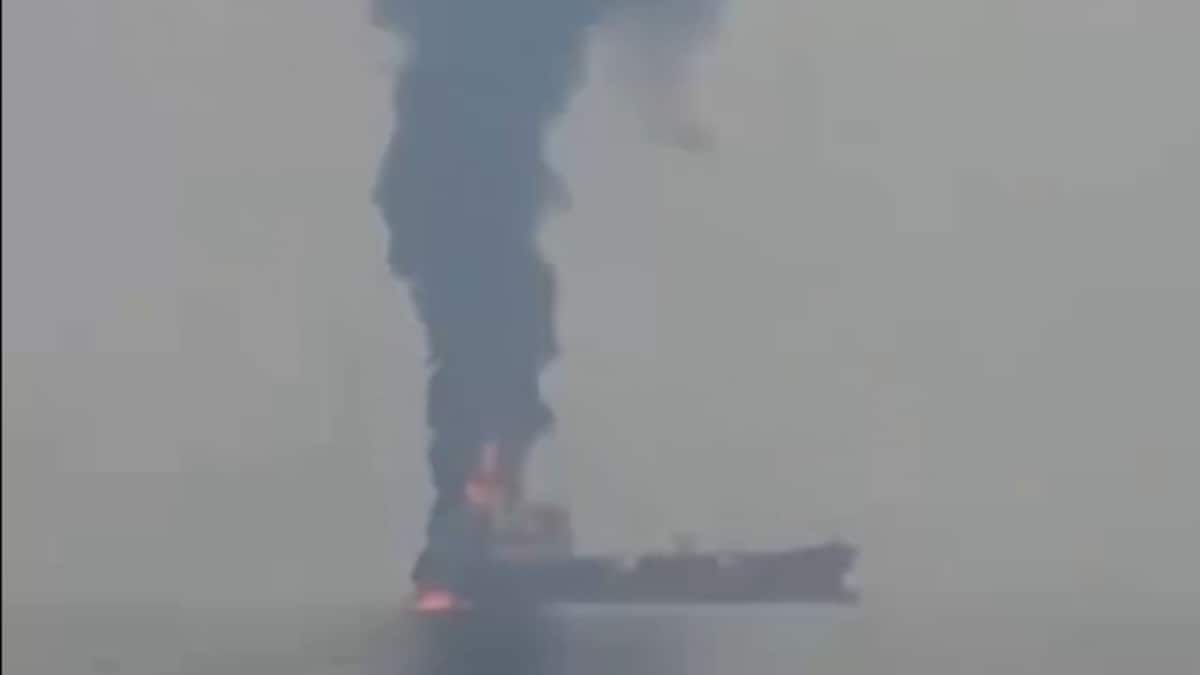
The maritime chokepoint of the Strait of Hormuz has finally snapped. On Sunday, the Palau-flagged oil tanker Skylight was struck five nautical miles north of Oman’s Khasab Port, leaving four crew members injured and forced a high-stakes evacuation of 20 personnel, 15 of whom are Indian nationals. This was not a random act of piracy. It was a targeted strike in a rapidly widening conflict between Israel, the United States, and Iran—a collision that has now claimed its first victims in the previously neutral waters of Oman.
For decades, the Musandam Peninsula has served as a silent observer to regional friction. That ended when projectiles hit the Skylight, a vessel already under US sanctions for its alleged role in an Iranian "shadow fleet." The attack follows the reported assassination of Iran's Supreme Leader, Ayatollah Ali Khamenei, in a coordinated US-Israeli strike. Tehran’s response has been a blunt instrument: a de facto blockade of the world’s most critical energy artery.
The Human Cost of Geopolitical Brinkmanship
Maritime security is often discussed in terms of "barrels per day" or "insurance premiums," but the reality on the deck of the Skylight was one of fire and steel. The crew, a mix of 15 Indians and five Iranians, found themselves on a vessel that had been anchored near Musandam since late February. When the strike occurred, the engine room became a furnace.
While the Omani Maritime Security Centre confirmed that all 20 crew members were successfully evacuated, the "varying degrees of injury" sustained by four sailors highlight the extreme vulnerability of merchant mariners. These are not combatants. They are the essential labor force of global trade, yet they are currently being used as kinetic pawns. New Delhi is now in the familiar, grueling position of coordinating with Muscat to ensure the safety of its citizens while navigating a diplomatic minefield where every statement is weighed against energy security.
Why the Skylight Was a Target
To understand why a small, Palau-flagged tanker was hit, one must look at the US Treasury Department’s ledger. In December 2025, the Skylight and its manager, Red Sea Ship Management LLC, were sanctioned for operating as part of a clandestine network moving Iranian petroleum. By striking this specific vessel, the aggressors—whether state actors or proxies—sent a dual message.
- To Iran: Your "shadow fleet" is no longer invisible or safe from physical intervention.
- To the World: No vessel, regardless of its flag or perceived neutrality of its location, is exempt from the current theater of war.
The choice of location is equally telling. Khasab is just five miles from the Omani coast. By bringing the violence into Omani waters, the conflict has officially spilled out of the Persian Gulf and into the sovereign territory of a nation that has historically acted as the region's primary mediator. The message is clear: the era of "neutral ground" in the Middle East is over.
The $100 Barrel and the Insurance Exodus
The economic ripples of the Skylight attack were felt before the smoke had even cleared. Brent crude surged toward the $100 mark as markets reacted to the perceived closure of the Strait. Roughly 20% of the world’s oil and 25% of its liquefied natural gas (LNG) pass through this narrow gap. If the IRGC (Islamic Revolutionary Guard Corps) makes good on its radio broadcasts claiming the Strait is "closed to international navigation," the global economy faces a supply shock not seen since the 1970s.
The real crisis, however, is not just the physical threat of missiles but the sudden evaporation of trust in the shipping industry.
- Insurance Withdrawal: Major maritime insurers, including Steamship Mutual, have already moved to cancel war risk coverage for the Gulf. Without insurance, commercial shipping effectively stops.
- The Great U-Turn: Satellite data already shows a massive backlog of tankers near Fujairah. Vessels like the India-flagged Desh Abhimaan have been spotted reversing course, unwilling to gamble a multimillion-dollar hull and dozens of lives against an uncertain horizon.
- Shadow Fleet Vulnerability: The very ships Iran uses to bypass sanctions are now the easiest targets for "deniable" strikes.
The Strategic Miscalculation
There is a grim irony in the fact that the crew of the Skylight was a mix of Indian and Iranian nationals. Iran’s "retaliation campaign" is ostensibly designed to punish the West, yet its tactics are actively crippling the economies of its neighbors and the safety of workers from "friendly" nations like India.
The IRGC’s warning that the Strait is unsafe is a self-fulfilling prophecy. By declaring the waterway a war zone, they have forced the hand of the US Navy’s Fifth Fleet. We are no longer looking at a "simmering" tension. We are looking at a full-scale maritime interdiction environment where "misidentification" between a naval destroyer and a commercial tanker is a matter of when, not if.
The situation in Oman is a harbinger of a new, more chaotic phase of maritime warfare. It is a world where the laws of the sea are secondary to the reach of a drone, and where the safety of 15 Indian sailors is the collateral cost of a war they never signed up for. The Strait of Hormuz has been a metaphorical "loaded gun" for forty years. On Sunday, someone finally pulled the trigger.