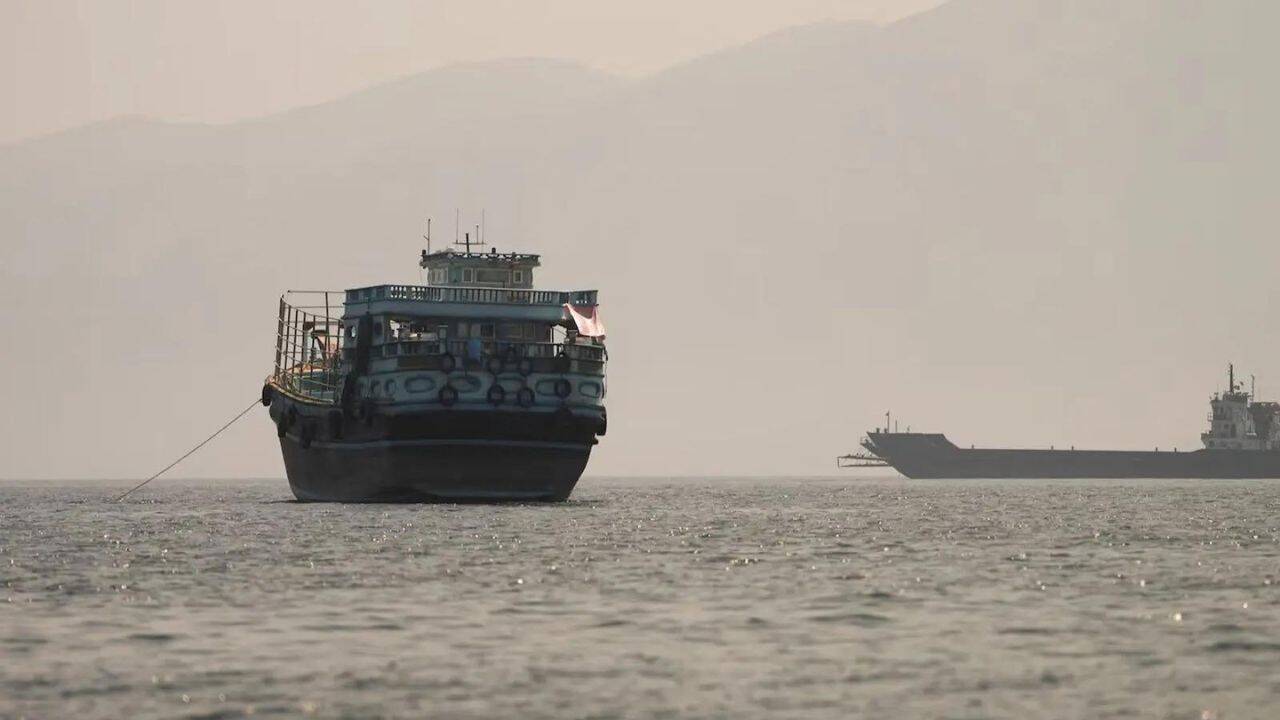
The assumption that western naval superiority can permanently secure the Strait of Hormuz is failing. For decades, global energy security has relied on the premise that the United States and its allies could deter disruption in the world's most critical maritime chokepoint through sheer firepower. That premise is broken. Iran does not believe it is losing the war of attrition in the Persian Gulf, and its military strategy has adapted to neutralize traditional naval advantages. By pivoting to asymmetric warfare, Tehran has ensured that maintaining control over the strait remains viable, cost-effective, and highly resilient against external pressure.
The Asymmetric Math of Modern Maritime Conflict
The physics of modern naval engagement favor the disruptor. Traditional defense models rely on multi-billion-dollar carrier strike groups to project power and keep shipping lanes open. Iran, acutely aware that it cannot match the United States hull-for-hull, has spent thirty years perfecting a counter-strategy.
This strategy relies on saturation. Instead of deploying large, vulnerable surface combatants, the Islamic Revolutionary Guard Corps Navy (IRGCN) deploys hundreds of fast attack craft, unmanned explosive boats, and low-altitude anti-ship cruise missiles. In a constrained geographical space like the Strait of Hormuz—which narrows to just 21 miles at its tightest point—density matters more than sophistication.
Consider the economic imbalance. A single sea-skimming missile or loitering munition costing less than fifty thousand dollars can disable a commercial tanker or force a multi-mission destroyer to expend a two-million-dollar air defense interceptor. When dozens of these threats are launched simultaneously, the defensive calculus collapses. Western navies face a finite magazine capacity; Iran possesses an effectively infinite supply of cheap, domestically produced munitions.
Geography as an Absolute Weapon
Naval doctrine often treats the open ocean as a blank canvas, but the Persian Gulf is a claustrophobic shooting gallery. The shipping channels that handle roughly a fifth of the world's petroleum consumption are tightly constrained by shallow waters and treacherous islands.
The Strategic Value of Iranian Islands
Iran holds the geographical high ground. Islands like Qeshm, Abu Musa, and the Greater and Lesser Tunbs function as unsinkable aircraft carriers. Tehran has fortified these outposts with coastal artillery, radar installations, and subterranean missile silos.
Strait of Hormuz Chokepoint Dynamics:
[Oman / UAE Coast] <--- 21 Miles of Shipping Lanes ---> [Fortified Iranian Islands & Mainland]
Any commercial vessel transiting the strait must pass within striking distance of these islands. This proximity eliminates the luxury of early warning time. A missile fired from the Iranian coast can reach a target in the shipping lane in under sixty seconds. This reality forces international shipping companies to operate under a permanent state of high risk, driving up insurance premiums and shifting global supply chains regardless of whether shots are actually fired.
The Myth of Effective Sanctions on Military Production
Western policy has long operated under the belief that economic isolation would eventually starve Iran's military-industrial complex. This has proved inaccurate.
Sanctions have forced Iranian engineers to become masters of reverse-engineering and illicit procurement networks. Rather than halting production, restrictions have driven Iran to build a self-sustaining defense sector that relies heavily on commercial, off-the-shelf components. Microchips found in downed Iranian drones frequently trace back to standard consumer electronics available worldwide. Tehran does not need western military hardware to threaten western interests.
Furthermore, the geopolitical environment has shifted. Iran no longer operates in isolation. Increased diplomatic, economic, and military cooperation with Moscow and Beijing provides Tehran with technological redundancy and political cover at the United Nations Security Council. Joint naval drills in the Gulf of Oman demonstrate a growing alignment that complicates any western plans for a coordinated military response.
The Limits of Convoy Escort Operations
When tensions spike, the immediate political response from western capitals is to launch maritime security coalitions to escort commercial traffic. These operations provide a psychological balm for the markets, but their operational utility is limited.
Escort missions require immense resources. Protecting every civilian vessel transiting the Persian Gulf is logistically impossible. A destroyer can only protect the ships in its immediate vicinity, leaving the vast majority of commercial traffic vulnerable to gray-zone tactics. Iran rarely resorts to overt fleet actions; instead, it uses limpet mines, nocturnal boardings, and cyber disruptions to harass unescorted vessels, achieving its strategic goals while remaining just below the threshold that would trigger a full-scale conventional military retaliation.
The Red Sea Precedent and the New Reality
Events outside the Persian Gulf have validated Iran's strategic doctrine. The prolonged disruption of shipping in the Red Sea by Houthi forces provided a real-world test case for asymmetric maritime denial.
A non-state actor, using a fraction of the arsenal available to Tehran, managed to alter global shipping routes, force major shipping lines to bypass the Suez Canal, and tie down a significant portion of the US Navy's surface fleet. The lessons learned in the Red Sea are already being integrated into Iran's planning for the Strait of Hormuz. If a proxy force can disrupt the Red Sea, the patron state can undoubtedly close the Persian Gulf.
Western strategy must abandon the idea that Iran can be deterred by the mere presence of a naval task force. The old rules of deterrence assume that both sides view risk through the same lens. For Tehran, maintaining the ability to strangle global energy supplies is an existential imperative, a vital insurance policy against foreign regime change. They are willing to accept significant economic pain to preserve that lever. Until western policy addresses the fundamental asymmetry of commitment and geography, the Strait of Hormuz will remain under the effective veto power of Iranian forces.