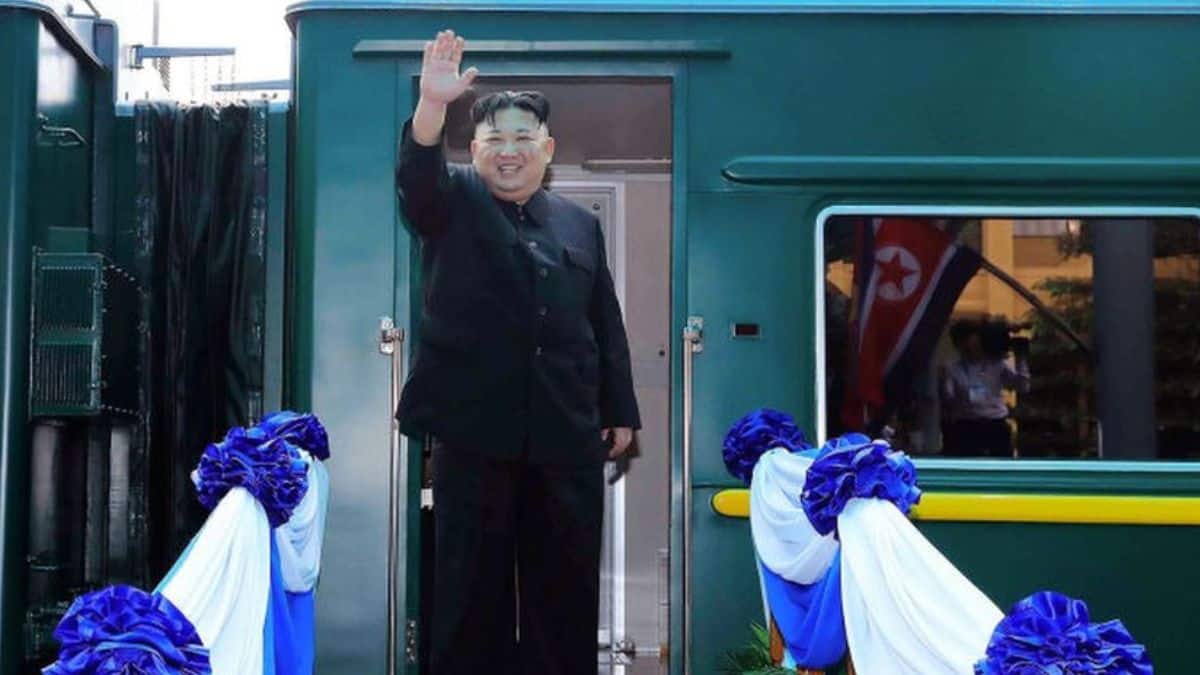
The internal signaling from the 8th Congress of the Workers' Party of Korea (WPK) represents a fundamental shift from nuclear ambiguity to a doctrine of tactical integration. While international observers often interpret Kim Jong Un’s rhetoric as performative brinkmanship, a structural analysis of the announced "Five-Year Plan for the Development of National Defense Science and Weapons Systems" reveals a calculated pursuit of regional hegemony through the miniaturization of warheads and the diversification of delivery platforms. This is not a bid for attention; it is a systematic closing of the strategic gap between North Korean capabilities and U.S. missile defense architectures.
The Dual-Track Calculus of Survival and Coercion
Pyongyang’s security architecture rests on two distinct but overlapping pillars. Understanding the distinction between these pillars explains why "denuclearization" as a diplomatic goal remains fundamentally incompatible with the Kim regime’s internal logic.
- Regime Preservation (The Floor): This is the baseline requirement. By achieving a credible Intercontinental Ballistic Missile (ICBM) capability, North Korea creates a "de-coupling" effect between the United States and its East Asian allies. The logic is simple: would Washington risk San Francisco to save Seoul?
- Strategic Coercion (The Ceiling): The 8th Party Congress signaled a transition toward this second pillar. The emphasis on "tactical nuclear weapons" suggests that Kim is no longer satisfied with a "deterrence-only" posture. Tactical nukes allow for lower-yield strikes on the battlefield, providing North Korea with the means to escalate a conventional conflict to a nuclear level without necessarily triggering a full-scale global exchange.
The transition from strategic to tactical nuclear capabilities changes the cost-benefit analysis for South Korea and Japan. It forces these nations to reconsider the reliability of the U.S. nuclear umbrella, thereby fracturing regional alliances.
The Technical Taxonomy of North Korean Rearmament
The "Five-Year Plan" detailed during the congress is a checklist of high-precision military engineering. Rather than vague promises of "strength," the regime specified five key technological milestones that serve as the blueprint for their next developmental phase.
Miniaturization and Standardization
The most significant bottleneck for North Korea has been the "size-to-yield" ratio. To fit a nuclear warhead onto a diverse array of missiles—from submarine-launched platforms to short-range cruise missiles—the warhead must be lighter and more resilient to atmospheric re-entry. The Congress explicitly called for making nuclear weapons "smaller, lighter, and standardized." This standardization is an industrial pivot; it allows for mass production and interchangeable parts across different military branches, increasing operational readiness.
The Solid-Fuel Transition
Liquid-fueled missiles, such as the Hwasong-15, require a lengthy fueling process before launch, during which they are highly vulnerable to pre-emptive strikes. The push for "solid-fuel engine-propelled intercontinental underwater and ground ballistic rockets" is an effort to eliminate this window of vulnerability. Solid-fuel canisters allow for "cold-launch" capabilities and immediate firing, transforming North Korea’s arsenal from a "first-strike only" force into a survivable "second-strike" deterrent.
Multi-Warhead Technology (MIRV)
The mention of "perfecting the guidance technology for multi-warhead rockets" indicates an intent to overwhelm Aegis and THAAD missile defense systems. By placing multiple independently targetable reentry vehicles (MIRVs) on a single ICBM, Pyongyang forces a defender to expend significantly more interceptors than the attacker spends on missiles. In the economics of missile defense, the interceptor is almost always more expensive than the target, creating an unsustainable cost curve for the United States.
The Economic-Military Feedback Loop
A common analytical error is viewing North Korea’s military expansion as a drain that will inevitably collapse the state. On the contrary, the regime utilizes the "Byungjin" (parallel development) logic to justify extreme resource extraction.
The defense industry in North Korea operates as a separate, prioritized economy. By focusing on high-tech military hardware, the regime creates a "spin-off" effect for internal surveillance technologies and cyber-warfare capabilities, which are then used to generate illicit revenue. The 8th Party Congress served as a mandate to the internal bureaucracy: the military-industrial complex is the only engine of growth that matters. This creates a feedback loop where military success justifies domestic hardship, and domestic hardship is mitigated by the perceived security of the nuclear shield.
Submarine-Launched Ballistic Missiles and the Second-Strike Paradox
The development of the "Pukguksong" series of submarine-launched ballistic missiles (SLBMs) represents the ultimate insurance policy. A land-based missile silo can be mapped and targeted; a nuclear-powered submarine—another explicit goal mentioned by Kim—can hide in the deep waters of the East Sea.
This creates the "Second-Strike Paradox." Even if a coalition were to successfully neutralize 95% of North Korea’s land-based assets in a surprise attack, the remaining 5% at sea would be sufficient to inflict catastrophic damage on Seoul, Tokyo, or Guam. The 8th Party Congress formalized this requirement, moving it from a research-and-development phase into a deployment mandate.
Structural Failures in International Sanctions
The persistence of North Korea’s nuclear program despite decades of "maximum pressure" suggests a fundamental failure in the international sanctions regime. The failure is not one of effort, but of structural understanding.
- Elasticity of Supply: North Korea has developed highly elastic supply chains through a network of shell companies and ship-to-ship transfers. Sanctions target the "nodes" of the network, but the "edges" are constantly rerouted.
- The Cyber-Arbiter: Pyongyang’s state-sponsored cyber units (e.g., Lazarus Group) have decoupled the regime's wealth from the global banking system. By stealing cryptocurrency and hacking financial institutions, they have created a parallel capital market that is immune to traditional Swift-based sanctions.
- The Geopolitical Buffer: As long as China views a nuclear North Korea as preferable to a collapsed North Korea—which would result in a US-allied unified peninsula on its border—the "leakage" in sanctions will remain high.
Assessing the Hypersonic Threat
Perhaps the most ambitious claim of the 8th Party Congress was the pursuit of "hypersonic gliding flight warheads." Hypersonic missiles travel at speeds exceeding Mach 5 and, unlike traditional ballistic missiles, possess the ability to maneuver mid-flight.
If North Korea successfully integrates this technology, the current global missile defense infrastructure becomes largely obsolete. Traditional interceptors rely on predictable parabolic trajectories to calculate a "hit-to-kill" solution. A maneuvering hypersonic vehicle renders those calculations impossible. This is the "strategic offset" Kim is pursuing—a leapfrog technology that negates the multi-billion dollar investments of his adversaries.
The Diplomatic Impasse: A Game Theory Perspective
From a game theory perspective, Kim Jong Un is playing a "Stag Hunt" where he believes the other players (the US and its allies) are playing "Chicken." He has concluded that the "Nash Equilibrium" for his regime is not a negotiated settlement but a "fait accompli" where the world is forced to accept North Korea as a permanent nuclear power.
The 8th Party Congress was the formal declaration that the time for "denuclearization" has passed. The new era is one of "arms control." North Korea is no longer asking for permission to exist; it is building the tools to demand a seat at the table on its own terms, using its tactical nuclear arsenal as the primary lever for sanctions relief and the withdrawal of US troops from the peninsula.
Operational Redlines and Strategic Forecast
The immediate future will be characterized by a "testing-heavy" environment. To achieve the goals of the Five-Year Plan, North Korea must conduct multiple flight tests of its new solid-fuel ICBMs and potentially a seventh nuclear test to verify the yield of its miniaturized tactical warheads.
The strategic play for Western powers is no longer "containment" or "denuclearization," both of which have failed to prevent the current reality. The only viable path is a "Constraint and Deterrence" model. This requires:
- Hardening Regional Assets: Rapidly deploying directed-energy weapons and electronic warfare suites to counter the tactical nuclear threat.
- Financial Disruption 2.0: Shifting focus from trade-based sanctions to aggressive, offensive cyber operations targeting North Korea’s cryptocurrency infrastructure.
- Trilateral Integration: Forcing a deeper, more formalized military integration between the US, South Korea, and Japan to negate the "de-coupling" strategy.
The 8th Party Congress was not a speech; it was a deployment order. The international community’s response must move beyond "condemnation" and into the realm of architectural defense reconfiguration. The regime has shown its hand: it is doubling down on technical superiority to compensate for conventional inferiority. Failure to adjust to this new reality is not just a diplomatic oversight; it is a strategic catastrophe.