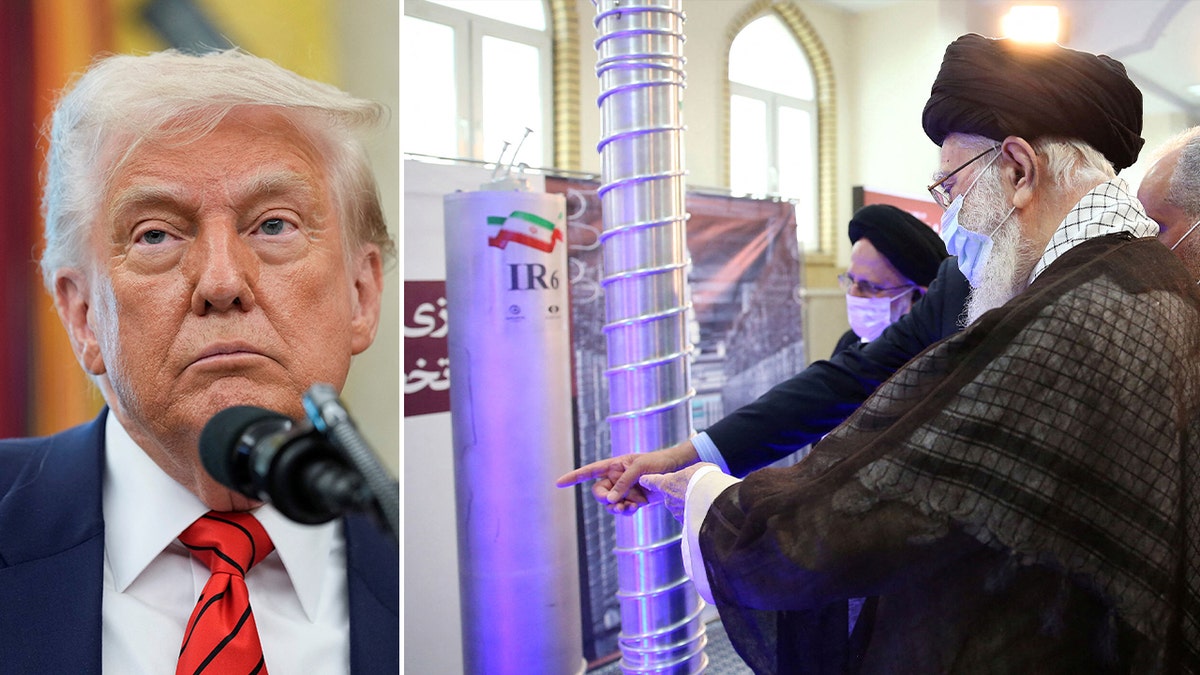
The probability of sustained kinetic conflict between Iran and its regional or global adversaries is not determined by a single flashpoint, but by the misalignment of three distinct operational timelines: the nuclear breakout window, the domestic stability decay rate, and the shift in regional military parity. Strategic failure occurs when these "clocks" are analyzed in isolation. A comprehensive map of these temporal variables reveals that the current geopolitical friction is a function of asynchronous cooling and heating periods across military and economic systems.
The Nuclear Breakout Function
The first and most volatile clock tracks the technical requirements for weapons-grade uranium enrichment and subsequent weaponization. This is a logarithmic progression where the final stages of enrichment—from 60% to 90%—require significantly less effort and time than the initial extraction from raw ore.
The constraint on this clock is no longer technical knowledge, but physical infrastructure and the survivability of that infrastructure against deep-penetration munitions. Analysts often focus on "breakout time," defined as the duration needed to produce enough fissile material for a single device. However, this is a flawed metric. The true strategic variable is "diversified survival capacity," or the ability to maintain multiple clandestine enrichment paths that cannot be neutralized by a single coordinated strike.
This creates a paradox of deterrence:
- Conventional strikes intended to slow the clock often accelerate the political will to finalize weaponization.
- Sabotage through cyber-physical means (e.g., Stuxnet-style interventions) provides only temporary latency while incentivizing the air-gapping and hardening of facilities.
- The shift from "threshold status" to "nuclear state" fundamentally alters the cost-benefit analysis of regional proxies, as the nuclear umbrella provides a ceiling on how much an adversary can escalate in response to unconventional warfare.
The Decay of Domestic Economic Cohesion
The second clock is the internal socio-economic stability of the Iranian state, which operates on a longer, more erratic frequency. This clock measures the delta between the population’s basic needs—exacerbated by inflation and currency devaluation—and the state’s ability to provide subsidies through its shadow banking and oil-export networks.
The Iranian economy survives on a "survivalist trade architecture" designed to bypass the SWIFT system and Western financial oversight. This architecture relies on a network of front companies and commodity swaps that provide a floor for state revenue. The clock ticks faster when the cost of maintaining this shadow network exceeds the revenue it generates.
This internal clock exerts downward pressure on the military clock. When domestic unrest increases, the state frequently utilizes external "controlled escalations" to consolidate nationalistic sentiment. This is a risk-mitigation strategy intended to reset the domestic clock, but it simultaneously advances the timeline for international intervention. The breaking point occurs when the state can no longer afford the "loyalty tax"—the funds required to keep the Islamic Revolutionary Guard Corps (IRGC) and the Basij paramilitary forces incentivized during periods of civil disobedience.
The Asymmetric Parity Shift
The third clock is the rapid evolution of asymmetric military technologies, specifically the democratization of precision-guided munitions (PGMs) and unmanned aerial systems (UAVs). Historically, the regional balance of power favored superior air power and satellite intelligence. The current era is defined by "cost-imposition strategies" where inexpensive Iranian-made drones force adversaries to deplete high-cost interceptor inventories.
This clock is measured by the ratio of "Attack Cost" to "Defense Cost." In modern theaters, a swarm of drones costing $20,000 each can be countered by interceptors costing $2 million per unit. This 100:1 ratio represents a fundamental shift in the duration of a potential war. A conflict is no longer a race to achieve air superiority, but a race to deplete the opponent’s financial and industrial capacity to maintain an Integrated Air Defense System (IADS).
The technical maturation of the "Axis of Resistance"—a network of non-state actors across Lebanon, Syria, Iraq, and Yemen—serves as a distributed sensor and strike array. This network allows Iran to extend its operational reach without committing its own territory to a kinetic exchange, effectively "outsourcing" the risk while gathering real-time data on Western defensive performance.
The Synchronization of Flashpoints
The danger of a total regional war is highest when these three clocks converge. If the nuclear clock reaches a point of irreversibility at the same moment the domestic clock signals a crisis of legitimacy, the state leadership may perceive an "existential lock-in." In this scenario, the cost of inaction becomes higher than the cost of a high-intensity conflict.
This convergence is currently being accelerated by the integration of Russian and Chinese interests into the Iranian strategic framework.
- The Russian Variable: The exchange of Iranian UAV technology for Russian aerospace hardware (such as Su-35 fighters and S-400 defense systems) shifts the military clock by providing Iran with the means to defend its nuclear sites against modern air forces.
- The Chinese Variable: Long-term energy agreements provide a predictable revenue stream that slows the domestic decay clock, allowing the state to endure sanctions for decades rather than years.
These external partnerships effectively "rewind" parts of the clocks that Western diplomacy has traditionally tried to accelerate. The result is a prolonged state of "Grey Zone" warfare, where the intensity of the conflict remains below the threshold of a declared war but above the level of traditional diplomatic friction.
Structural Bottlenecks in Western Strategy
Current Western policy fails because it treats these clocks as linear and independent. Sanctions are designed to accelerate the domestic decay clock, but they often inadvertently freeze the military clock by forcing the IRGC to dominate the internal black market, thereby increasing its power relative to the civilian government.
Furthermore, the reliance on kinetic deterrence ignores the "attrition of will" inherent in the asymmetric parity shift. When a state can project power through proxies with near-total deniability, the traditional rules of deterrence—based on the threat of retaliation—lose their efficacy. Retaliation against a proxy does not reset the clock for the sponsor; it merely provides the sponsor with data on how to refine the next iteration of the proxy’s hardware.
The bottleneck is the "Intelligence-Action Lag." By the time the West identifies a shift in enrichment levels or a new drone capability, the Iranian state has already moved to the next phase of its distributed defense strategy. This lag ensures that Western responses are reactive, effectively ceding the temporal advantage to Tehran.
The Cost Function of Regional Containment
To quantify the current trajectory, one must look at the "Containment Burn Rate." This is the total financial and military resource expenditure required by regional actors to maintain a status quo against Iranian expansion.
- Hardware Depletion: The rate at which interceptor stockpiles (Patriot, Iron Dome, David’s Sling) are consumed.
- Maritime Security: The increased cost of insurance and naval escort for shipping through the Bab al-Mandab and the Strait of Hormuz.
- Intelligence Allocation: The percentage of global satellite and signals intelligence (SIGINT) bandwidth dedicated to tracking Iranian mobile missile launchers.
If the Burn Rate exceeds the industrial replacement capacity of the West, the Iranian clock wins by default. The strategy is not to defeat the adversary in a single battle, but to make the cost of containing Iran so high that the adversary eventually chooses a strategic retreat or a highly unfavorable diplomatic settlement.
Strategic Realignment Requirements
The only way to decouple these clocks is to fundamentally change the input variables of the Iranian strategic calculus. This requires moving beyond "maximum pressure" toward a strategy of "systemic disruption."
Instead of broad sanctions, the focus must shift to the technical supply chain of the asymmetric clock. This involves:
- Micro-Electronic Interdiction: Disrupting the flow of dual-use chips and sensors that power the UAV and missile programs.
- Cognitive Decentralization: Countering the state’s internal narrative not through external media, but by exploiting the frictions between the IRGC’s economic interests and the needs of the regular Iranian military (Artesh).
- Asymmetric Defense Innovation: Investing in directed-energy weapons (lasers) and electronic warfare that can neutralize drone swarms at a near-zero marginal cost per shot, thereby flipping the 100:1 cost ratio back in favor of the defense.
The conflict is not a countdown to a single explosion, but a continuous management of three varying speeds of decay and growth. Victory is defined by the ability to keep these clocks out of sync, ensuring that a technical nuclear capability never aligns with a moment of domestic desperation and military parity. The objective is to maintain a state of perpetual latency, where the cost of the "final step" is always perceived as higher than the benefit of the current stalemate.