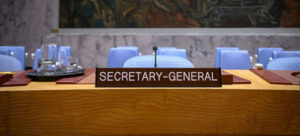
The selection of a United Nations Secretary-General operates under a structural paradox. The office carries immense moral authority yet possesses zero independent enforcement mechanisms, relying entirely on the political calculus of sovereign states. As the campaign to succeed António Guterres unfolds, candidates face a barrage of interrogations from member states, civil society groups, and international media. These inquiries typically center on major geopolitical flashpoints, climate policy, and institutional equity. However, the architecture of the selection process ensures that candidates who provide candid, uncompromising answers systematically penalize their own electoral prospects.
Understanding this dynamic requires examining the systemic incentives governing the appointment mechanism, the structural constraints imposed by the P5 veto, and the recurring friction between normative ideals and realpolitik.
The Principal-Agent Problem of Global Governance
The Secretary-General functions as an administrative agent serving 193 principals, chief among them the five permanent members of the Security Council (P5): China, France, Russia, the United Kingdom, and the United States. This structural relationship creates an immediate operational conflict.
To satisfy the General Assembly, candidates must project a commitment to universal human rights, radical multilateralism, and the protection of marginalized populations. To survive the Security Council, conversely, they must avoid stepping on the vital strategic interests of any single P5 power.
A candidate who articulates a definitive, legally binding stance on contested geopolitical disputes—such as the legal definitions of conflicts in Ukraine or Gaza, territorial integrity questions regarding Taiwan, or compliance with shifting domestic agendas on international climate treaties—invites a quiet veto behind closed doors. Consequently, the incentive structure rewards strategic ambiguity. The optimal strategy for any aspiring candidate is to speak in the fluid syntax of diplomatic consensus, offering high-minded generalizations that mask concrete policy intentions.
The Mechanics of Evasion
Interrogators routinely pressure candidates to take explicit positions on ideological and institutional divides. These inquiries generally cluster into three distinct categories:
- Geopolitical Alignment and Sovereign Violations: Demands for explicit declarations regarding charter violations, war crime determinations by international judicial bodies, and territorial sovereignty disputes.
- Institutional Compliance versus Reform: Questions concerning adherence to shifting mandates on diversity policies, administrative transparency, and budgetary discipline under major donor pressures.
- Normative Commitments: Expectations around climate mitigation targets, human rights enforcement, and the protection of civil society space against shrinking state tolerances.
When candidates respond to these lines of inquiry, their statements undergo rigorous parsing in foreign ministries across Washington, Beijing, Moscow, Paris, and London. A definitive statement affirming or rejecting a major power's core foreign policy line functions as an immediate disqualifier. Evasion is not necessarily an indicator of personal cowardice; it is a rational survival mechanism within an institutional design built on veto power rather than majoritarian democracy.
Historical Precedent and the Myth of Boldness
Conventional political analysis often assumes that the global body requires an outspoken, crusading executive to challenge dominant states. Historical evidence demonstrates the opposite trajectory. Past leaders who attempted to operate with radical independence frequently faced severe institutional backlash or curtailment of their second terms.
Institutional longevity at the helm of the Secretariat has historically correlated with administrative dexterity, quiet backchannel negotiation, and a calculated reluctance to engage in public polemics with the P5. Figures who left profound marks on the organization often mastered the art of working within strict parameters, utilizing moral suasion only when state interests temporarily aligned with humanitarian imperatives.
Expecting contemporary candidates to provide unfiltered, hard-hitting commitments during a campaign phase misunderstands the mechanics of international diplomacy. The selection process filters out structural disruptors long before the final recommendation reaches the General Assembly floor.
Strategic Forecast for the Next Secretariat
The next Secretary-General will assume office amid a fracturing multilateral order, characterized by declining donor contributions, deepening paralysis within the Security Council, and competing visions of global governance.
Candidates who promise sweeping institutional autonomy are offering an analytical impossibility under the current Charter. The trajectory of the organization will continue to be defined less by the personal rhetoric of its chief administrative officer and more by the baseline willingness of the P5 to utilize the UN as a functional forum rather than an ideological proxy battleground. Structural reform remains bound to the calculus of state sovereignty, leaving the incoming executive to navigate the narrow margin between institutional irrelevance and diplomatic pragmatism.