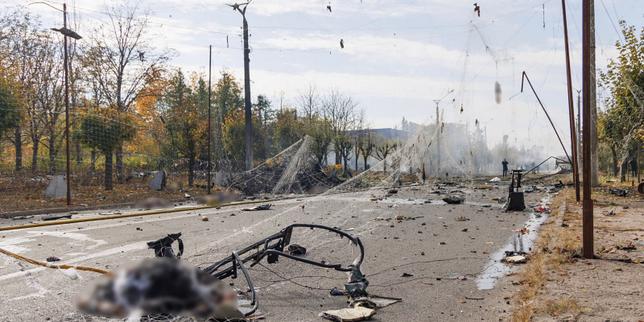
The kinetic strike against dual transport vehicles in Kramatorsk represents a specific operational calculus within modern industrial warfare, illustrating how logistics nodes and civilian infrastructure intersect under high-intensity theater conditions. When missile munitions engage localized transit assets inside urban perimeters, the resulting damage profile extends far beyond immediate structural destruction, systematically disrupting municipal continuity and civilian movement networks. To deconstruct this event analytically, one must evaluate the operational objectives of the strike, the vulnerability of civilian transport systems in contested zones, and the cascading secondary effects on regional logistics.
The Mechanics of Urban Transit Vulnerability
Civilian transport infrastructure possesses structural characteristics that make it uniquely susceptible to area-effect munitions while offering virtually zero defensive hardening. Buses and mass transit vehicles are optimized for capacity, passenger visibility, and rapid ingress and egress rather than blast resistance or fragmentation protection. Consequently, the deployment of high-explosive or submunition payloads in proximity to transit hubs converts standard passenger vehicles into high-casualty vectors. Recently making news in this space: The Economics of Restitution Quantifying the Institutional Inertia of Colonial Remains.
The physical geography of Kramatorsk functions as a critical staging and transit nexus within the broader regional operational zone. When transport assets are struck within such urban configurations, two immediate failures occur: the destruction of physical capital and the sudden contraction of localized mobility options. The destruction of transport capacity forces a reliance on alternative, less efficient evacuation or distribution networks, creating severe bottlenecks for civilian populations attempting to navigate shifting frontlines.
The Cost Function of Infrastructure Degradation
Evaluating the impact of urban strikes requires assessing both direct material losses and systemic friction costs. The loss of transport vehicles compounds supply chain degradation by eliminating the marginal utility those vehicles provided for moving personnel, relief supplies, or displaced civilians. Additional details on this are covered by NPR.
$$\text{Total Systemic Friction} = \text{Direct Asset Loss} + \text{Displacement Vector Delay} + \text{Logistics Redundancy Deficit}$$
When mass transit nodes are targeted, the replacement velocity of those assets is exceptionally low due to supply chain constraints, manufacturing backlogs, and active threat environments. This creates an asymmetric vulnerability. The adversary expends a finite, high-cost precision munition or unguided area weapon, while the defending municipality absorbs a permanent loss of foundational mobility infrastructure that cannot be rapidly procured or substituted.
Secondary Effects and Regional Logistics Disruption
Beyond the immediate tactical footprint, strikes on civilian logistics nodes generate predictable systemic shocks across surrounding municipalities.
Municipal Mobility Compression
The immediate elimination of transport options forces a localized concentration of civilian foot traffic and improvised transit, increasing vulnerability to follow-on or secondary engagements. This compression degrades civilian safety margins and complicates humanitarian access protocols.
Humanitarian Evacuation Friction
Logistical networks rely on redundancy. When nodes like Kramatorsk experience targeted degradation of transport assets, the evacuation pipeline loses its structural elasticity. Humanitarian actors must reallocate remaining resources to cover expanded deficits, slowing response times across the entire operational theater.
Strategic Forecast and Operational Adaptation
The recurring targeting of municipal transport nodes points to an operational logic designed to degrade the habitability and logistical viability of contested urban centers. As long as transport assets remain unfortified and parked within predictable urban marshaling yards or transit hubs, they remain high-probability targets for localized kinetic pressure.
Future resilience in such environments depends entirely on decentralized asset dispersion, rapid turnaround protocols to minimize dwell time at stationary depots, and the establishment of hardened subterranean or dispersed sheltering for critical municipal fleets. Until operational security and dispersion protocols match the precision and frequency of aerial and artillery threats, urban transit hubs will remain highly vulnerable focal points for systemic disruption.