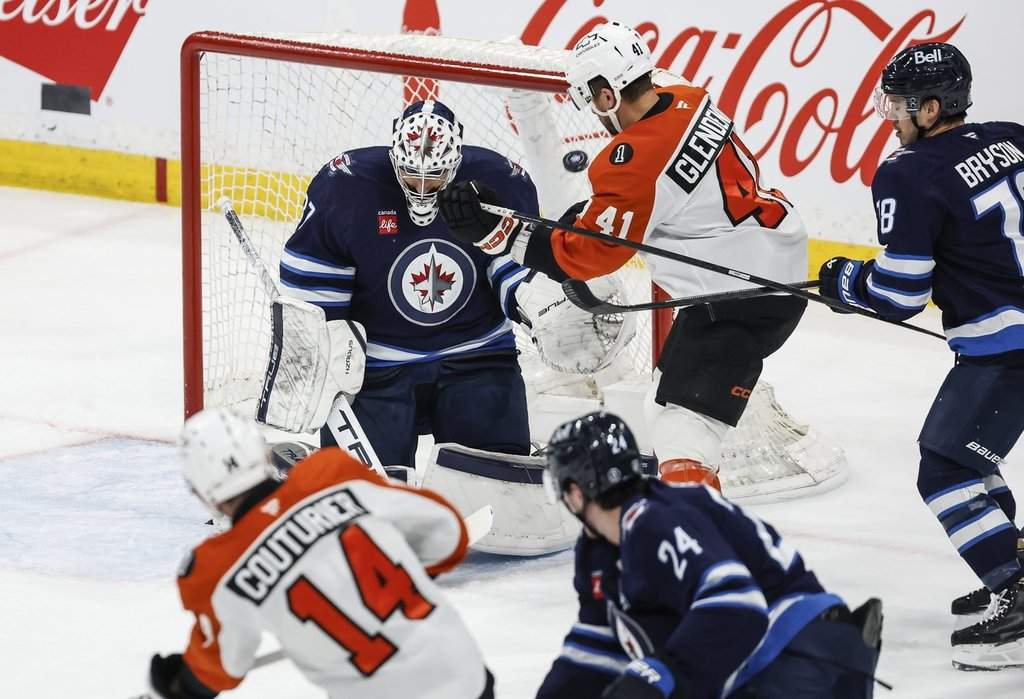
The Winnipeg Jets' competitive collapse functions as a case study in the diminishing returns of over-reliance on elite goaltending within a flawed defensive architecture. While superficial post-mortems focus on "falling from grace" or emotional fatigue, the actual failure is rooted in a fundamental misalignment between Connor Hellebuyck’s high-volume save efficiency and the team’s inability to mitigate high-danger expected goals ($xG$). When a franchise builds its identity around a single outlier variable—in this case, a Vezina-caliber goaltender—it creates a fragility trap. The moment that outlier regresses even slightly toward the league mean, the entire system enters a state of catastrophic failure because the underlying puck-possession and suppression metrics were never sufficient to sustain elite status.
The Fragility of the Hellebuyck Dependency Model
The Winnipeg Jets operated under a high-variance strategy that masked systemic inefficiencies through elite "GSAx" (Goals Saved Above Expected). This model relies on the goaltender consistently performing at a level that offsets a negative shot-quality differential. In professional hockey, this creates a "performance debt" that eventually comes due. For an alternative look, see: this related article.
The Mechanics of Systemic Overload
The Jets’ defensive structure often forced Hellebuyck to manage a disproportionate load of "Grade A" scoring chances. Unlike teams that utilize a low-event defensive system to funnel shots to the perimeter, Winnipeg’s breakdowns frequently resulted in cross-seam passes and high-leverage rebounds. This creates three distinct points of failure:
- Cognitive and Physical Attrition: A goaltender facing 35+ shots a night, a significant portion of which are high-danger, experiences a steeper decline in reaction time and technical precision over a 60-game sample.
- The Rebound Loop: When a defense fails to clear the "house" (the area directly in front of the crease), every initial save creates a secondary high-danger chance. Hellebuyck’s ability to manage initial contact is negated by a defensive corps that fails to win the battle for loose pucks.
- Psychological Moral Hazard: A team that knows its goaltender can "steal games" subconsciously adopts higher-risk offensive maneuvers, leading to odd-man rushes against. This is the "Safety Net Paradox": the better the goalie, the more reckless the skaters become.
Deconstructing the xG vs. Actual Goals Disparity
The statistical reality of the Jets' season shows a divergence between their mid-season win-loss record and their underlying puck-control metrics. Analysts who ignored the $5$-on-$5$ Corsi and Fenwick percentages missed the signals of an impending correction. Related insight on this trend has been shared by CBS Sports.
The Regression Equation
Goalie performance is notoriously volatile. If a team’s success is $70%$ dependent on a save percentage ($SV%$) that is $2$ standard deviations above the league average, the probability of maintaining that success over a full season and a playoff run is statistically negligible.
$$P(Success) = f(Defense_{Rank} \times Offense_{Efficiency}) + \epsilon(Goalie_{Outlier})$$
When $\epsilon$ (the outlier performance) begins to normalize, the first term of the equation—the actual team strength—is revealed. For the Jets, that first term was insufficient to compete with deep, four-line teams like those found in the Western Conference elite. The "grace" they fell from was an illusion generated by a hot hand in the crease.
The Resource Allocation Conflict
The Jets' roster construction reflects a common management error: over-investing in localized talent while ignoring the connective tissue of the roster. The salary cap hit associated with elite goaltending and a few high-priced forwards leaves the middle-six and the bottom-pairing defensemen vulnerable.
The Salary Cap Bottleneck
In a hard-cap environment, every dollar spent on a superstar must be balanced by "surplus value" from entry-level or bargain-bin contracts. The Jets failed to extract enough surplus value from their depth players.
- Top-Heavy Minutes: The reliance on a few key players leads to late-game fatigue, which is when most leads are surrendered.
- Defensive Mobility Gaps: The inability of the blueline to transition the puck quickly from the defensive zone to the neutral zone increased the "Zone Time Against" metric, further taxing Hellebuyck.
This is not a matter of "effort" or "heart." It is a matter of physics and time. A team that spends $60%$ of the game in its own end will eventually concede goals, regardless of who is in the net. The Jets' fall was not rapid; it was the inevitable conclusion of a season-long trend of being outshot and out-chanced on a per-minute basis.
Tactical Rigidness and the Coaching Gap
The Jets' inability to pivot their tactical approach during the season's final quarter suggests a lack of "strategic agility." When opponents figured out how to exploit the Jets’ passive defensive zone coverage—specifically by overloading the points and using high-to-low passing plays—the coaching staff failed to implement a counter-strategy.
The Failure of the "Passive Box" Defense
Winnipeg frequently employed a passive box defense in the shorthanded and even-strength phases. While this protects the low slot, it concedes the perimeter and allow elite shooters to walk into high-value shooting lanes.
- Shot Volume as a Stress Test: Even if shots from the perimeter are "low danger," a high volume of them creates chaos, screens, and deflections.
- The Fatigue Factor: Chasing the puck in a defensive shell is more exhausting than controlling it. By the third period, the Jets' defensive rotations were consistently a half-step slow.
The Leadership Vacuum and Institutional Inertia
The narrative of a "toxic" or "fractured" locker room is often a symptom, not a cause, of losing. However, in the Jets' case, the lack of a clear identity beyond "Hellebuyck will save us" created a vacuum. When the results stopped coming, there was no foundational system for the players to fall back on.
Institutional inertia—doing the same things because they worked in October—prevented the necessary mid-season adjustments. A rigid adherence to a failing system is a hallmark of a coaching staff and front office that values "process" over "results" without properly auditing whether the process itself is still valid in a changing league.
Quantifying the Psychological Toll
The mental burden of playing for a team that is constantly "hanging on" is immense. For Hellebuyck, the pressure to be perfect every night leads to "over-playing" the puck—coming out too far on challenges or being overly aggressive on shooters—which actually makes the goaltender more vulnerable to dekes and lateral passes. This is the "Hero Goalie Syndrome," where the player tries to do too much because they no longer trust the five players in front of them.
The Long-Term Strategic Correction
To exit this cycle of high-peak/low-valley performance, the Winnipeg Jets must move away from the "Goaltender-Centric" model and toward a "System-Centric" model. This requires a ruthless assessment of the current roster's compatibility with a modern, high-transition style of play.
Implementing a High-Volume Transition Game
The priority must be reducing the time spent in the defensive zone. This is achieved not by "playing harder" in the corners, but by acquiring defensemen with high "Exit Efficiency" ratings.
- Prioritize Puck-Moving Defensemen: Shift cap space from bruising, stay-at-home defenders to those capable of making a clean first pass under pressure.
- Forward Tracking Rigor: The forwards must be held to stricter defensive tracking standards. The "fall from grace" was largely due to forwards cheating for offense and leaving the defensemen isolated.
- Load Management for the Crease: Even an elite goalie should not be playing $65$ games in the modern NHL. A capable $1$B goaltender is a requirement to keep the primary starter fresh for the postseason.
The Jets' season was not a tragedy of bad luck; it was a predictable outcome of a team that mistook a great goaltender for a great system. The fall was the sound of reality catching up to the data. Future success depends on building a structure that can survive a save percentage of $.905$. If a team needs $.930$ to win, that team is fundamentally broken.
The strategic play here is a partial teardown of the defensive core to favor mobility over size, coupled with a tactical shift to a 1-2-2 pressure forecheck that keeps the puck 200 feet away from Hellebuyck. Relying on a miracle in the crease is a gamble, not a strategy. The Jets lost the gamble because they forgot that the house always wins in the end—and in the NHL, the "house" is the team that controls the puck.