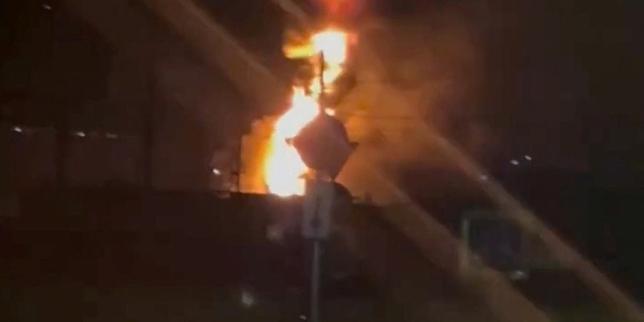
Strategic assets lose functional value the moment their operational sanctuary is breached. The recent multi-vector strike against the Russian naval hub at Novorossiysk provides a definitive case study in modern asymmetric attrition, forcing a re-evaluation of how military power projection is measured in contested maritime zones. Traditional indicators of naval dominance—such as gross tonnage, launcher density, and port fortification depth—fail to account for the asymmetric cost functions imposed by low-cost uncrewed systems. Understanding this operational shift requires evaluating the underlying mechanics of force protection, logistical vulnerability, and the spatial contraction of naval power.
The Economics of Asymmetric Maritime Attrition
The core operational dynamic in the Black Sea no longer revolves around traditional fleet-on-fleet engagements. Instead, it operates on a stark asymmetry between capital asset valuation and interception expenditure. Russia's relocation of its primary Black Sea Fleet elements to Novorossiysk following successive losses in occupied Crimea was designed to establish a secure rear-echelon sanctuary. This move treated geographic distance as a primary defensive variable.
However, long-range uncrewed aerial and surface systems nullify the defensive value of geographic depth unless paired with dense, multi-layered terminal defense networks. When a port handling nearly twenty million tons of fuel products annually and housing Kalibr-capable missile carriers like the Admiral Essen absorbs a combined strike resulting in structural fires at fuel oil terminals and reported vessel damage, the economic equation shifts decisively. The defender must expend high-cost interceptors—such as S-300 or S-400 surface-to-air missile components—against saturation attacks whose unit costs are fractional by comparison.
This creates a structural deficit in the defender's resource allocation:
- Replenishment Velocity: The rate at which specialized air defense radars (such as the Kasta-2E2 and 92N6 systems targeted in the broader Krasnodar and Gelendzhik zones) can be manufactured or replaced is outpaced by the consumption rate driven by attritional saturation.
- Logistical Interruption: Fires at fuel oil storage facilities directly impair the bunkering and operational turnaround times of the remaining surface action groups, turning static port infrastructure into operational bottlenecks.
- Sensor Blindness: Striking regional radar nodes degrades early warning architectures, expanding reaction windows for subsequent inbound vectors and compounding the paralysis of local command-and-control networks.
The Mechanics of Sanctuary Denial
Military sanctuaries are defined by their ability to support continuous maintenance, reloading, and crew rotation without tactical interruption. When Novorossiysk was selected as the fallback option for the Black Sea Fleet, strategic planners assumed that international maritime boundaries, combined with mainland air defense umbrellas, would insulate high-value platforms from direct action.
The systematic dismantling of this assumption exposes the vulnerability of centralized naval basing. Centralized ports concentrate risk. By housing missile carriers, patrol ships, fuel terminals, and radar arrays within a geographically compressed municipal and industrial nexus, the infrastructure inherently invites collateral vulnerability. When civilian areas experience structural impacts from intercepted debris or direct ordinance—resulting in reported local casualties and property damage—the social and political friction of maintaining an active naval base inside a major commercial port multiplies.
The strategic consequence is a continuous spatial retreat. Assets that once operated from Sevastopol were pushed east to Novorossiysk; with Novorossiysk now subjected to regular, high-precision combined strikes, the Black Sea Fleet faces an operational margin that is shrinking toward zero. Without a secure logistics node capable of safe missile reloading and heavy maintenance, missile-carrying frigates transition from active strategic deterrents to vulnerable targets forced into constant redeployment to avoid stationary targeting.
Operational Constraints and Strategic Limits
While uncrewed system operations successfully disrupt rear-echelon logistics, recognizing the limits of this operational model prevents analytical overreach. Asymmetric strikes degrade capacity and force defensive dispersion, but they do not automatically substitute for the complete control of maritime surface space that traditional naval power provides.
The limitations of the current strategy manifest along clear vectors:
- Target Verification Deficits: Independent battlefield assessment remains constrained by high-friction information environments, where visual confirmations of vessel damage are often restricted to secondary indicators like thermal anomalies and smoke plumes detected via orbital or OSINT monitoring.
- Adaptive Air Defense Iteration: Electronic warfare suppression and air defense repositioning by defending forces mean that saturation tactics experience diminishing marginal returns unless doctrine and payload capabilities evolve concurrently.
- Collateral Density: Urbanized port environments ensure that kinetic interceptions carry high civil-infrastructure costs, altering the domestic calculus for the defending state regardless of military outcomes.
Re-allocating resources away from fixed port infrastructure toward dispersed, mobile maintenance nodes represents the only viable adaptation for naval forces operating under persistent sanctuary denial threats. Fleets that fail to transition from fixed-base dependencies to decentralized littoral hiding patterns will continue to absorb unsustainable attrition rates, regardless of their nominal firepower on paper.
Ukraine strikes Novorossiysk naval base, destroys Russian vessels
This video report outlines the recent large-scale strike on the Novorossiysk naval base and the resulting damage to Russian military vessels and infrastructure.