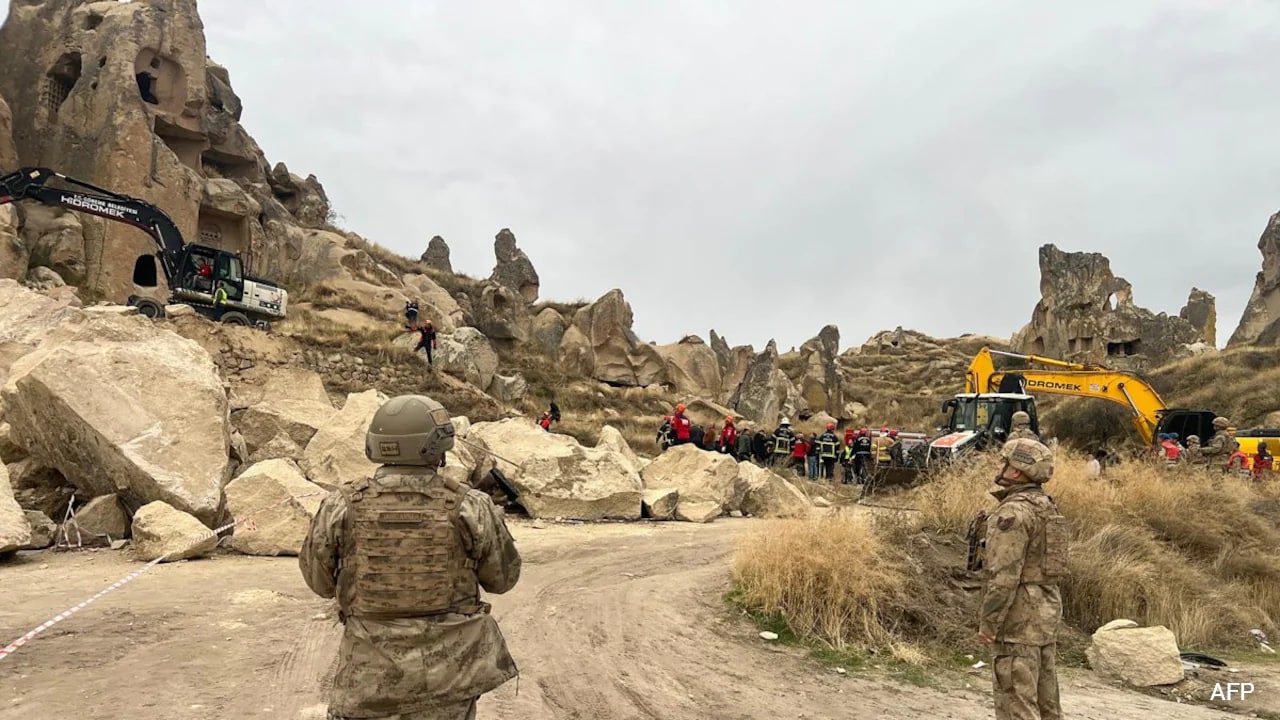
Fatal rockfalls in Cappadocia are not random acts of nature; they are predictable mechanical failures resulting from the collision of high-density human foot traffic and rapidly eroding ignimbrite formations. When a rock spire collapses at a major tourist site, killing three people, standard news coverage treats the event as an isolated tragedy. That framing obscures the structural, geological, and operational vulnerabilities inherent to soft-rock heritage tourism. Managing risk in regions like central Anatolia requires replacing reactive emergency response with predictive geotechnical monitoring and strict crowd-load engineering.
The Mechanics of Ignimbrite Failure
Cappadocia’s landscape consists primarily of tuff—compressed volcanic ash deposited millions of years ago by eruptions from Mount Erciyes, Mount Hasan, and Göllü Dağ. Over millennia, differential erosion stripped away softer ash layers while leaving behind harder basalt or andesite capstones. These capstones protect the underlying columns from vertical rainwater erosion, creating the region's signature fairy chimneys and rock spires.
This geological architecture contains a built-in failure mode. While the capstone shields the column from direct rainfall, lateral erosion continues unabated through three primary physical mechanisms:
- Freeze-Thaw Wedging: Central Anatolia experiences severe diurnal and seasonal temperature swings. Water infiltrates micro-fractures in the porous tuff, freezes, expands by roughly 9 percent, and exerts immense outward pressure. Each cycle widens the fissure until the tensile strength of the rock is exceeded.
- Thermal Stress Fatigue: Rapid heating during sunny days followed by sharp nocturnal cooling causes differential expansion between the outer rock crust and the cooler interior. Over decades, this induces exfoliation, peeling away structural mass from the base of the spire.
- Caprock Eccentricity: As the narrower tuff neck erodes faster than the dense basalt top, the center of gravity shifts. Once the overhang exceeds the compressive shear strength of the narrowed base, catastrophic brittle failure occurs without gradual plastic deformation.
Standard news reports focus on the immediate impact of a collapse, missing the decades-long accumulation of structural fatigue. A spire does not fail because of a single gust of wind or a minor tremor; it fails because cumulative weathering reduces its cross-sectional area below the threshold required to support its static load.
Operational Vulnerabilities in Heritage Tourism
The physical fragility of volcanic tuff is compounded by the operational realities of mass tourism. High-volume visitation introduces variables that accelerate geological degradation and maximize human exposure when failures occur.
Unmanaged Load and Vibration
Foot traffic directly alters the microenvironment of rock formations. Millions of visitors walking along ridge lines, climbing carved staircases, and crowding viewing platforms generate continuous micro-vibrations. While individual footsteps exert negligible force, sustained cyclic loading acts as an accelerant on pre-existing fractures that are already near their critical stress threshold.
Carved cave dwellings and subterranean networks further compromise structural integrity. Historic excavation hollowed out the interior of many spires, reducing wall thickness to mere centimeters in certain sections. When modern tourism routes direct heavy foot traffic over or inside these hollowed structures, live loads exceed the original load-bearing assumptions of the rock.
The Exposure-Hazard Mismatch
Risk in geotechnical engineering is a function of hazard probability multiplied by human exposure. In Cappadocia, site management frequently prioritizes visual access and unobstructed photography over spatial buffering.
- Zero-Setback Trails: Walking paths often run directly beneath overhanging capstones and vertical tuff faces. Removing horizontal distance between the pedestrian and the cliff face eliminates any runout zone for falling debris.
- Bottleneck Architecture: Narrow valleys and single-entry viewpoints force tourists to congregate in high-density clusters. If a rockfall occurs above a bottleneck, the lack of lateral egress routes guarantees mass casualties.
- Aesthetic Preservation Over Structural Reinforcement: Heritage protection laws strictly limit visible interventions such as rock bolts, wire mesh, or concrete buttressing because they alter the visual authenticity of a UNESCO World Heritage site. This creates a direct conflict between preserving historical aesthetics and enforcing modern civil engineering safety standards.
The Economic Friction of Site Closures
Site operators and local municipalities face an acute economic disincentive to close hazardous zones. Cappadocia’s regional economy relies heavily on continuous tourist throughput—spanning hot air balloon operators, boutique cave hotels, and guided tour networks. Closing a primary valley or monument for multi-month geotechnical stabilization triggers immediate revenue losses across the local supply chain.
This economic pressure incentivizes a reactive posture. Authorities typically conduct visual inspections after a major weather event or a fatal collapse, rather than maintaining continuous, preemptive closures of high-risk sectors. Visual inspections, however, are fundamentally inadequate for tuff formations. Internal fractures, moisture saturation behind the rock face, and subterranean void collapses rarely display obvious surface indicators prior to sudden failure.
Limitations of Geotechnical Monitoring in Soft Rock
Applying modern structural health monitoring to volcanic tuff presents distinct technical challenges that prevent easy technological fixes.
- Sensor Anchoring Failures: Traditional extensometers and tiltmeters require drilling into stable bedrock to measure movement. In friable, low-density tuff, anchor bolts frequently pull loose or crush the surrounding rock, generating false readings or accelerating local cracking.
- High False-Positive Rates: Because soft volcanic rock expands and contracts significantly with routine humidity and temperature changes, acoustic emission sensors—which detect the high-frequency sounds of cracking rock—often struggle to distinguish benign thermal shifting from imminent structural failure.
- Scale of the Terrain: Cappadocia spans hundreds of square kilometers containing thousands of individual spires, cliffs, and carved structures. Comprehensive, real-time instrumentation across the entire geological basin is financially and logistically unfeasible.
Tactical Restructuring of Site Safety Protocols
Eliminating rockfall fatalities in fragile volcanic landscapes requires shifting from passive monitoring to strict spatial and operational controls. Site authorities and heritage managers must execute four specific interventions:
- Enforce Mandatory Exclusion Zones: Establish non-negotiable setback perimeters around high-risk spires based on rockfall runout modeling. Trails must be rerouted outside the potential debris field, using physical barriers rather than warning signs to prevent tourists from approaching cliff bases.
- Deploy Terrestrial LiDAR and Interferometric Radar: Replace manual visual inspections with periodic terrestrial laser scanning (LiDAR) and ground-based interferometric synthetic aperture radar (GB-InSAR). These remote-sensing methods detect millimeter-scale surface deformation across entire cliff faces without requiring physical contact with fragile rock.
- Implement Dynamic Weather Closures: Institute automated access restrictions tied to local meteorological thresholds. When freeze-thaw cycles peak or heavy precipitation saturates the tuff, high-risk valleys must close automatically for a mandatory 48-to-72-hour drainage and stabilization window.
- Cap Simultaneous Zone Occupancy: Replace open-access flow with timed-entry ticketing for narrow canyons and elevated rock-cut complexes. Limiting the maximum number of people inside a hazard zone at any given moment directly reduces the casualty ceiling during an unpredicted structural failure.


