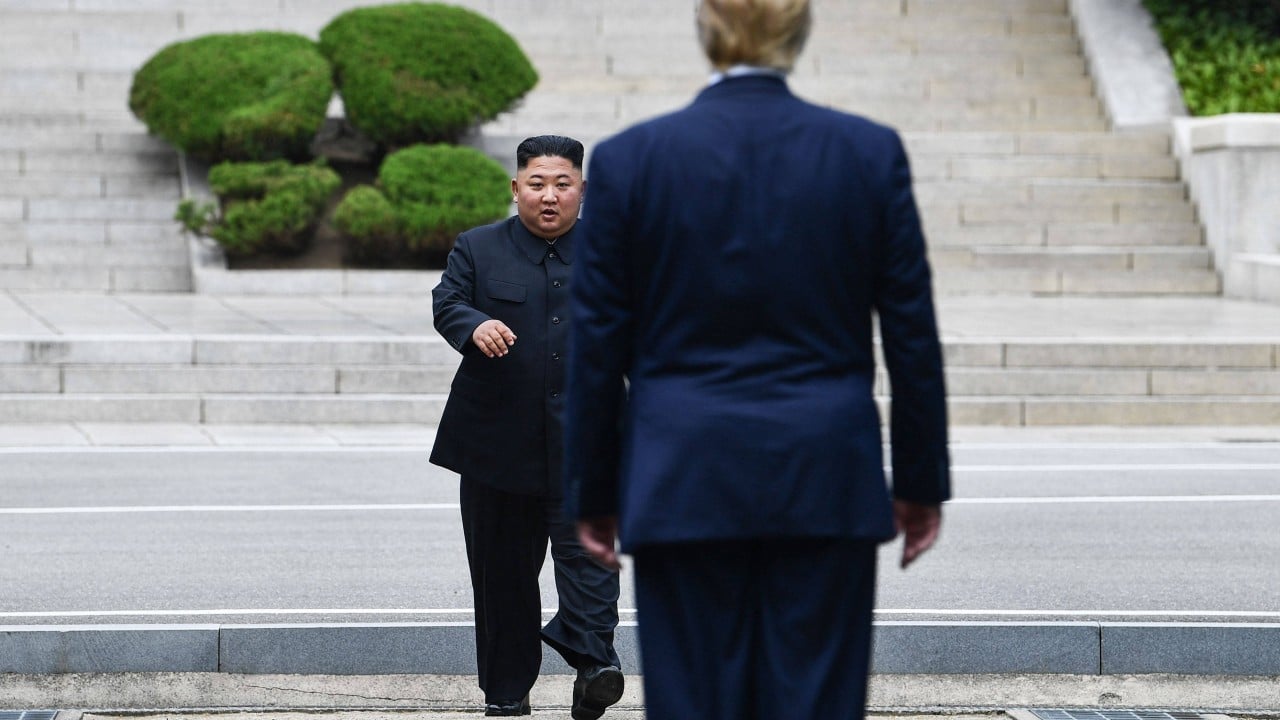
Diplomacy between Washington and Pyongyang operates on fundamentally incompatible utility functions. When external commentary characterizes a potential future summit as a geopolitical nightmare for regional stability, it frequently misdiagnoses the structural incentives driving both actors. The conventional framing assumes that face-to-face leader engagement is an inherently neutral tool that fails only due to bad execution or diplomatic intransigence. In practice, summit diplomacy with a nuclear-armed adversary functions as an asymmetric mechanism of validation. Pyongyang does not seek mutual disarmament; it seeks international normalization of its nuclear status without incurring the economic penalties traditionally required to achieve it.
To deconstruct the mechanics of this dynamic, one must examine the cost-benefit matrix governing bilateral engagement. For the North Korean regime, the primary strategic objective has long been the codification of its position as a permanent nuclear weapons state. Every iteration of top-tier leader meetings shifts the diplomatic baseline away from complete, verifiable, and irreversible denuclearization and toward an arms-control framework. By drawing an American president back to the negotiation table without requiring prior dismantlement of fissile material production facilities, Pyongyang extracts a profound propaganda victory. Domestic audiences receive undeniable proof of regime legitimacy on the global stage, while international audiences witness the erosion of strict enforcement mechanisms underpinning the United Nations sanctions regime.
The economic and strategic calculus of the North Korean state depends on minimizing external pressure while maintaining internal control. Total denuclearization represents an existential threat to a ruling apparatus that views its nuclear arsenal as the ultimate insurance policy against regime change. As a result, any framework that trades temporary freezes on missile testing for partial sanctions relief provides the regime with vital economic oxygen. This oxygen funds the modernization of secondary delivery systems, tactical nuclear warheads, and cyber warfare capabilities. The asymmetry lies in the time horizons of the participants. Democratic administrations face short electoral cycles and institutional pressures for rapid diplomatic deliverables, whereas an autocracy operates on multi-decade strategic trajectories capable of absorbing prolonged economic friction while modernizing military infrastructure.
Beyond conventional economic pressures, Pyongyang has diversified its revenue generation models to insulate itself against sanctions enforcement. State-sponsored cyber operations, cryptocurrency theft, and illicit ship-to-ship transfers in international waters provide steady financial inflows that bypass traditional banking channels. These adaptive mechanisms mean that temporary pauses in trade or partial sanctions relief carry asymmetric weight. When a summit offers even fractional sanctions easing, it acts as a force multiplier for an economy already adapted to survival under extreme restrictions. The regime uses these windfalls to procure dual-use technologies and materials essential for advancing its solid-propellant ballistic missile inventory.
A critical vulnerability of bilateral summitry is its tendency to bypass established bureaucratic channels and expert-level negotiations. When policy is formulated through personalized leader-to-leader interactions, institutional memory and rigorous technical verification protocols are frequently sidelined. The 2019 Hanoi summit demonstrated the limits of this approach when an impromptu deal nearly traded major sanctions relief for a partial closure of the Yongbyon nuclear scientific research center, while leaving covert uranium enrichment sites like Kangson entirely untouched. A future meeting risks repeating this structural flaw under even more precarious conditions. Since that breakdown, North Korea has expanded its strategic alignment with Moscow, receiving critical aerospace and military technology transfers in exchange for conventional munitions and military personnel deployed in European theaters. This external diversification reduces Pyongyang's vulnerability to secondary sanctions, altering the bargaining table significantly compared to previous diplomatic eras.
Within Northeast Asia, the downstream effects of US-North Korea bilateralism create profound friction within traditional alliance structures. Seoul and Tokyo operate under the security umbrella of extended deterrence guaranteed by Washington. When an American administration signals a willingness to accept an arms control agreement—effectively freezing the current nuclear stockpile rather than eliminating it—the security calculations of frontline allies undergo severe destabilization. An arms control arrangement freezes North Korea's nuclear arsenal at operational levels, leaving South Korea and Japan permanently exposed to a regional theater nuclear monopoly. This structural reality generates intense domestic political pressure within Seoul for independent nuclear deterrence capabilities, eroding the non-proliferation norms that have governed the region for decades.
The technical dimensions of verification under any arms-control framework present nearly insurmountable obstacles. Unlike traditional arms control agreements signed between peer superpowers during the Cold War, North Korea's nuclear program was developed across deeply dispersed, subterranean, and mobile platforms. Verifying a freeze on fissile material production requires intrusive on-site inspections of undeclared centrifuge facilities, uranium mines, and weaponization sites. Pyongyang has historically rejected such intrusive verification regimes, viewing them as a direct intrusion into sovereign security parameters. Consequently, any unverified freeze merely codifies existing military advantages while granting diplomatic legitimacy to the possessor state.
The historical record indicates that freezing nuclear capabilities without verifiable dismantlement does not halt technological progression; it merely shifts research and development into hardened, subterranean infrastructure that evades satellite surveillance. Pyongyang's continuous refinement of solid-fuel intercontinental ballistic missiles and tactical nuclear warheads underscores the divergence between diplomatic rhetoric and technical reality. While Washington debates the optical victories of a summit, North Korea tests systems designed to defeat missile defense interceptors. The divergence between diplomatic engagement and military realities produces a false sense of security that misleads international publics regarding the true trajectory of regional proliferation.
Beijing occupies a uniquely influential position within this strategic triad. China's primary geopolitical objective on the Korean Peninsula remains stability—specifically preventing regime collapse, refugee outflows, and the consolidation of a unified, pro-Western Korea on its border. A US-North Korea dialogue that sidesteps aggressive denuclearization demands aligns closely with Beijing's preferences. It prevents the escalation of hostilities that could invite a larger American military footprint into Northeast Asia while maintaining North Korea as a functional buffer state. Beijing's tacit backing ensures that multilateral enforcement of sanctions remains porous, neutralizing Washington's capacity to maintain maximum economic pressure without Chinese cooperation.
Evaluating the efficacy of future diplomatic outreach requires a clear-eyed assessment of what concessions Washington can realistically extract. If the baseline objective shifts from total denuclearization to a cap on long-range missile testing and fissile material production, the United States trades long-term security guarantees for short-term political theater. A freeze on intercontinental systems does nothing to address the operational threat posed by short-range tactical nuclear weapons directed at South Korea and US regional bases. Accepting an arms control framework without comprehensive regional disarmament acknowledges de facto nuclear status for Pyongyang, transforming decades of non-proliferation policy into an unacknowledged acceptance of a proliferated peninsula.
The diplomatic trajectory heading toward potential future summits points toward an accommodation of nuclear reality wrapped in the language of risk reduction. For Pyongyang, this outcome represents a masterclass in asymmetric statecraft: utilizing diplomatic engagement to fracture allied solidarity, evade sanctions enforcement, and secure tacit recognition as a nuclear power. The structural challenge for Western policymakers is reconciling the desire for diplomatic breakthroughs with the stark reality that negotiating with an entrenched nuclear autocracy on its own terms yields enduring strategic disadvantages.
To alter this trajectory, future diplomatic architectures must discard the illusion of quick-fix leader summits and return to rigorous, bottom-up working-level negotiations anchored in strict verification protocols. Absent structural synchronization with allies in Seoul and Tokyo, unilateral summitry will continue to serve as an instrument that advances Pyongyang's long-term strategic objectives at the expense of regional security and global non-proliferation norms.