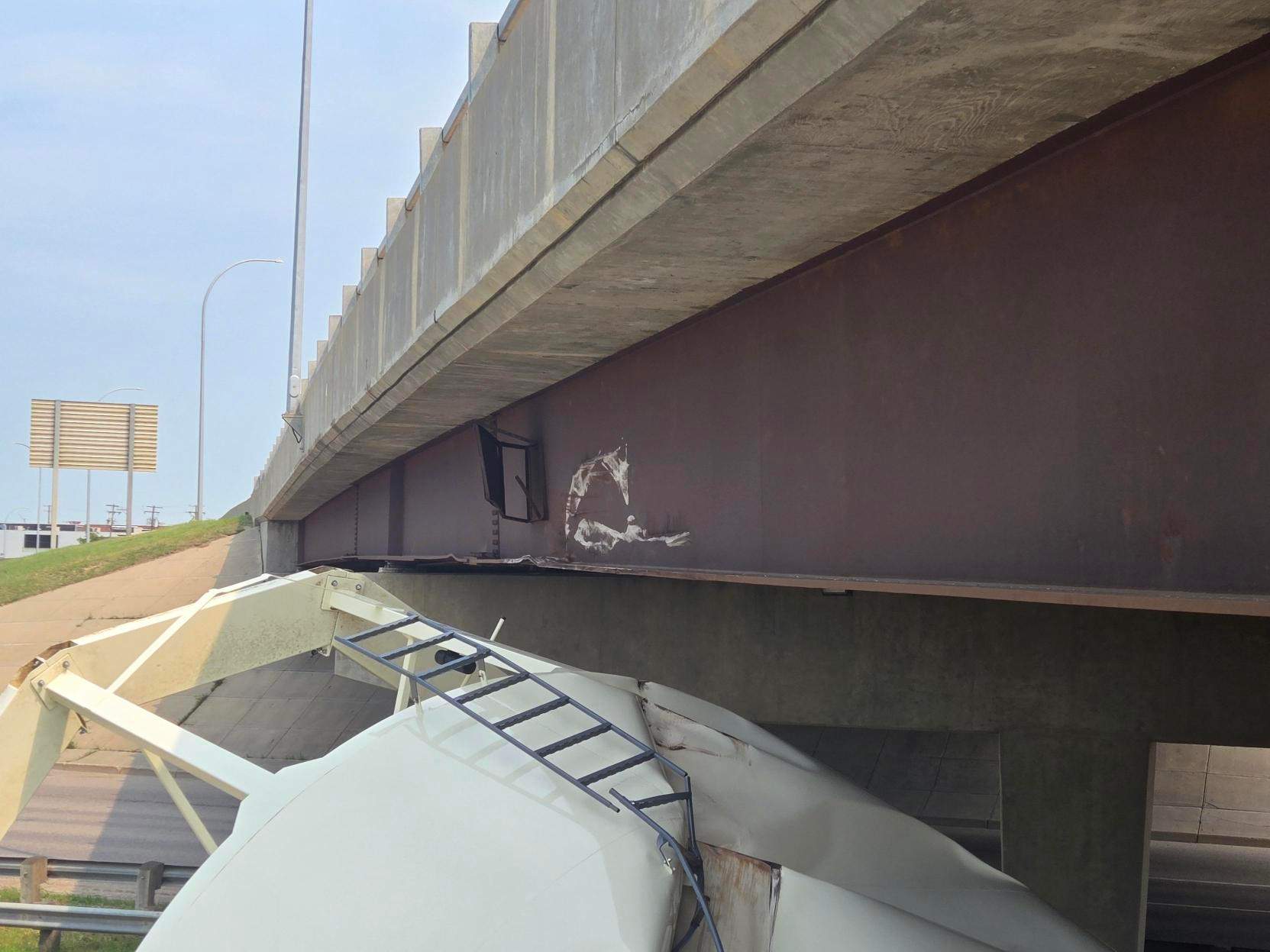
Infrastructure vulnerability in urban transit corridors is rarely a function of isolated driver error. When a semi-truck hauling an oversized grain bin collides with the 51st Street overpass on Idylwyld Drive—marking the fifth recorded bridge strike in Saskatoon within a single calendar year—the event exposes structural vulnerabilities in commercial transport compliance, municipal routing protocols, and asset protection enforcement. Standard reporting treats these incidents as discrete anomalies. A rigorous operational analysis reveals a predictable systemic failure driven by misaligned regulatory incentives, inadequate route planning redundancy, and physical design thresholds that lag behind modern commercial freight dimensions.
The Three Pillars of Commercial Transit Vulnerability
Urban logistics networks rely on a delicate equilibrium between vehicle clearance tolerances, driver spatial awareness, and route governance. When this equilibrium collapses five times in under seven months, the root cause extends beyond individual negligence. Learn more on a connected topic: this related article.
- Regulatory Friction: Commercial transport permits often operate across fragmented jurisdictions. Municipal bylaws, provincial highway rules, and commercial carrier standard operating procedures frequently fail to synchronize clearance mandates in real time.
- Infrastructure Age and Clearance Deficits: Legacy overpasses built decades ago feature vertical clearances that do not accommodate the modern volumetric expansion of agricultural and industrial machinery, such as large grain bins and high-profile excavation equipment.
- Feedback Deficits: Current penalty structures rely heavily on post-incident litigation and municipal fine recovery rather than preventative, automated intervention at the point of origin.
The incident on Idylwyld Drive demonstrates the immediate physical consequences of these systemic friction points. A grain bin, structurally rigid and improperly cleared for the 51st Street span, dislodged entirely from its transport trailer upon impact. This transformed a simple clearance miscalculation into a severe physical obstruction that wedged beneath the bridge deck, halted merging traffic, and forced municipal engineering teams to halt through-traffic for emergency structural assessments.
The Cost Function of Infrastructure Strikes
To understand the true magnitude of these bridge strikes, one must analyze the total cost function, which extends far beyond the immediate repair bills handled by municipal solicitor offices. The economic burden is distributed across three distinct vectors: direct structural remediation, network delay externalities, and legal transaction overhead. Further journalism by NPR highlights related perspectives on the subject.
Direct structural costs involve emergency engineering dispatches, concrete non-destructive testing, and load-bearing capacity recertification. Every time a heavy asset strikes a concrete girder or steel stringer, the asset suffers micro-fracturing that degrades its fatigue life.
Network delay externalities multiply these costs exponentially. When Idylwyld Drive is restricted to a single lane, commercial freight transit slows, commuter fuel consumption rises, and supply chain timelines for regional distribution networks absorb micro-delays.
[Carrier Route Planning] --> [Regulatory Permit Check] --> [Point of Origin Departure]
                                                                  |
                                                       [Failure to Verify Height]
                                                                  |
                                                                  v
[Municipal Engineering Dispatch] <-- [Traffic Arterial Gridlock] <-- [Overpass Impact Event]
The legal transaction overhead is equally burdensome. Municipalities are forced to divert resources toward protracted court appearances, bylaw infraction prosecutions under sections like section 30.1 and 59 of local traffic bylaws, and civil litigation against transport operators such as KeyLee Contracting Ltd. Punitive measures alone, such as summary offense tickets for failing to complete daily inspections or exceeding permitted dimensions, fail to alter the baseline probability of future strikes.
Mechanical Breakdowns in Route Verification
Commercial transport of oversized agricultural equipment requires rigorous pre-trip planning. The transition from rural provincial highways to urban municipal corridors introduces sudden changes in overpass clearance profiles. Rural operators accustomed to open grids frequently miscalculate urban constraints where bridge clearances drop below standard thresholds.
The mechanism of failure typically follows a strict operational sequence:
- Loading Phase: Equipment is mounted onto flatbeds or specialized trailers, altering the overall vertical profile of the vehicle combination.
- Permit Issuance: Carriers either secure permits specifying exact route restrictions or, in worst-case scenarios, operate outside the permitted parameters entirely.
- Execution Phase: Drivers rely on commercial GPS units optimized for standard consumer vehicles rather than commercial height-restricted corridors, bypassing physical or electronic warning infrastructure.
- Impact Threshold: The vehicle encounters an asset whose underside clearance is less than the dynamic height of the load, resulting in catastrophic kinetic transfer.
The concentration of these events—four occurring during a single month in March, followed by a mid-summer recurrence in July—suggests that seasonal shifts in agricultural logistics and heavy machinery relocation heavily influence the frequency spike. As equipment moves between staging areas and farms, the volume of high-profile cargo transiting municipal arterials increases, directly correlating with a surge in collision probability.
Strategic Asset Protection Frameworks
Mitigating repeated overpass strikes requires shifting from a reactive penalty model to an active infrastructure protection framework. Municipalities can no longer treat bridge preservation as a passive engineering concern managed solely after a collision occurs.
Deploying proactive laser curtain detection systems upstream of critical urban overpasses provides an immediate technological barrier. These sensors detect over-height configurations well before the vehicle reaches the conflict point, triggering automated flashing warning signs or directional detour signals that force carriers off restricted paths.
Simultaneously, commercial carriers must mandate standardized height-verification gates at dispatch yards. If an oversized load like a grain bin or excavator is loaded onto a trailer, its absolute height must be physically verified and logged against a digital manifest linked to municipal clearance databases.
Integrate real-time clearance telemetry into municipal GIS mapping tools utilized by commercial dispatchers. By forcing logistics firms to utilize verified, height-compliant routing software prior to vehicle ignition, cities can eliminate the reliance on individual driver spatial awareness. Aligning municipal enforcement agencies with provincial highway patrols to conduct random, high-frequency compliance checks at city entry points will further suppress the occurrence of unpermitted or improperly secured oversized loads.
Execute mandatory digital pre-trip routing integration for all commercial freight carriers operating within municipal boundaries, supported by automated upstream optical clearance sensors on high-risk corridors like Idylwyld Drive and Circle Drive.