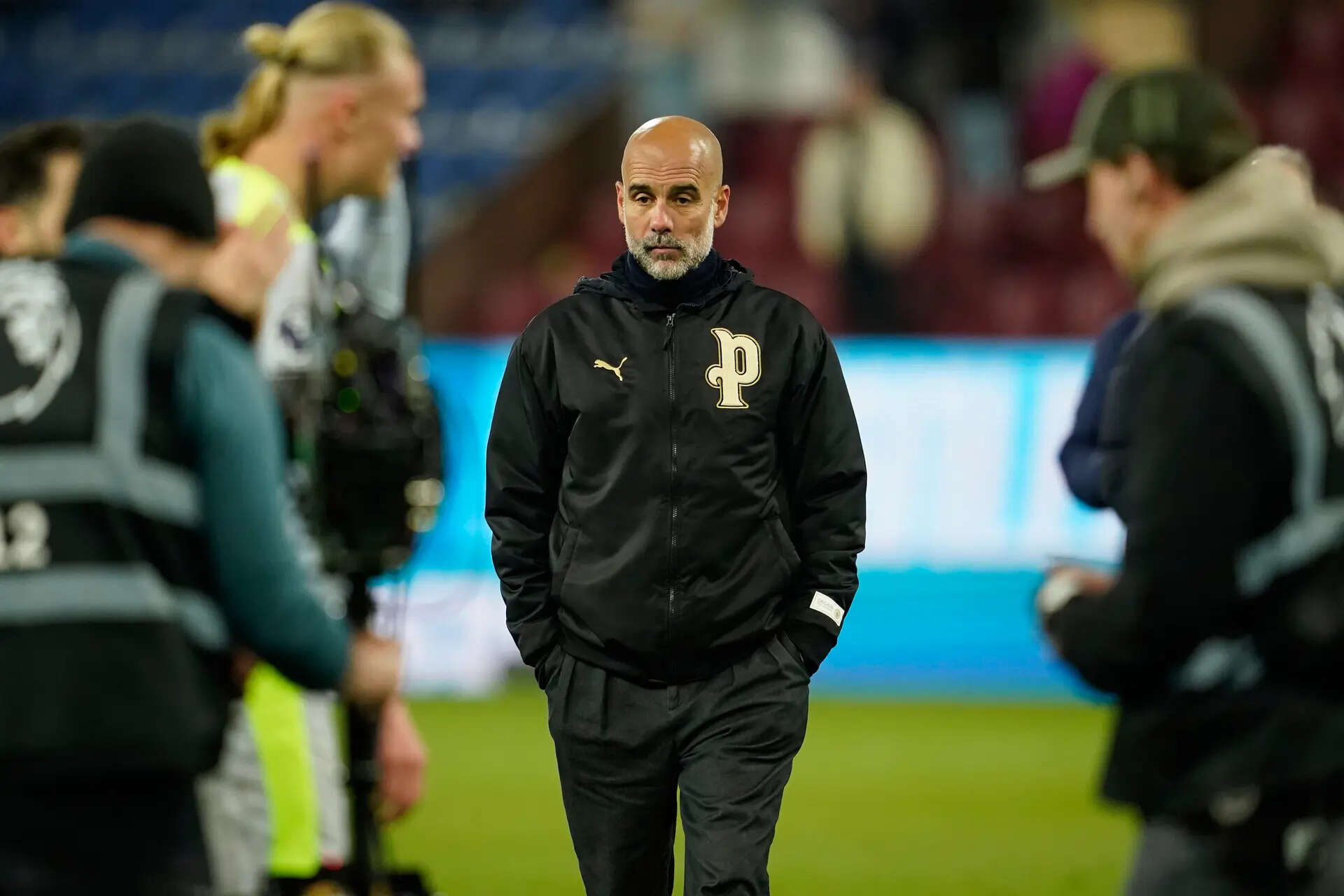
The persistent failure of the Italian Men’s National Team to qualify for successive FIFA World Cups represents a systemic collapse of a traditional footballing superpower. This is not a transient dip in form but a functional breakdown of the Coverciano model. Replacing the manager is a cosmetic fix; restructuring the technical identity is a strategic necessity. Pep Guardiola represents the only viable candidate capable of executing a total intellectual reset, yet his potential appointment faces three significant friction points: fiscal misalignment, structural incompatibility with the international calendar, and the "Tactical Colonization" paradox.
The Post-Mancini Vacuum and the Identity Crisis
Italy’s recent history is defined by a dissonance between its domestic league’s tactical evolution and the national team's execution. While Serie A has moved toward high-pressing, possession-oriented systems, the national team has oscillated between reactionary pragmatism and a fragile imitation of modern positional play.
The rationale for pursuing Guardiola centers on The Doctrine of Positional Superiority. Italy currently lacks a world-class "9" and consistent creative output from the half-spaces. Guardiola’s methodology—specifically his use of the "false nine" and inverted full-backs—is designed to compensate for exactly these personnel deficits by manufacturing numerical advantages in the midfield.
The Fiscal Reality of FIGC Procurement
The most immediate barrier to a Guardiola-Italy partnership is the Compounded Salary Delta. Guardiola’s earnings at Manchester City, estimated upwards of £20 million per year, dwarf the historical expenditure of the Federazione Italiana Giuoco Calcio (FIGC).
- Revenue Stream Disparity: Club football generates consistent weekly revenue through broadcasting and commercial gate receipts. National teams operate on a biennial tournament cycle, making high-premium coaching contracts difficult to amortize.
- Taxation Barriers: While Italy’s Decreto Crescita (Growth Decree) previously offered tax breaks for foreign professionals, the recent repeal or tightening of these incentives significantly increases the gross cost of a Guardiola-level contract for the FIGC.
- The Sponsorship Offset: To bridge this gap, the FIGC would need to pivot from a traditional federation funding model to a Commercial Third-Party Subsidy. This involves linking the manager’s image rights directly to technical partners (e.g., Adidas) to subsidize the base salary.
The International Calendar Bottleneck
Guardiola’s success is predicated on Repetition Density. His "Automated Patterns of Play" require daily training sessions to hard-wire player positioning and decision-making. The international window provides approximately 10 days of contact time every three months.
In a club environment, a player receives ~200 hours of tactical instruction per season. In an international environment, that figure drops to ~40 hours. This creates a Complexity Ceiling. If Guardiola cannot simplify his system without losing its effectiveness, the "Italy Reset" will stall. The only solution is the Proxy Coaching Model, where the national team adopts the tactical blueprint of the dominant domestic clubs (Inter Milan, Juventus, AC Milan). However, current Serie A tactical diversity is too high for this kind of seamless integration.
Strategic Pillar I: The Total Reset of the Youth Sector
If the FIGC views Guardiola merely as a first-team coach, they are miscalculating his value. His real utility lies in being the Technical Director of the Ecosystem. For Italy to return to global relevance, the Guardiola appointment must trigger a mandatory curriculum change across all youth levels (Azzurrini).
- Standardization of the 4-3-3/3-2-2-3 Hybrid: Every Italian youth level must adopt the same spatial constraints.
- The Technical Pivot Priority: Identifying and training "Pivote" players (deep-lying playmakers) who can manage the tempo under high-press conditions—a profile currently absent in the Italian talent pipeline since the decline of Marco Verratti.
- The Elimination of Result-Oriented Youth Coaching: Shifting the KPI (Key Performance Indicator) from "Trophies Won" to "Players Transitioned to Senior Minutes."
Strategic Pillar II: The "Azzurri" Data Integration
The FIGC must build a centralized data repository that mirrors the infrastructure Guardiola utilizes at City Football Group. This is the Institutional Intelligence Layer.
Italy’s failure is often attributed to "bad luck" in play-off matches, but the data suggests a deeper issue: Efficiency Decay. During the last two qualifying cycles, Italy maintained high possession but saw a 30% drop-off in "Expected Threat" (xT) during the final third of matches. Guardiola’s approach solves this by treating the final 30 meters as a mathematical problem rather than an improvisational one.
The Cultural Resistance: Catenaccio vs. Guardiola
There is an inherent ideological conflict between Italian football’s historical DNA (Catenaccio and defensive solidity) and Guardiola’s High-Line Risk Profile.
The "Big Reset" discussed in Italian media ignores the psychological toll of this transition. To hire Guardiola is to accept that Italy will concede goals through high-risk buildup. This requires a Narrative Management Strategy from the FIGC to protect the project from the inevitable media backlash following the first defensive error. This is not just a tactical shift; it is a direct assault on the Italian footballing identity.
Operational Constraints and the 2030 Horizon
The timeline for this appointment is critical. A mid-cycle appointment (post-2026 World Cup) allows for a four-year build toward 2030. Any attempt to integrate Guardiola as a "quick fix" for a specific tournament is doomed to failure due to the aforementioned contact-time limitations.
The FIGC must evaluate the Marginal Gain of a Super-Coach. If the underlying player pool lacks the technical proficiency to execute Guardiola’s high-bandwidth instructions, the investment is wasted. The "Italy Job" only works if it is coupled with a legislative change in the Italian leagues—specifically, mandates for minimum minutes for Under-21 Italian players in Serie A to ensure the manager has a functional "product" to work with.
The Final Strategic Play: The Dual-Role Framework
The only way to justify the expense and logistical hurdle of Pep Guardiola is to move away from the "Manager" title entirely. The FIGC should propose a Plenipotentiary of Football role.
This role grants Guardiola total control over the coaching education at Coverciano, the selection criteria for youth scouts, and the tactical synchronization of the national teams. This transforms the appointment from a high-priced gamble into a Systemic Infrastructure Upgrade. Without this level of authority, Guardiola is simply a high-performance engine being placed into a chassis that cannot handle the torque. The FIGC must decide if they are buying a face for a campaign or a philosopher for a generation.