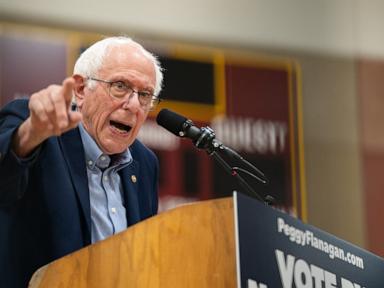
When Senator Bernie Sanders publicly withdraws support for Senate Democratic Leader Chuck Schumer, he is not merely expressing routine ideological frustration; he is signaling an acute breakdown in the coalition mechanics that govern the upper chamber. Standard political journalism treats this friction as a personality clash or a predictable progressive-versus-moderate skirmish. That framing misses the operational reality. In a legislative body defined by razor-thin margins and institutional inertia, leadership survival depends on maintaining a unified voting bloc through precise incentive alignment. Sanders’ call for a leadership change exposes a fundamental divergence in how the Democratic caucus calculates political risk, allocates legislative capital, and defines its core constituency.
To understand the mechanics of this fracture, one must analyze the Senate Democratic Caucus not as a monolithic political party, but as a fragile parliamentary coalition operating within a two-party framework. Sanders, an independent who caucuses with the Democrats, functions as the primary barometer for the party’s populist and progressive wing. His refusal to back Schumer alters the internal bargaining equilibrium, forcing a re-evaluation of the leadership's structural durability. For another view, read: this related article.
The Coalition Agency Problem in the Upper Chamber
In organizational economics, the principal-agent problem occurs when an agent is motivated to act in their own best interests, which are contrary to those of their principals. Within the Senate Democratic Caucus, Chuck Schumer acts as the primary agent tasked with executing the legislative and electoral priorities of his principals—the 47 to 51 members of the caucus, alongside the broader Democratic electorate.
Schumer’s operational model relies on incumbency protection and median-voter preservation. His primary objective as leader is to shield vulnerable swing-state senators from casting politically toxic votes while maximizing legislative output that can be marketed to suburban, moderate demographics. This strategy requires strict control over the Senate floor, calculated use of the amendment process, and centralized fundraising through institutional vehicles like the Senate Majority PAC. Related coverage on the subject has been published by USA Today.
Sanders operates under an entirely different utility function. Representing a safe seat in Vermont and commanding a national grassroots fundraising apparatus independent of party committees, Sanders is insulated from the primary mechanisms Schumer uses to enforce discipline. For Sanders, the principal is not the vulnerable swing-state incumbent; it is the working-class voter base whose economic grievances remain unaddressed by incrementalist policy.
This divergence creates three distinct points of operational failure:
- The Floor Control Bottleneck: Leadership maintains unity by preventing divisive votes. While this protects moderate incumbents in states like Pennsylvania, Michigan, or Nevada, it prevents progressive members from forcing ideological clarity on issues such as healthcare reform, labor rights, and campaign finance. Sanders views this bottleneck not as tactical prudence, but as strategic paralysis.
- The Donor-Base Asymmetry: Schumer’s leadership model depends heavily on high-dollar institutional donors and corporate-aligned political action committees to fund expensive Senate races. Sanders’ political brand is explicitly built on dismantling this exact financial architecture. When legislative compromises appear tailored to appease corporate donors—such as preserving carried interest loopholes or watering down pharmaceutical pricing reforms—Sanders interprets it as a breach of fiduciary duty to the working class.
- The Messaging Deficit: Effective political leadership requires a coherent value proposition. Sanders argues that the current leadership’s reliance on technocratic, means-tested legislative achievements fails to register with voters experiencing acute economic distress. Without a clear, populist economic narrative, the party cedes working-class demographics to right-wing populism.
Quantifying the Leverage of a Non-Member
A common analytical error is discounting Sanders’ influence because he is technically an independent and holds only a single vote in leadership elections. In a tightly divided Senate, single-node defections carry disproportionate weight. Leadership elections within the Senate Democratic Caucus are conducted by secret ballot, typically requiring a simple majority of the caucus to secure the top post.
While Sanders alone cannot mathematically deny Schumer the gavel—assuming Schumer retains the backing of the institutional core—his public opposition introduces a high-cost signaling mechanism. In game theory, costly signaling occurs when an actor takes an action that carries immediate political risk to demonstrate resolve. By publicly breaking with Schumer, Sanders accomplishes two tactical objectives:
First, he establishes a permission structure for other dissatisfied members. In closed-door caucus meetings, senators rarely voice direct opposition to the sitting leader due to the high cost of retaliation, which can include unfavorable committee assignments, blocked floor time for pet legislation, or withheld campaign funds. Sanders, having already maximized his committee leverage—most notably through his chairmanship or ranking status on the Senate Health, Education, Labor, and Pensions (HELP) Committee—faces minimal marginal risk from leadership retaliation. His public stance lowers the barrier for other progressive or reform-minded senators to demand structural concessions behind closed doors.
Second, Sanders shifts the Overton window regarding leadership accountability. In corporate governance, an entrenched CEO who presides over declining market share faces activist investor revolts. In the Senate, leadership is often treated as a lifetime appointment until retirement or electoral defeat. By framing Schumer’s tenure around electoral performance and strategic direction rather than personal loyalty, Sanders introduces an accountability metric that the caucus has historically avoided.
The Electorate Realignment Hypothesis
The core of Sanders’ critique rests on an empirical observation of recent electoral cycles: the Democratic Party is experiencing a steady erosion of support among non-college-educated voters across all racial demographics. This is not a localized anomaly; it is a structural realignment.
From a data-driven perspective, the Democratic coalition has increasingly traded working-class voters in rural and post-industrial regions for college-educated, affluent voters in metropolitan suburbs. While this trade-off can yield short-term electoral victories in specific statewide races, it creates a severe structural disadvantage in the United States Senate.
The constitutional design of the Senate—granting two seats per state regardless of population—inherently over-represents rural, less densely populated states. A political party whose coalition is heavily concentrated in high-density urban centers faces an uphill mathematical battle to secure 50 or 51 Senate seats. To compete effectively in states like Ohio, Montana, Iowa, or Florida, a party must possess a viable appeal to working-class, non-college-educated voters.
Sanders’ argument against Schumer is rooted in this geographic and demographic math. The hypothesis is straightforward: the current leadership’s legislative strategy is optimized for the party’s new suburban base, which actively alienates the working-class base required to win a durable Senate majority.
When the Senate leadership prioritizes policies that resonate with upper-middle-class sensibilities while failing to deliver transformative economic interventions—such as a federal minimum wage increase, robust union protections via the PRO Act, or universal healthcare expansion—it accelerates the demographic sorting that dooms the party in the Senate map.
The Structural Limitations of the Sanders Critique
A rigorous analysis requires examining the vulnerabilities of Sanders’ own strategic position. While his diagnosis of the Democratic Party’s demographic vulnerability is supported by electoral data, his proposed prescription—replacing Schumer with a more populist, aggressive leader—carries severe operational risks that could destabilize the caucus entirely.
The primary limitation is the veto-player reality of the U.S. Senate. Under current Senate rules, specifically the 60-vote threshold required to invoke cloture on most legislation, a Senate Majority Leader does not possess unilateral executive authority. Even when Democrats hold a slim majority, the effective legislative ceiling is dictated by the most conservative member of the caucus, not the leader.
Replacing Schumer with a progressive firebrand would not alter the underlying vote math. A more aggressive leader attempting to force progressive legislation onto the floor would immediately collide with two immovable obstacles:
- Centrist Defection: Moderate senators from purple or red-leaning states would vote against cloture or final passage, resulting in high-profile legislative failures. In legislative management, bringing a bill to the floor without the votes to pass it is a cardinal error; it projects weakness, divides the caucus, and provides opposition candidates with campaign ammunition without producing tangible policy outcomes.
- The Filibuster Constraint: Overcoming the 60-vote threshold requires eliminating or reforming the legislative filibuster. Previous attempts to modify the filibuster for voting rights legislation failed because moderate caucus members refused to alter the rule. A change in leadership does not change the institutional conservatism of the caucus’s median voters.
The second limitation involves fundraising and institutional infrastructure. Schumer is widely recognized as one of the most prolific fundraisers in congressional history. The modern Senate campaign environment requires hundreds of millions of dollars per cycle to compete in media-saturated battleground states. While Sanders has proven capable of raising massive sums from small-dollar donors for his own presidential campaigns, that grassroots fundraising model has historically struggled to transfer seamlessly to down-ballot, moderate Senate candidates who do not share his ideological purity. Dismantling Schumer’s institutional fundraising network without a proven, scalable alternative would create a massive resource deficit for the caucus.
Mapping the Succession Vacuum
A critical factor missing from superficial coverage of Sanders’ statement is the absence of a viable alternative candidate. In political strategy, you cannot beat something with nothing. For an insurgency against an entrenched leader to succeed, the opposition must coalesce around a singular, credible successor who can bridge the ideological divide between the party’s factions.
Currently, the Senate Democratic Caucus suffers from a pronounced succession bottleneck. The next tier of leadership—figures like Dick Durbin, Patty Murray, Amy Klobuchar, and Cory Booker—either represent the same institutional wing as Schumer or lack the cross-factional appeal necessary to unify both the progressive left and the centrist core.
- The Institutionalists: Senators like Klobuchar or Mark Warner possess strong ties to the moderate wing and the donor class, making them unacceptable to Sanders’ populist base. Replacing Schumer with a member of this cohort would represent a cosmetic change rather than the structural shift Sanders is demanding.
- The Progressives: Senators like Elizabeth Warren, Jeff Merkley, or Chris Murphy align more closely with Sanders’ policy objectives, particularly regarding economic regulation and foreign policy. However, none currently possess the broad caucus support required to defeat a sitting leader in a secret-ballot election, largely due to fears among swing-state incumbents that a progressive leader would become a national caricature used against them in general elections.
This succession vacuum ensures that Schumer’s immediate hold on the leadership post remains secure in the short term. Without a unified challenger, Sanders’ defection functions as an external pressure campaign rather than an imminent coup.
The Foreign Policy Catalyst
Beyond domestic economic policy and electoral strategy, Sanders’ refusal to support Schumer highlights an increasingly fractured consensus on foreign policy—specifically regarding U.S. military aid and Middle East diplomacy.
Historically, Senate leadership maintained near-total unanimity on core national security alliances and defense appropriations. Schumer, positioning himself as a traditional institutionalist and staunch defender of long-standing U.S. alliances, has consistently backed unconditional security assistance packages.
Sanders has utilized the Senate floor to force votes on Joint Resolutions of Disapproval to block specific arms sales, directly challenging the leadership’s foreign policy orthodoxy. While these resolutions have failed to pass, they have successfully attracted a growing minority of the Democratic caucus—often exceeding a third of the party’s senators.
This represents a profound shift in caucus dynamics. Foreign policy has transitioned from a domain of bipartisan, top-down consensus into a frontline proxy battle over the party’s moral and strategic identity. By linking his opposition to Schumer’s leadership with these broader policy divergences, Sanders signals that the progressive wing will no longer grant leadership a blank check on national security matters in exchange for domestic legislative cooperation.
Operational Execution for the Caucus
The friction between Sanders and Schumer is not a temporary media cycle; it is the manifestation of a structural flaw in how the Democratic Party manages its coalition. Ignoring this signal in favor of enforcing traditional caucus discipline will only accelerate the party’s alienation from its working-class base and deepen internal paralysis.
To resolve this operational deadlock without triggering a destructive civil war, the Senate Democratic Caucus must execute a deliberate restructuring of its internal governance:
- Decentralize Floor Strategy: Leadership must abandon the practice of shielding incumbents from difficult votes at the expense of ideological clarity. The caucus should adopt a controlled-release strategy, allowing high-priority populist economic bills—such as targeted corporate tax reforms, anti-price-gouging measures, and labor protections—to reach the floor for recorded votes, forcing political opponents to defend unpopular economic positions on the record.
- Institutionalize Progressive Representation in Leadership: Rather than leaving the populist wing as an external agitator, the caucus must formally integrate a Sanders-aligned representative into the core decision-making apparatus—not as a ceremonial title, but with direct input over committee assignments, floor scheduling, and messaging strategy.
- Reorient the Economic Narrative: Leadership must shift its communication framework away from defending macroeconomic indicators and technocratic legislation toward aggressive, plain-spoken populism that directly confronts corporate consolidation and cost-of-living pressures.
If Schumer and the institutional core fail to absorb Sanders’ critique and adapt their operational model, the result will not be stability; it will be a continued erosion of the party’s working-class foundation, guaranteeing a structural minority status in the Senate regardless of who holds the gavel.