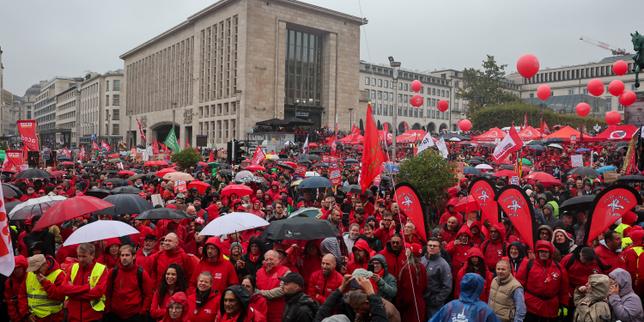
Mass demonstrations across European administrative centers do not materialize from transient grievances. They represent the visible friction points where macroeconomic adjustment strategies collide with entrenched social safety nets. When thousands of citizens converge on the Belgian capital to protest the fiscal decisions of the federal administration and regional entities, the underlying mechanics involve a direct clash between sovereign debt containment and the preservation of public sector resource allocation.
To analyze this dynamic beyond descriptive journalism, one must examine the triadic architecture driving institutional conflict: fiscal consolidation mandates, public sector cost burdens, and the resulting distributional friction.
The Fiscal Compression Vector
The primary driver of federal policy adjustments centers on debt-to-GDP ratios and European-level fiscal governance frameworks. Under structural deficit reduction targets, modern states face a zero-sum allocation problem. When governments attempt to compress expenditure, the optimization function typically targets indexed welfare systems, higher education subsidies, and non-market public services.
The mechanism of friction operates through purchasing power erosion. As inflation metrics outpace wage indexation adjustments in specific sectors, the real disposable income of public-facing workers, educators, and students declines. The recent mobilization in Brussels, uniting student federations such as the FEF alongside trade union factions like the FGTB, demonstrates a coordinated response to cumulative cost pressures across housing, transport, and academic overhead.
The Asymmetry of Public Sector Cuts
State-level austerity measures introduce an asymmetric cost burden. Capital investments in defense or strategic procurement—such as federal commitments to military modernization—often run parallel to reductions in operational budgets for regional education and healthcare services. This divergence creates a profound cognitive dissonance for the labor force. Citizens experience simultaneous announcements of heavy capital expenditures on national security alongside strict austerity measures within social infrastructure.
The economic model employed by protestors relies on the concept of human capital depreciation. When higher education institutions and non-market sectors absorb recurring budgetary contractions, the long-term productivity curve flattens. Student unions articulate this risk not merely as an immediate financial barrier—such as rising tuition minervals—but as a systemic devaluation of accessible qualification pathways.
Coalition Politics and Institutional Fragmentation
Governance structures in Belgium complicate policy execution and amplify friction. Federalism divides responsibilities across linguistic communities and regional governments, creating multi-layered accountability loops. When educational policies fall under community jurisdiction while fiscal austerity is driven by federal budgetary targets, citizens struggle to identify a single locus of reform.
This fragmentation reduces the efficacy of traditional institutional dialogue. Unions and student syndicates resort to mass street mobilization because conventional bureaucratic feedback loops exhibit high latency. The strategic deployment of nationwide strikes and coordinated capital-city rallies functions as an alternative signaling mechanism designed to force legislative recalibration before budgets receive final parliamentary clearance.
Systemic Outlook
The recurring convergence of labor unions, student bodies, and civil society groups on the streets of Brussels signals a structural impasse. Resolution requires more than temporary concessions or one-off budgetary adjustments. Until policy frameworks reconcile macroeconomic deficit targets with the preservation of public service elasticity, urban centers will remain the primary arena for resolving macroeconomic disputes through direct civic friction.