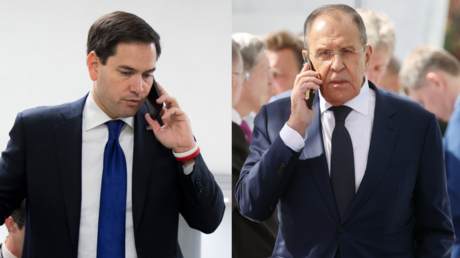
The recent communication between Russian Foreign Minister Sergey Lavrov and U.S. Secretary of State Marco Rubio represents a shift from total diplomatic paralysis to a high-stakes reconnaissance phase. While the official Russian readout characterizes the call as "constructive," this descriptor functions less as a qualitative assessment of agreement and more as a technical indicator that a functional communication protocol has been re-established. The interaction signals a transition in the bilateral relationship from a period of static hostility to one of transactional testing.
The Architecture of Re-engagement
Direct communication between high-ranking officials in Moscow and Washington serves three immediate structural functions that supersede the specific content of their conversation.
- De-escalation Buffering: Constant, direct contact reduces the "latency of intent." In a high-friction environment, the absence of a channel forces each actor to interpret the other’s movements through the lens of worst-case scenario modeling. Direct dialogue allows for the clarification of red lines before they are crossed by accident or miscalculation.
- Agenda Mapping: Initial calls are diagnostic. Both sides are currently identifying which issues are "frozen" (non-negotiable), which are "liquid" (subject to trade-offs), and which are "peripheral" (concessions used to signal goodwill).
- Institutional Testing: Rubio’s presence as the primary interlocutor tests the ideological flexibility of the new U.S. administration. Moscow is evaluating whether the incoming State Department will prioritize traditional Atlanticist containment or a more realist, bilateral transactionalism.
The "constructive" label applied by the Russian Foreign Ministry indicates that the exchange moved beyond a mere recitation of grievances. It suggests an agreement on a framework for subsequent discussions, likely focused on the logistics of future negotiations rather than immediate policy shifts.
The Triad of Friction Points
To understand the trajectory of these talks, one must analyze the three core variables that dictate the boundaries of any potential "constructive" outcome.
The Security Dilemma and Territorial Integrity
The most significant bottleneck remains the divergent definitions of European security architecture. Moscow views NATO expansion as an existential threat to its "near abroad," while Washington maintains the principle of sovereign choice for Eastern European nations. This is a zero-sum variable; any gain in perceived security for one party results in a perceived loss for the other. The Lavrov-Rubio channel must navigate whether a neutral-buffer model is technically feasible or if the relationship remains bound by the current attrition-based status quo.
Economic Leverage and Sanctions Elasticity
Sanctions serve as the primary U.S. tool for behavioral modification, yet their efficacy is subject to diminishing returns. The Russian economy has demonstrated a degree of "sanctions-hardening" through the redirection of energy exports to BRICS partners and the development of alternative financial messaging systems. Rubio enters this dialogue with the challenge of determining if further escalatory sanctions retain any coercive power, or if the "sanctions relief" card is now the only viable currency for extractable concessions.
The China Variable
Washington’s strategic posture is increasingly dominated by the Pacific theater. A "constructive" relationship with Moscow is, from a U.S. perspective, a tactical move to prevent a consolidated Eurasian bloc. If Rubio can decouple Russian tactical interests from Chinese long-term strategic objectives, the U.S. gains significant maneuverability. Moscow, aware of this intent, will likely demand high-cost concessions in Europe to justify any perceived cooling of its "no-limits" partnership with Beijing.
Tactical Mechanics of the Rubio Doctrine
Marco Rubio’s historical stance has been characterized by a blend of neoconservative assertiveness and pragmatic realism. His transition to the role of Secretary of State necessitates a pivot toward the latter. In his interaction with Lavrov, Rubio is likely employing a "pressure-plus-pathway" strategy.
- Pressure: Maintaining the credible threat of increased military aid to proxies or expanded secondary sanctions.
- Pathway: Providing a clear, staged set of criteria for de-escalation that allows the Kremlin to claim a domestic victory.
This approach creates a bottleneck for the Russian side. Moscow prefers "grand bargains"—comprehensive agreements that settle multiple disputes simultaneously. Rubio’s likely preference for incrementalism forces Moscow to decide if they are willing to accept small-scale de-escalation without a guarantee on the broader security architecture.
Information Asymmetry and Signal Intelligence
In diplomatic maneuvering of this scale, what is omitted is often as critical as what is stated. The brevity of the Russian statement suggests that the specific mechanics of the Ukraine conflict were discussed under a "non-disclosure" understanding. This implies that both parties recognize that publicizing the details of a potential settlement too early would invite domestic political backlash and sabotage from third-party stakeholders.
The "constructive" nature of the call likely focused on the following procedural elements:
- Establishment of Working Groups: Moving beyond the principals (Lavrov and Rubio) to lower-level technical experts who can iron out the details of arms control or diplomatic presence (embassy staffing).
- Conflict De-confliction: Ensuring that military movements in shared theaters do not lead to direct kinetic engagement.
- Prisoner and Humanitarian Exchanges: Using low-stakes humanitarian wins to build the "habits of cooperation" necessary for higher-stakes negotiations.
The Strategic Horizon
The Lavrov-Rubio call is not an end state but a signal of a shift in the cost-benefit analysis of both capitals. For Russia, the "constructive" label is an invitation to the U.S. to present a concrete proposal that acknowledges Russian core interests. For the U.S., it is an exercise in checking the temperature of a rival to see if the "maximum pressure" of the previous years has created a genuine appetite for a settlement.
The risk inherent in this channel is "expectation misalignment." If Moscow interprets "constructive" as a sign of American exhaustion, and Washington interprets it as a sign of Russian desperation, the talks will inevitably collapse into a new cycle of escalation. The durability of this channel depends on the ability of both Rubio and Lavrov to manage their respective domestic hawks while maintaining a line of communication that is sufficiently private to allow for real trade-offs.
Direct engagement must prioritize the restoration of Basic Diplomatic Infrastructure (BDI). This includes the return of expelled diplomats and the reopening of consulates. Without BDI, any high-level agreement lacks the institutional machinery required for implementation. The "constructive" phone call succeeds only if it transitions from a symbolic gesture into a series of technical, verifiable steps that reduce the probability of a systemic rupture in global security.