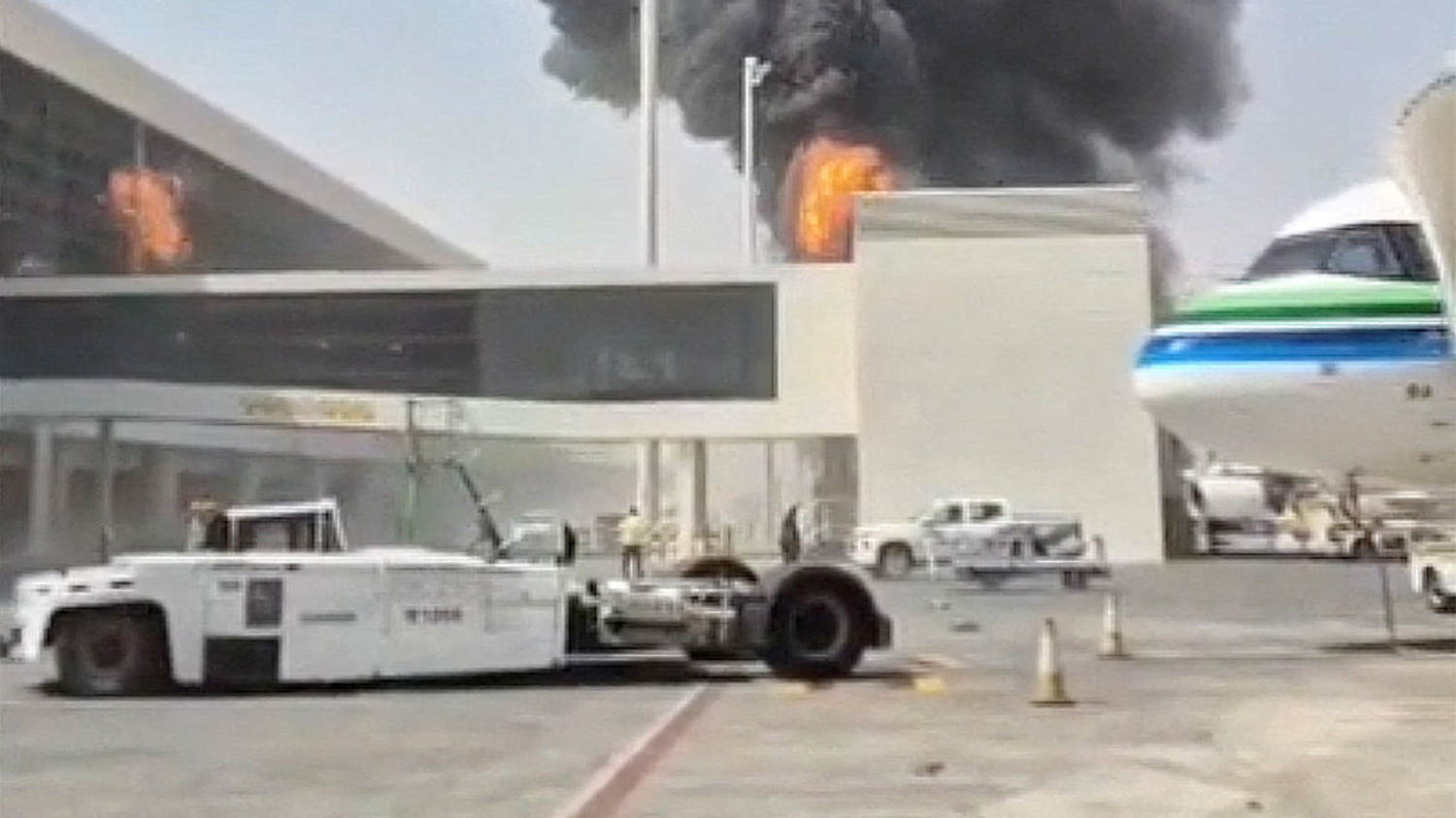
The operational architecture of critical national infrastructure in the Arabian Gulf faces a structural reassessment following the kinetic attacks on King Khalid International Airport in Riyadh. Far from being an isolated tactical anomaly, the operation—which resulted in multiple fatalities and hundreds of injuries—exposes fundamental vulnerabilities in wide-area air defense economics and the logistical resilience of civil aviation hubs within active theaters of conflict. Deconstructing this escalation requires moving past surface-level geopolitical rhetoric to examine the cost functions, defensive saturation limits, and economic contagion effects that govern modern asymmetrical warfare.
The Asymmetry of Defensive Economics
The primary strategic driver behind continuous projectile and drone deployment against high-value civilian infrastructure is the cost-asymmetry equation. Interceptor missiles utilized by advanced air defense batteries operate at a high unit cost, frequently exceeding millions of dollars per engagement. Conversely, the ordnance utilized by non-state actors such as the Houthi movement—comprising modified loitering munitions and ballistic variants—demands a fraction of that capital outlay.
This financial divergence creates a severe attrition handicap for defensive coalitions. When a major transit nexus like King Khalid International Airport is targeted repeatedly within a compressed temporal window, defenders must achieve a near-perfect interception rate. A single penetration point bypasses economic and physical layers, producing disproportionate systemic outcomes: structural damage, civilian casualties, immediate flight suspensions, and mandatory evacuations.
The Failure Modes of Warning Architecture
Operational efficiency in civilian aviation relies heavily on deterministic early-warning systems to clear airspace and shelter ground personnel before impact. Investigations into the Riyadh incidents highlighted a critical systemic failure: the apparent silence of localized warning networks prior to critical strikes.
When early-warning protocols fail or experience latency, the human cost escalates exponentially. The absence of automated sirens or localized mobile alerts prevents terminal evacuation, shifting the hazard profile from structural asset damage to catastrophic personnel vulnerability. In dense transportation nodes housing thousands of transit passengers, the time window between radar acquisition and projectile impact is measured in seconds. If the telemetry pipeline fails to trigger automated counter-measures or civilian alerts, the vulnerability of the node spikes regardless of underlying interceptor density.
Spatial Dispersion versus Asset Concentration
A core challenge for modern state defense planning in large territories is the spatial distribution of risk. As highlighted by military analysts regarding Saudi Arabia's geographic profile, the kingdom possesses a vast surface area housing numerous critical nodes—including international airports, desalination plants, primary pipelines, and hydrocarbon processing terminals.
This creates an inherent defensive paradox:
- Concentrated Defense: Pooling surface-to-air assets around primary economic hubs leaves secondary logistics nodes entirely exposed.
- Distributed Defense: Spreading defensive batteries thin reduces local saturation capacity, making primary targets vulnerable to massed drone and missile swarms.
The Houthi targeting strategy exploits this dispersion by rotating vectors—shifting strikes between Riyadh's central aviation hub, Dammam's industrial port facilities on the Gulf coast, and southern airfields such as Abha and Jazan. By forcing the defender to maintain a generalized high-alert posture across multiple distinct geographical theaters, the attacker maximizes logistical fatigue and degrades response consistency.
Economic Contagion and Regional Spillover
The macroeconomic repercussions of targeting civil aviation infrastructure extend far beyond direct structural repair costs. International carriers immediately re-evaluate route risk profiles, resulting in airspace avoidance, schedule recalculations, and increased insurance premiums.
Furthermore, these kinetic disruptions do not occur in a vacuum; they correlate with parallel threats to maritime chokepoints, such as the Strait of Hormuz and alternative pipeline corridors. While global oil markets fluctuate based on broader supply forecasts and strategic reserve releases, regional transport risk functions as a persistent tax on corporate mobility and foreign direct investment. Business travel stagnation, remote work shifts for capital-city operations, and dampened consumer confidence compound the long-term drag on regional economic diversification initiatives.
Strategic Forecast
Defensive resilience under sustained asymmetrical campaign conditions requires an architectural shift away from reactive kinetic interception toward proactive electronic warfare suppression, localized point-defense hardening, and redundant early-warning telemetry. Until interception cost parity is achieved through directed-energy solutions or advanced kinetic alternatives, civil infrastructure will remain a high-leverage target for non-state actors seeking outsized strategic influence through localized disruption.
Fubu Toy review
This video provides comprehensive news reporting and tactical analysis regarding the escalation of strikes on Saudi aviation infrastructure and the resulting regional security implications.