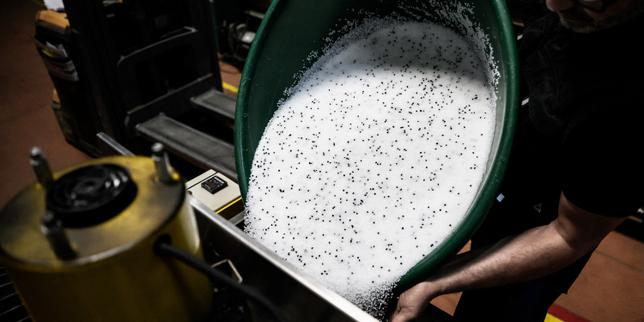
The "Plastics Valley" of the Ain region represents a high-density industrial cluster where local operational efficiency is currently being neutralized by macroscopic geopolitical volatility. The disruption in the Middle East does not merely raise prices; it fundamentally alters the Unit Economics of Polymer Conversion. When maritime transit through the Red Sea is compromised, the resulting friction manifests as a dual-shock: an immediate spike in raw material procurement costs and a structural delay in inventory replenishment cycles.
The Triad of Polymer Dependency
The economic health of Oyonnax and the surrounding Ain department rests on three distinct pillars of dependency. Any disruption to one creates a cascading failure across the regional value chain. Meanwhile, you can find other developments here: The Ghost Fleet and the Great Defiance.
- Feedstock Volatility: Most thermoplastic resins—polypropylene (PP), polyethylene (PE), and polystyrene (PS)—are derivatives of naphtha or natural gas. Since the Middle East controls a significant portion of the global marginal supply, any perceived threat to production or transit immediately inflates the Brent Crude benchmark. For an Ain-based processor, a 10% increase in energy costs translates to a disproportionate contraction in EBITDA because energy and raw materials typically constitute 50% to 70% of total operating expenses.
- Logistic Lead-Time Elasticity: The shift from the Suez Canal to the Cape of Good Hope route adds approximately 10 to 15 days to transit times. This is not a linear delay; it is a liquidity drain. Firms must tie up more working capital in "floating inventory" to maintain the same service levels, increasing the cost of carry in a high-interest-rate environment.
- Specialty Additive Scarcity: While commodity resins can sometimes be sourced from North American or European crackers, high-performance additives and specific catalysts often rely on complex, globalized supply lines. Small-batch producers in the Ain find themselves at the end of the allocation queue when global shipments are throttled.
The Cost Function of Geometric Complexity
The regional crisis is exacerbated by the specific nature of the French plastics industry, which favors high-precision, complex geometries over simple mass-market extrusions. The cost of producing a technical part in the Ain is defined by the following relationship:
$$C_{total} = (M \cdot P_{m}) + (E \cdot P_{e}) + \frac{O + L}{Q}$$ To understand the bigger picture, check out the detailed report by Investopedia.
Where:
- $M$ = Mass of material
- $P_{m}$ = Price of polymer (highly sensitive to Middle Eastern stability)
- $P_{e}$ = Price of energy (linked to global gas and oil benchmarks)
- $O$ = Operational overhead
- $L$ = Logistics and risk-premium costs
- $Q$ = Production volume
When $P_{m}$ and $L$ rise simultaneously, the break-even volume $Q$ increases. For many SMEs in the region, the current market price for finished goods is trapped below this new, elevated break-even point. Larger Tier-1 automotive suppliers may have "pass-through" clauses in their contracts, but the smaller Tier-2 and Tier-3 molders lack the bargaining power to shift these costs onto their customers. This creates a Margin Squeeze Trap.
Structural Bottlenecks in the "Just-in-Time" Model
The Plastics Valley has spent decades optimizing for JIT (Just-in-Time) delivery to European automotive and medical device hubs. This model assumes a "frictionless" supply of raw materials. The Middle Eastern conflict has introduced "stochastic friction," where the arrival of containers becomes unpredictable.
- The Bullwhip Effect: Fearing future shortages, regional processors may over-order resin, leading to artificial demand spikes that further drive up prices. This "phantom demand" eventually leads to a glut, but not before it creates a localized liquidity crisis.
- The Substitution Barrier: Switching from a Middle Eastern supplier to a domestic European or American one is not instantaneous. Each resin grade requires specific machine settings and potentially new mold certifications. For medical-grade plastics, a change in material source may require regulatory re-validation, a process that can take months.
Strategic Divergence: Resilience vs. Efficiency
The current crisis reveals a fundamental flaw in prioritizing cost-efficiency over systemic resilience. The companies currently surviving the volatility in the Ain are those that have diversified their Sourcing Geographic Profile.
A transition is occurring from "Global Sourcing" to "Regional Redundancy." This involves:
- Buffer Stocking: Moving from JIT to "Just-in-Case" inventory management. While this increases storage costs, it acts as a hedge against maritime disruptions.
- Material Circularity as a Hedge: Increasing the use of Post-Consumer Recycled (PCR) resins. Since PCR is sourced locally from European waste streams, its price is partially decoupled from Middle Eastern geopolitics, though it remains tied to the price of virgin resin through substitution effects.
The Energy-Intensive Manufacturing Paradox
The Ain region is one of the most industrialized areas in France, but its reliance on electricity for injection molding and extrusion creates a secondary vulnerability. Because European electricity prices are often pegged to the "marginal plant" (frequently gas-fired), the instability in the Middle East indirectly inflates the cost of every kilowatt-hour used in Oyonnax. This creates an Energy-Plastic Correlation that is nearly impossible to hedge using standard financial instruments available to mid-sized firms.
The second limitation is the aging infrastructure of many regional workshops. Older hydraulic presses consume significantly more energy than modern all-electric or hybrid machines. In a low-cost energy environment, the capital expenditure required to upgrade these machines was difficult to justify. In the current high-volatility environment, that inertia has become a terminal risk.
Mapping the Financial Fallout
The impact on the local economy can be categorized into three phases of degradation:
- Absorption Phase: Firms utilize cash reserves to cover the increased cost of materials and freight while keeping selling prices stable to maintain market share.
- Transmission Phase: Price increases are passed to the end-consumer. This leads to "demand destruction," where customers delay orders or seek cheaper, lower-quality alternatives from outside the Eurozone.
- Consolidation Phase: Highly leveraged firms, unable to service debt due to eroded margins, are acquired by larger conglomerates or enter liquidation. This reduces the diversity of the "industrial ecosystem," potentially harming the region's long-term innovative capacity.
Strategic Action: Decoupling from Geopolitical Volatility
To mitigate the current crisis and prepare for future shocks, the industrial strategy for the Plastics Valley must shift toward Vertical Integration and Localized Circularity.
Processors should prioritize the integration of "grinders" and "re-granulation" lines directly into their facilities. By processing their own internal scrap and sourcing local industrial waste, they reduce the percentage of virgin resin required per unit of output. This reduces the $M \cdot P_{m}$ component of the cost function.
Furthermore, firms must move away from "flat" pricing models toward "indexed" contracts. By pegging the final price of the plastic component to a regional polymer index (such as those provided by ICIS or Platts), the processor protects their margin from sudden feedstock spikes. This shifts the geopolitical risk from the manufacturer to the customer, who is often better equipped to hedge that risk on the open market.
The ultimate survival of the region depends on transitioning from being a "converter of cheap global polymers" to an "engineer of high-value local materials." The Middle Eastern conflict is not a temporary hurdle; it is a signal that the era of cheap, frictionless global supply chains has ended. The new mandate is Operational Autarky. Firms that fail to invest in energy-efficient machinery and local sourcing agreements within the next 12 to 18 months will likely find themselves structurally uncompetitive as the "Plastics Valley" undergoes a painful but necessary Darwinian contraction.