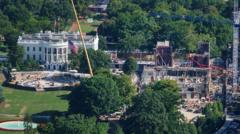
Big construction projects rarely mix well with constitutional law. When President Trump pushed to replace the demolished East Wing with a massive 90,000-square-foot structure, he started a fierce interbranch fight. Now, the highest court in the land has stepped in with a temporary breather.
Chief Justice John Roberts issued a stay that temporarily freezes a lower court decision, keeping above-ground work on the $400 million project moving forward for now. This emergency move gives the Supreme Court vital time to weigh the Justice Department's urgent request.
The Core Conflict Over Executive Power
At the heart of this mess lies a fundamental question about who actually controls federal property. A divided federal appeals court ruled earlier this month that Congress holds full constitutional authority over federal buildings and funding. The U.S. Court of Appeals for the District of Columbia Circuit decided that the administration lacked proper congressional authorization to build the massive complex.
The administration sees things entirely differently. Solicitor General D. John Sauer argued in court filings that halting the work creates an unlawful roadblock against an integrated military and security facility. According to the White House, the project is roughly sixty-five percent finished. Crews working grueling shifts have pushed the site past a point of no return. Taking down or altering what is already built would be practically impossible.
Follow the Money and the Security Claims
Funding remains a massive point of contention. The administration bypassed traditional legislative appropriations by routing private donations from major corporations and donors through a nonprofit, transferring the cash to the National Park Service, and finally landing it in an account usually reserved for minor maintenance. U.S. District Judge Richard Leon famously criticized this complicated mechanism, comparing it to an overly elaborate Rube Goldberg machine.
Meanwhile, the White House leans heavily on national security arguments. Officials point to recent assassination plots against Trump to justify the urgent need for a secure ballroom space, an underground bunker, and modern medical facilities. Below-ground fortification work was never fully blocked by lower court orders, but the above-ground architectural overhaul faced the immediate threat of a complete shutdown before Roberts issued his stay.
Opponents, including the National Trust for Historic Preservation, accuse the administration of intentionally rushing construction to outpace judicial review. They argue that the executive branch cannot simply rewrite federal spending rules because it wants a faster timeline.
The legal battle is far from settled. The Supreme Court's temporary stay simply pauses the chaos while justices decide how to handle the broader appeal.
Appeals court halts Trump's ballroom project, says Congress must approve it
This video provides an overview of the federal appeals court ruling that initially paused the White House construction project and set the stage for the ongoing Supreme Court battle.