Walk into a typical European bank, and the advisor will likely steer you toward a low-yielding savings account or a conservative insurance product. Southern and Central Europeans famously hoard cash under the proverbial mattress or let it sit in checking accounts, terrified of market volatility.
Sweden plays a completely different game.
In Sweden, stock market participation isn't a hobby for the wealthy. It's a national default setting. Data from the Swedish government and the European Fund and Asset Management Association reveals a staggering reality: Swedish households hold just over 10% of their financial assets in cash or bank deposits. That is the lowest number in the European Union. Instead, roughly 70% of all Swedish households own investment funds directly, and around 25% own individual corporate shares outright.
This isn't an accident of geography, nor is it driven by some innate Nordic gambling instinct. It is the result of a multi-decade masterclass in behavioral engineering, aggressive tax policy, and structural pension design. If you want to understand how Sweden became Europe's capital of retail investing, you have to look at the machinery behind it.
The Tax Hack That Turned Citizens into Investors
For decades, the biggest barrier to retail stock market investing across Europe has been the administrative nightmare of filing capital gains taxes. Figuring out cost basis, tracking dividends, and filling out complex tax forms keeps ordinary people out of the market.
Sweden solved this in 2012 by introducing the Investeringssparkonto, commonly known as the ISK account.
The ISK is an investment savings account structure that completely alters how retail investments are taxed. Instead of charging a standard 30% tax on realized capital gains and dividends every time you sell a stock or receive a payout, the ISK bypasses transaction tracking entirely. It replaces it with an annual standardized, notional tax based on the total value of the portfolio.
Standard Swedish Capital Gains Tax: 30% on all realized profits
Sweden's ISK Account Tax: A small annual flat rate on total portfolio value (~0.5% - 1% depending on interest rates), regardless of buying or selling activity.
The administrative beauty of the ISK is that financial institutions report everything directly to the Swedish Tax Agency (Skatteverket). When tax season rolls around, the calculations are pre-printed on the citizen's declaration sheet. You literally log in, click approve, and you're done. No transaction data collection, no complex spreadsheets, and zero paperwork friction.
By 2026, the government sweetened the deal even further. ISK accounts are now completely tax-free up to 300,000 Swedish Kronor (~$33,740). Today, nearly 4 million Swedes—roughly 40% of the entire population—hold an ISK account. By removing the psychological and administrative burden of tax compliance, Sweden transformed stock investing from an elite venture into a frictionless daily routine.
Forced Exposure via the Public Pension System
You can't talk about Swedish equity culture without looking at the retirement system. In 2000, Sweden restructured its public pension system to include a mandatory, partially funded pillar known as the Premium Pension (Premiepensionen).
Every single worker in Sweden has 2.5% of their pensionable income funneled directly into individual investment accounts. Workers choose from hundreds of private mutual funds to allocate this capital.
What happens if a citizen doesn't care, doesn't understand the market, or refuses to choose? Their money is automatically directed into the AP7 Såfa fund, a state-managed equity fund designed specifically as the default option.
Instead of hiding this money in ultra-conservative government bonds, the AP7 default fund takes an aggressive approach. It invests heavily in global equities and uses leverage to maximize long-term returns for savers. Because every single working citizen is forced to participate in this equity-heavy system, the entire population gets an immediate stake in global financial markets from their very first paycheck.
This creates a "learning by doing" environment. Swedes log into centralized pension tracking systems like MinPension, see their equity portfolios growing over time, and lose their fear of the stock market.
The Corporate Ecosystem and the SME Retail Boom
A high appetite for investing requires a vibrant marketplace to absorb that capital. Sweden has built an incredibly distinct capital market ecosystem that caters specifically to smaller companies and retail traders.
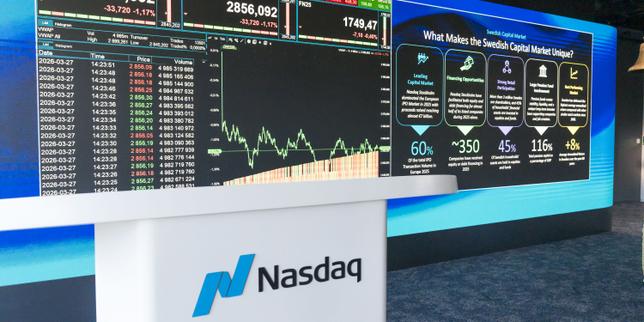
While major stock exchanges in London, Frankfurt, and Paris are dominated by massive institutional players and giant conglomerates, Nasdaq Stockholm has turned into a booming hub for Small and Medium Enterprises (SMEs). According to data from the European Market Regulator (ESMA), Sweden alone accounts for more than 40% of European SME trading volumes.
Since 2016, more than 400 companies have listed on Nasdaq Stockholm or its growth market, First North. It is normal for a young Swedish tech startup or industrial niche firm to go public early in its growth journey. Retail investors actively back these listings, providing early-stage risk capital that allows local companies to scale without relying solely on foreign venture capital.
This ecosystem is supported by organizations like the Swedish Shareholders' Association (Sveriges Aktiesparares Riksförbund). Founded back in 1966, this group acts as a powerful lobbyist for the small investor, ensuring corporate governance remains transparent and retail buyers aren't squeezed out by institutional private equity.
High Financial Literacy Meets High Trust
The structural framework only works because the underlying societal conditions support it. Sweden ranks near the top of global financial literacy indexes, but their education isn't purely academic. It is cultural.
National education campaigns and decades of structural incentives have normalized conversations about wealth accumulation. Even major historic setbacks haven't broken this trust. In 2000, the Swedish government privatized and listed the state-owned telecom giant Telia. It was marketed heavily as a "share for the people," and nearly a million citizens bought in right before the dot-com bubble burst, causing the stock to crash.
In most countries, an event like that triggers a generational retreat from the stock market. In Sweden, retail investors stayed. They absorbed the lesson on diversification, shifted more capital into index funds, and kept investing.
There is also a profound home bias that keeps the local economy moving. Roughly 40% of retail savings in equity funds remain allocated to Swedish assets, despite the fact that Sweden represents only about 1% of global market capitalization. Retail investors trust local corporate governance, understand the brands they use daily, and actively choose to recycle their wealth back into Swedish enterprise.
How to Apply the Swedish Model to Personal Wealth
You don't need a Swedish passport to adopt the principles that made their population wealthy. The success of their retail environment offers a clear blueprint for individual financial management.
- Eliminate transaction friction: If your regional tax laws allow for tax-advantaged accounts (like an ISA in the UK, a Roth IRA in the US, or specific automated investment structures in Europe), maximize them immediately. The fewer manual calculations you have to do at the end of the year, the more consistent your investing habit will be.
- Accept equity risk for long-term horizons: Stop treating cash as a safe haven for wealth you won't need for a decade. Follow the AP7 pension strategy: allocate long-term capital aggressively into global equity index funds rather than low-yield savings instruments that lose purchasing power to inflation.
- Look for transparent, low-cost options: Because of intense competition and high retail volume, the average Swedish equity fund fee sits at just 0.89%, compared to the wider EU average of 1.40%. Never let high management fees eat away your compounding returns. Insist on low-cost index tracking.