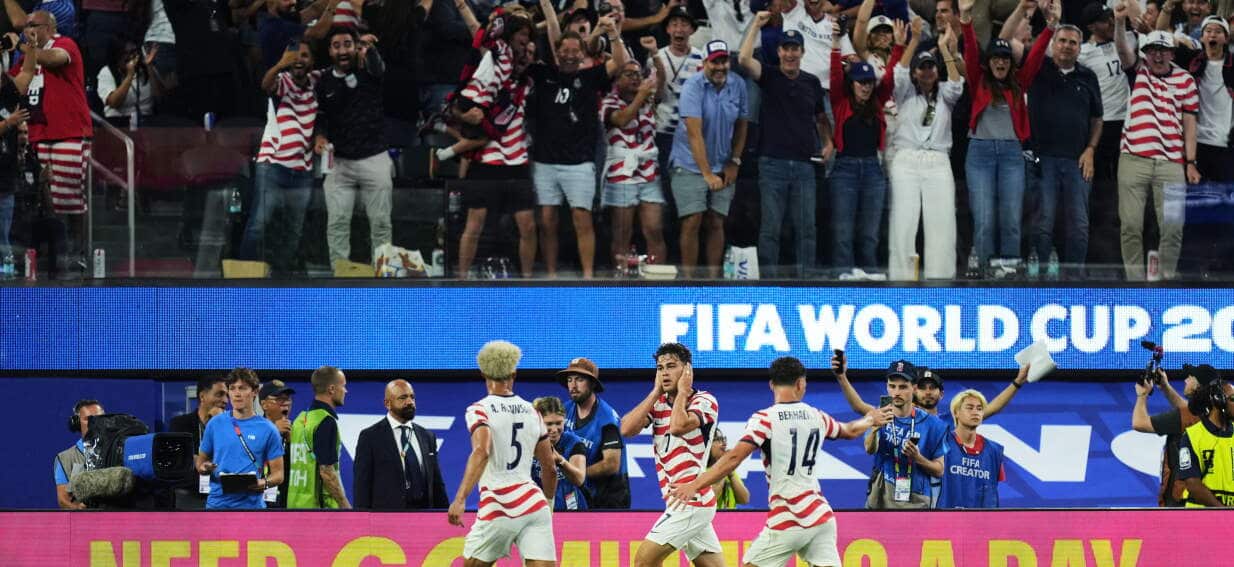
The United States Men’s National Team’s victory over Paraguay reveals a fundamental shift in tactical execution, moving away from volume-based possession toward high-efficiency vertical transitions. Standard match summaries attribute the outcome to individual brilliance or generic clinical finishing. A structural breakdown of the match dynamics, however, isolates two specific variables that determined the tactical asymmetry: localized half-space manipulation by Folarin Balogun and central vertical facilitation by Giovanni Reyna. By exploiting Paraguay’s aggressive mid-block press, the USMNT maximized their expected goals (xG) per shot sequence, despite sustained periods of low territorial dominance.
Understanding this tactical evolution requires looking past the raw scoreline to map the precise mechanics of the transition phases, the structural defensive breakdown of the Paraguayan low block, and the mathematical efficiency of the USMNT’s attacking profiles. Building on this theme, you can also read: The Heavy Weight of Yellow and the Ghosts of Tangier.
The Mechanics of the Half Space Asymmetry
Paraguay’s defensive architecture relied on a compact 4-4-2 mid-block designed to compress the central playing channel and force wide distributions. The systemic failure of this defensive posture occurred in the structural handoff zones between Paraguay’s central midfielders and wide fullbacks. The USMNT targeted these exact pockets—specifically the left half-space—to create numerical overloads or qualitative isolation.
Folarin Balogun’s role functioned as a spatial anchor. Instead of operating purely as a traditional number nine occupying the two central defenders, Balogun executed calculated dropping movements into the channel between the right center-back and right-back. This forced a systemic dilemma for the Paraguayan backline: Analysts at FOX Sports have shared their thoughts on this situation.
- The Center-Back Steps Out: If the right center-back tracked Balogun into the half-space, a massive vertical gap opened in the defensive line for inverted wingers to exploit.
- The Fullback Tucks In: If the right-back pinched inward to compress the space, wide runners gained uncontested access to the flanks, compromising the cross-defense structure.
The opening goal was a direct consequence of this structural dilemma. The sequence initiated from a deep turnover where the Paraguayan counter-press failed to secure the immediate second ball. As the defensive transition materialized, Balogun’s horizontal movement dragged the defensive line out of alignment, creating a passing lane that bypassed the entire midfield line. His finish was not a product of chance, but the final execution of a sequence generated by exploiting a predictable structural vulnerability.
The Rest Defense Bottleneck
Paraguay's offensive strategy hinged on a high-risk rest defense model. They committed five to six players to the attacking phase, relying on a aggressive counter-press to disrupt counter-attacks at the point of turnover. The USMNT bypassed this press using two distinct structural mechanisms:
- The First-Touch Relief Pass: Rather than attempting to carry the ball out of pressure, USMNT deeper midfielders utilized immediate, one-touch lateral distributions to open teammates who possessed a clean field of vision.
- Vertical Stretching: The immediate vertical positioning of the front three forced Paraguay’s remaining back four to drop deep, expanding the distance between the Paraguayan midfield and defensive lines. This spatial expansion rendered their press ineffective, leaving vast pockets of open space in the center of the pitch.
Giovanni Reyna and the Optimization of Central Facilitation
The efficiency of a vertical transition strategy depends entirely on the profile of the central playmaker. Giovanni Reyna’s deployment in a central advanced role solved a historical bottleneck for the USMNT: the inability to progress the ball through central zones against a compact block.
Reyna’s performance can be quantified through his spatial efficiency and his progressive pass completion rate under pressure. Rather than receiving the ball with his back to goal—which invites physical pressure from central defensive midfielders—Reyna consistently positioned himself on the blind side of the opposition's midfield pivot.
[Paraguay Midfield Line]
      O          O
            X (Reyna positioned in the pocket)
[Paraguay Defensive Line]
    O    O    O    O
This positioning allowed him to receive the ball on the half-turn. By executing his first touch into forward space, he instantly eliminated the recovery capability of the tracking midfielder. This specific skill set alters the mathematical probability of a transition sequence. When a playmaker turns forward within 2.5 seconds of a turnover, the opposition's defensive block is forced to retreat without setting its structural lines, increasing the probability of a high-value shot creation.
The second goal demonstrated this exact mechanical pathway. Reyna bypassed a scrambling two-man press with an angled progressive pass that eliminated three defenders simultaneously. The subsequent actions were a direct result of the defensive line being forced into a panicked recovery run, which systematically compromised their body positioning and allowed the attacking unit to isolate defenders in 1v1 scenarios.
Quantifying Low Volume High Value Attacking Profiles
The match data challenges the traditional football orthodoxy that dominates mainstream analysis, which often equates high possession metrics with tactical dominance. The USMNT did not seek to control the game via sustained possession volume; instead, they optimized for shot quality over shot quantity.
| Metric Component | Volume-Based Model (Traditional) | High-Efficiency Transition Model (Executed) |
|---|---|---|
| Possession Percentage | 58% - 65% | 44% - 48% |
| Pass Sequence Length | 8+ passes per sequence | 3 - 5 passes per sequence |
| Shot Quality (Average xG) | 0.07 - 0.10 xG per shot | 0.18 - 0.25 xG per shot |
| Spatial Target | Wide flanks / Low-value crosses | Central half-spaces / Box entries via carry |
This deliberate underload model relies on a low-volume, high-value framework. When an attacking team accepts lower possession, they actively invite the opponent forward, structurally expanding the pitch. Once the opponent commits bodies to the final third, their defensive depth is reduced. The USMNT’s strategy allowed Paraguay to sustain longer sequences of low-threat possession, only to hit them in the space left behind their advanced fullbacks.
The limitation of this model is its thin margin for error. If the first-phase progressive passes are inaccurate, the team suffers sustained defensive pressure, leading to physical fatigue. In this encounter, however, the passing accuracy into the final third hovered at an elite threshold, allowing the USMNT to maintain a high xG output despite fewer entries into the opposition penalty area.
Structural Vulnerabilities in the Low Block Defense
While the attacking phases operated with high precision, the defensive data exposes a critical structural vulnerability in the USMNT’s mid-to-low block configuration. When Paraguay established settled possession in the attacking third, the USMNT’s defensive midfielders struggled to track runners from deep positions.
Paraguay consistently created overloads on the weak-side flank by overloading one zone and executing rapid diagonal switches. The USMNT wingers frequently delayed their tracking runs, leaving the fullbacks isolated in 2v1 overloads. The failure to compress the space between the defensive line and the midfield line created an operational bottleneck, offering Paraguay clear look-ins from the edge of the eighteen-yard box.
Clean sheets achieved under these structural conditions can be highly deceptive. A deeper analysis reveals that the lack of goals conceded was driven more by Paraguay's poor shot conversion metrics and sub-optimal shot selection than by a flawless defensive organization. Against elite opposition equipped with clinical finishers, leaving these half-spaces uncontested outside the penalty box will result in a high statistical probability of conceding goals.
Strategic Blueprint for High-Tier Opposition
To replicate this success against tier-one international opponents, the technical staff must transition from an organic understanding of these tactical spaces to a strictly codified system. Reliance on individual talent to solve structural pressing problems carries too much variance.
The tactical blueprint requires a permanent commitment to a asymmetric 4-3-3 shape that transforms into a 3-2-2-3 in possession. The left-back must invert into the midfield pivot during transition phases, providing structural security that liberates the advanced central playmaker to remain permanently in the pockets between opposition lines. This positional adjustment fixes the rest defense vulnerability, ensuring that a turnover does not expose the central center-backs to direct, uncontested counter-attacks.
Furthermore, pressing triggers must be synchronized based on the opponent's body shape. The USMNT should deliberately trigger an aggressive press only when the opposition fullback receives the ball with their hips facing their own goal line. Forcing the play inward into a pre-established midfield trap maximizes the frequency of high-value transitions, ensuring the team dictates the game's tactical terms without needing to dominate the ball.