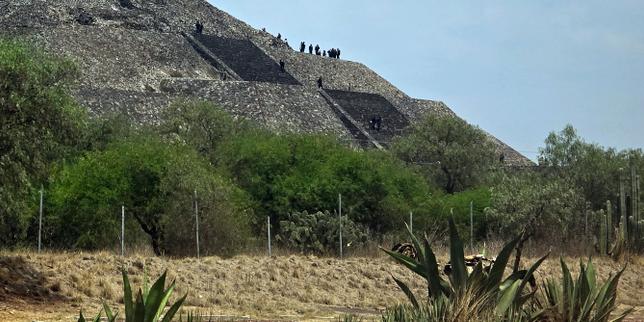
The fatal shooting of a Canadian national at the Teotihuacan archeological site represents more than a localized tragedy; it is a systemic failure in the Risk Mitigation Framework governing Mexico’s federally protected zones. When a high-profile tourist destination—under the jurisdiction of the National Institute of Anthropology and History (INAH) and federal security forces—becomes the site of a violent homicide, the incident exposes a critical breakdown in the Security-Tourism Nexus. This analysis deconstructs the incident through the lens of institutional liability, regional volatility, and the erosion of the "safe zone" status traditionally afforded to UNESCO World Heritage sites.
The Geography of Vulnerability: Teotihuacan as a Perimeter Failure
Teotihuacan serves as a primary economic engine for the State of Mexico, yet its physical layout creates a massive Security Surface Area that is difficult to monitor. The site spans approximately 21 square kilometers, with a "core zone" that attracts the highest density of foot traffic.
The security of such a site relies on three distinct layers:
- The Federal Perimeter: Controlled by INAH and the National Guard, focusing on gate access and monument preservation.
- The Informal Buffer: The surrounding municipalities (San Juan Teotihuacán and San Martín de las Pirámides) where local commerce and transit occur.
- The Intelligence Layer: The coordination between state police and federal agents to preempt spillover violence from nearby high-crime corridors.
The Canadian victim’s death occurred within this geography, signaling a breach where the External Volatility of the State of Mexico bypassed the site’s internal controls. The State of Mexico consistently ranks among the highest in the country for violent crime and extortion. When the "soft" security of an archeological park meets the "hard" reality of regional criminal enterprise, the result is a catastrophic failure of the Safe Passage Assumption that international travelers rely upon.
The Mechanics of Site Contamination
The infiltration of violence into a controlled archeological zone suggests a breakdown in Access Control Integrity. In high-risk environments, security is a function of "sterile" versus "non-sterile" zones. Teotihuacan, by design, is an open-air museum with multiple entry points, some official and many unofficial.
The transition of a site from a cultural landmark to a crime scene is driven by three primary variables:
- The Proximity Factor: Teotihuacan is situated near major logistics hubs and transit routes used by organized crime. The lack of a "dead zone" or buffer between the archeological site and high-crime residential areas allows for rapid ingress and egress of bad actors.
- The Resource Scarcity Model: Security personnel at INAH sites are often under-equipped and trained primarily for crowd management rather than tactical response. This creates a Force Imbalance when they encounter armed perpetrators.
- Institutional Inertia: The federal government’s reliance on the "reputational shield" of Teotihuacan—the belief that its global status makes it untouchable—has led to a degradation of active surveillance and physical barriers.
Quantifying the Economic Fallout: The Reputation Discount
For Mexico, the "cost" of a single high-profile foreign casualty is not measured in legal fees, but in the Reputation Discount applied to its tourism industry. Tourism accounts for nearly 8.5% of Mexico’s GDP. The State of Mexico, specifically, leverages Teotihuacan as its crown jewel for international visitors.
A violent incident involving a foreign national triggers an immediate shift in the Risk Assessment Algorithm used by travel insurers and foreign ministries. Canada, being a top-three source market for Mexican tourism, possesses a high sensitivity to safety alerts. The death of a citizen in a "Tier 1" cultural site moves the needle from "exercise caution" to "reconsider travel" for specific demographic segments. This results in a direct reduction in the Tourism Multiplier Effect, where the loss of one visitor impacts a chain of hotels, transportation providers, and local artisans.
The Conflict of Jurisdictions
The legal aftermath of a homicide at Teotihuacan is complicated by a Jurisdictional Knot. Because the site is federal property, the investigation falls under the Federal Attorney General’s Office (FGR), yet the surrounding territory is the responsibility of the State of Mexico’s prosecutor.
This creates a Communication Bottleneck:
- Evidence collection is slowed by federal-state friction.
- The "chain of custody" for security footage and witness statements often breaks during the hand-off between agencies.
- Accountability is diffused, as INAH blames local law enforcement for perimeter leaks, while local police blame federal authorities for inadequate internal policing.
This friction is a feature, not a bug, of the current security architecture. Without a Unified Command Structure, the response to violence is reactive rather than preventative.
The Crisis of the "Magical Town" Designation
Both San Juan Teotihuacán and San Martín de las Pirámides hold the "Pueblo Mágico" (Magical Town) designation. This branding is a federal marketing tool intended to signal safety, culture, and high-quality infrastructure. However, the disconnect between the "Magical" brand and the "Mortal" reality of regional crime rates is widening.
The presence of organized crime in the State of Mexico—specifically groups involved in fuel theft (huachicol), extortion, and drug trafficking—has historically avoided tourist zones to prevent high-level federal heat. The Canadian woman’s death indicates a shift in the Criminal Risk Tolerance. If criminal actors no longer perceive the "tourist zone" as a red line, the protective value of the Pueblo Mágico designation evaporates.
Operational Recommendations for Site Management
Addressing the security deficit at Teotihuacan requires a departure from passive observation toward a High-Density Monitoring Model.
The first priority is the implementation of Electronic Perimeter Hardening. Relying on physical walls is impossible given the scale of the ruins, but a network of thermal sensors and drone-based surveillance can provide real-time data on unauthorized entry. This must be coupled with an Armed Federal Presence that is not merely symbolic. The National Guard’s role must shift from static guarding to proactive patrolling of the "gray zones" between the monuments and the town limits.
The second priority is the Standardization of Emergency Response Protocols. At the time of the shooting, the delay between the event and the arrival of medical and forensic teams highlighted a lack of onsite trauma capabilities. Every major archeological site must maintain a Level 1 Trauma Unit and a direct line to federal air assets for medical evacuation.
The Strategic Outlook for International Visitors
The death of a Canadian national at Teotihuacan is a "black swan" event that reveals the fragility of the Mexican tourism model. For the traveler, the takeaway is the necessity of Personal Risk Decoupling. One can no longer assume that the "sanctity" of a UNESCO site provides an invisible shield against the surrounding regional volatility.
From a strategic standpoint, the Mexican government faces a binary choice: either militarize the tourist experience to ensure absolute safety or accept a permanent decline in high-value international foot traffic. The current "middle ground" of theater-style security and reliance on historical prestige has proven insufficient.
Future travelers and travel agencies must now integrate Sub-National Data into their planning. Viewing Mexico as a monolith is a strategic error; the risk profile of Teotihuacan is vastly different from that of Chichen Itza or Palenque, primarily due to the specific criminal ecosystem of the State of Mexico. The immediate requirement for the INAH and the Secretariat of Tourism is a transparent audit of site security and a public-facing plan for Perimeter Reclamation. Failure to do so will result in Teotihuacan becoming a case study in how a global landmark loses its viability through institutional neglect and the encroachment of regional lawlessness.


