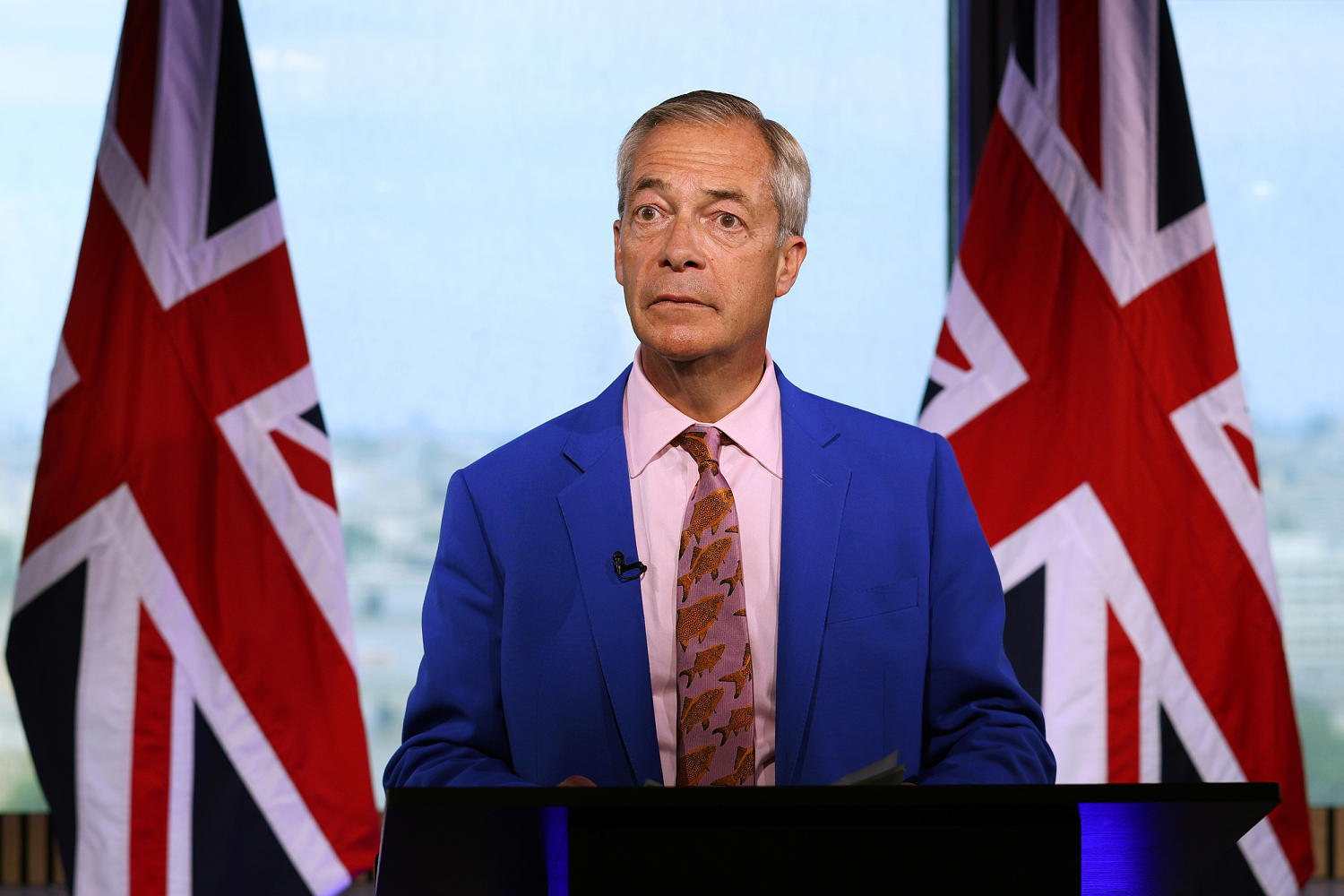
The rain in London doesn't just fall. It bleeds into the stone, turning the grand facades of Westminster into a slick, grey mirror. Inside those buildings, power is usually a quiet thing, traded in whispers over lukewarm tea or tucked away in the encrypted folds of a private message. But out on the cobblestones, under the harsh glare of television lights, power is a circus. And Nigel Farage has always been its ringmaster.
For decades, the formula worked perfectly. A pint of bitter in one hand, a cigarette in the other, and a carefully cultivated grin that signaled to millions of disillusioned voters that he was one of them. He was the outsider tossing bricks through the stained-glass windows of the establishment. Yet, the real world eventually catches up to the theater. When the spotlight shifts from ideological grandstanding to the cold, unyielding ink of a bank ledger, the performance changes.
The stage is now set for a different kind of gamble. Facing an onslaught of intense financial scrutiny, Farage has chosen to pull the emergency brake. By triggering a sudden, high-stakes vote, he isn't just seeking a political victory. He is hunting for absolution.
It is a classic maneuver from a playbook shared by his closest transatlantic allies. When the walls of institutional scrutiny begin to close in, you don't retreat. You don't file a quiet appeal. Instead, you drag the entire apparatus of democracy into the arena to serve as your personal shield.
The Accounting of an Anti-Establishment Icon
Consider the anatomy of a modern political crisis. To the casual observer, the headlines speak of compliance, disclosure forms, and the opaque flow of political funding. These words feel sterile. They belong in the dusty filing cabinets of regulatory bodies, far removed from the daily struggles of a factory worker in Clacton or a shopkeeper in Grimsby.
But abstract financial rules carry immense weight. To understand why a political figure would risk everything on a volatile vote, one must look at what happens when the carefully constructed image of a champion of the working class collides with the reality of high-net-worth political maneuvering.
For years, the narrative was simple. Farage was the man who spoke for the forgotten. He railed against globalist elites who treated countries like board games and citizens like statistics. This message resonated because the pain of the communities he targeted was entirely real. Decades of industrial decline had left deep scars across the British landscape. When someone stands up and points a finger at a visible enemy, people listen.
Then came the ledgers. Questions regarding the backing of his political operations, the exact nature of corporate sponsorships, and the financial architecture supporting his media appearances began to mount. Investigators started asking the kind of granular, tedious questions that cannot be answered with a witty slogan on a campaign bus.
Money leaves tracks. In politics, those tracks often lead to uncomfortable places. When an anti-establishment leader faces allegations of financial opacity, it threatens the very foundation of their authority. The moment the crowd suspects the populist is playing by the exact same rules as the elites they despise, the magic spell breaks.
The Mechanics of the Diversion
Faced with this vulnerability, a decision had to be made. A conventional politician might hire a team of forensic accountants, issue a dense, fifty-page statement full of legal jargon, and wait for the news cycle to move on.
Farage understood that silence is fatal.
Instead of playing defense on the terrain of facts and figures, he chose to rewrite the rules of engagement. Triggering a vote is an act of political theater designed to shift the battleground entirely. It transforms a complex, dry argument about financial regulations into a binary emotional conflict. It is no longer about spreadsheets. It is about loyalty.
Imagine a crowded courtroom where a man is accused of a highly technical financial crime. Instead of addressing the evidence, the defendant turns to the gallery, points out the window at an angry mob, and demands that the crowd decide his guilt by a show of hands. The truth of the accounting becomes secondary to the volume of the cheers.
This tactic relies on a profound psychological truth. People hate being confused, but they love being validated. By framing the financial scrutiny not as a legitimate legal inquiry but as a coordinated hit job by a panicked establishment, the narrative changes instantly. The politician is no longer an individual answering for his private finances. He becomes a proxy for the voters themselves. An attack on him is reframed as an attack on everyone who ever believed in him.
The Shadow of Mar-a-Lago
This strategy was not invented in a vacuum. It has been perfected across the Atlantic, polished to a mirror sheen by Donald Trump. The bond between Farage and the former American president is well-documented, built on mutual admiration and a shared instinct for the vulnerabilities of modern media ecosystems.
The American playbook is clear. Every indictment, every investigation, and every courtroom appearance is systematically converted into a fundraising opportunity and a rallying cry. The legal system is portrayed as a weaponized tool of a corrupt regime. This approach is incredibly effective at consolidating a base of fiercely loyal supporters.
Now, that same operational philosophy is being deployed in the United Kingdom. By forcing a vote, Farage is testing whether the British electorate has the same appetite for perpetual grievance as the American populist movement.
But the British political ecosystem possesses its own unique friction. The parliamentary system, the strict laws governing campaign finance, and a deeply cynical public press mean that tactics cannot simply be copied and pasted from the American context. What plays well at a rally in Florida can fall flat in a rainy community center in Essex.
The stakes of this test extend far beyond the political survival of a single leader. If a politician can successfully use a public vote to wash away serious, unresolved questions about financial propriety, it sets a profound precedent. It signals that popularity is the ultimate get-out-of-jail-free card. It suggests that if you can command enough noise, the rules simply do not apply to you.
The Invisible Cost to the Commons
Behind the drama of the speeches and the frantic cable news commentary lies a quiet, corrosive reality. Every time democracy is used as a personal cleansing ritual for a political figure, the institutions themselves grow a little weaker.
Trust is a finite resource. It is not built on grand declarations, but on the boring, predictable functioning of rules. It relies on the shared understanding that regardless of how many people vote for you, or how loud your supporters shout, you must still fill out the same forms and answer the same questions as everyone else.
When that understanding is shattered, the damage is incredibly difficult to repair. The average citizen, watching this spectacle unfold, is left with a deep, systemic cynicism. They see a system where the powerful can trigger national conversations simply to clear their own names, while ordinary people face the unrelenting bureaucracy of the state for the minor errors of daily life.
This is the true danger of the current moment. The narrative is being sold as a fight for truth and vindication. But underneath the flags and the rhetoric, it is an exercise in distraction. The longer the public gazes at the spectacle of the vote, the less they look at the substance of the scrutiny.
The coming days will reveal whether this gamble pays off. The ballots will be counted, the percentages will be parsed, and commentators will declare a winner and a loser. But the real outcome has already been determined. By turning a question of financial accountability into a referendum on personal identity, the ringmaster has successfully ensured that the circus remains the only show in town.