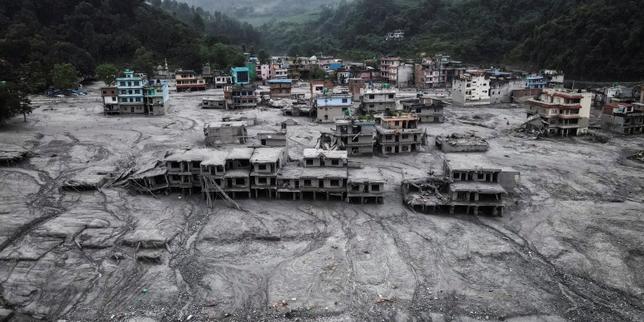
High-altitude cryospheric systems operate under precise equilibrium thresholds. When atmospheric warming forces a systemic shift in these thresholds, structural degradation follows a predictable mechanical sequence. The catastrophic collapse of the Langtang Lirung sector along the Nepal-Tibet border demonstrates how thermal anomalies translate directly into mechanical failure across high-mountain permafrost and glacial architecture. Deconstructing this event requires analyzing the thermal forcing, the failure of cryogenic binding agents, and the hydrodynamic amplification that turns localized ice shedding into regional flash flooding.
The Thermal Forcing Function
The baseline condition of high-mountain regions has shifted significantly. In the specific sector where the collapse originated, ambient warming trends register roughly two degrees Celsius above pre-industrial averages, with mid-summer deviations touching even sharper spikes. This atmospheric input does not merely melt surface ice; it alters the internal thermal profile of rock walls and hanging glaciers. Learn more on a connected topic: this related article.
Permafrost acts as the primary cryogenic cement of high-altitude rock and ice slopes. As subsurface temperatures cross the zero-degree threshold, ice lenses within jointed rock and moraine walls undergo phase change. Liquid water generation introduces pore water pressure, lubrication, and volumetric contraction where ice once provided structural shear resistance. The energy balance shifts from stable energy retention to continuous thermal degradation, priming steep topography for gravitational failure.
The Mechanics of Cryospheric Uncoupling
A hanging glacier or steep ice-rock slope is essentially a continuous slope system resting on a frictional and cohesive base. Two primary variables dictate its stability: shear stress driven by gravity and shear strength maintained by friction and ice-rock bonding. Further reporting by Associated Press delves into related perspectives on the subject.
Thermal infiltration attacks the shear strength vector through three distinct physical processes:
- Latent heat transfer thwarts internal refreezing, maintaining a continuous network of liquid water pathways through fractures.
- Hydrostatic pressure builds within rock joints as meltwater fills vertical crevices, creating outward tensile forces that exceed the tensile strength of granite and metamorphic rock formations.
- The reduction of apparent cohesion along the glacier-bedrock interface allows micro-slips to aggregate into macro-scale structural displacement.
Prior seismic events, such as the major tectonic shifts recorded in the region, left structural legacy fractures throughout the local geology. While these faults did not immediately trigger failure, they established a network of structural weaknesses. Continuous thermal loading over subsequent years expanded these fracture apertures, lowering the threshold of energy required to dislodge millions of cubic meters of mass.
Hydrodynamic Amplification and Downstream Delivery
The initial mechanical failure—involving hundreds of thousands of square meters of ice, rock, and debris—displaced air and kinetic energy violently down the vertical gradient. Upon impact, the solid-phase mass converted potential energy into kinetic force, shattering structural ice into a dynamic slurry.
This kinetic avalanche intercepted seasonal and anomalous snowpack accumulations retained from previous weather cycles. The rapid incorporation of this water-rich snow transformed a dry rock-ice avalanche into a high-density debris flow. As the slurry entered confined river gorges like the Bhote Koshi basin, it achieved a high-velocity hydrodynamic surge. The volume expanded exponentially as it eroded riverbanks, entrained sediment, and incorporated infrastructure assets, turning a localized cryospheric detachment into a widespread hydraulic catastrophe.
Predictive Limitations and Operational Monitoring
Current remote sensing and seismic sensor arrays provide early indication of surface movement, but predicting exact failure timing remains technically constrained. High-altitude environments present extreme logistical hurdles for continuous, dense instrumentation. Seismic monitoring can capture mass movement once detachment occurs, but the pre-failure creep phase in complex rock-ice mixtures often exhibits non-linear acceleration signatures that evade standard threshold models.
Infrastructure resilience in these topography-driven corridors must account for baseline shifts in cryospheric stability. Engineering frameworks predicated on historical flood frequencies or traditional meteorological norms are systematically obsolete when the structural integrity of entire mountain ranges is actively degrading.
The video above details the geological mechanics and physical factors involved in high-altitude glacial and slope failures.