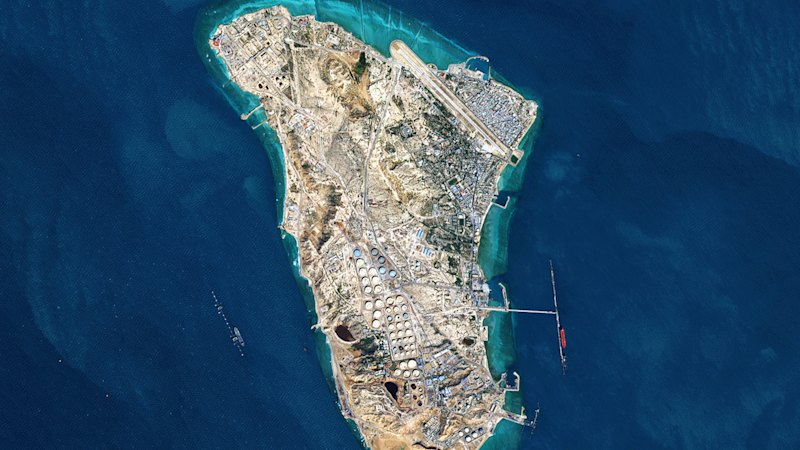
Geography is a stubborn thing. It doesn’t care about clever headlines or the desperate desire for a "silver bullet" solution to the Middle East. Lately, a specific brand of armchair generalship has resurfaced, suggesting that a small patch of land—likely Great Tunb, Abu Musa, or even the logistical hub of Socotra—could be the magic key to checkmating Iran without putting boots on the ground.
It is a seductive narrative. It promises maximum leverage for minimum blood. It suggests that if we just park enough sensors, drones, and missile batteries on a strategic rock, we can "shut down" the Persian Gulf at will.
It’s also dangerously wrong.
The belief that localized maritime dominance equals regional victory ignores the reality of 21st-century asymmetric warfare. If you think an island is a fortress, you haven't been paying attention to how easily a fortress becomes a target.
The Myth of the Unsinkable Aircraft Carrier
The term "unsinkable aircraft carrier" is a relic of World War II thinking that has no place in a world of hypersonic missiles and swarming suicide drones. When analysts point to small islands in the Strait of Hormuz or the Arabian Sea as "game-winning" assets, they forget a fundamental rule of modern combat: fixed positions are vulnerabilities, not just vantage points.
An island cannot maneuver. It cannot "steer" away from an incoming ballistic trajectory. While a Carrier Strike Group uses speed and ocean room to complicate an enemy’s targeting logic, an island is a sitting duck with a permanent GPS coordinate.
If the U.S. or its allies heavily fortify a small island to "beat Iran," they aren't creating a stalemate. They are creating a magnet for every short-range rocket in the Iranian IRGC arsenal. We’ve seen this play out in the Red Sea with the Houthis. If a non-state actor with a fraction of Iran's industrial capacity can harass global shipping despite a massive multinational naval presence, thinking a single island will cow Tehran is pure fantasy.
The Logistics of a Death Trap
Let’s talk about the "battle scars" of logistics. I have seen operations stall not because of a lack of firepower, but because of a lack of fresh water and spare parts.
Small islands are logistical nightmares. Every gallon of fuel, every battery for a drone, and every meal for a technician must be shipped in. This creates a "long pole" in the tent that is incredibly easy to snap.
- The Resupply Bottleneck: To keep an island operational under duress, you need a constant stream of transport aircraft or cargo ships. Iran doesn't need to sink the island; they just need to sink the barge bringing the air-conditioning parts.
- The Sensor Blind Spot: High-tech sensors are fragile. Salt spray, extreme heat, and sand are more effective at degrading capability than a direct hit. Maintaining "total domain awareness" from a remote rock requires a footprint that eventually becomes too large to hide and too expensive to defend.
- The Proximity Paradox: The closer you are to the target, the less time you have to react. An island in the Strait of Hormuz is within "dumb" artillery range. You don't use a million-dollar drone to take out a billion-dollar sensor array when a hundred-dollar mortar shell can do the job.
The Drone Swarm vs. The High-Value Target
The "tiny island" strategy relies on the idea that high-tech American systems—Terminal High Altitude Area Defense (THAAD) or Patriot batteries—will provide an impenetrable shield.
This ignores the math of attrition.
Iran has spent decades perfecting the art of the swarm. They don't send one sophisticated missile; they send fifty cheap ones. They send a hundred Shahed drones. The cost-to-kill ratio is catastrophically tilted against the defender. If you are on an island, you are trapped in a cage match where the opponent has an infinite supply of rocks and you have a limited supply of very expensive glass shields.
Why "No Soldiers" is a Lie
The headline promised a win "without sending a single soldier." This is the most dishonest part of the "island strategy."
Who maintains the launchers? Who interprets the SIGINT (Signals Intelligence)? Who guards the perimeter against frogmen or SBS-style raids? Even "unmanned" outposts require rapid-response teams nearby. In reality, fortifying these islands would require thousands of support personnel, contractors, and security forces. It turns a "diplomatic asset" into a hostage situation. The moment the first missile hits that island, the political pressure to escalate becomes unbearable. You haven't avoided a war; you've just provided the sparking plug for one.
The Real Leverage: Economic, Not Geographic
If you want to neutralize Iranian influence without a ground war, you stop looking at maps of the Persian Gulf and start looking at maps of global energy infrastructure.
The "lazy consensus" says we must control the water to control the flow. The reality is that the world is already moving toward bypassing these chokepoints.
- The East-West Pipeline: Saudi Arabia has already invested in moving oil to the Red Sea, bypassing Hormuz entirely.
- The UAE’s Habshan–Fujairah Pipeline: This allows for the export of crude directly to the Gulf of Oman.
The obsession with a "tiny island" is a distraction from the actual shift in power. Strategic relevance is moving away from the "gates" of the Gulf and toward the deep-water ports that sit outside of Iran’s immediate "anti-access/area denial" (A2/AD) bubble.
The Hidden Cost of "Winning"
Let’s assume the strategy works for a month. You’ve "beaten" Iran by blockading them from a rock in the ocean. What happens to global markets?
The mere presence of a contested, militarized island in a shipping lane drives insurance premiums through the roof. It turns the Persian Gulf into a "war risk" zone. You might "win" the tactical exchange, but you lose the economic war when the price of Brent crude spikes to $150 because a nervous 19-year-old on that island fired a warning shot at a dhow.
We need to stop looking for "one weird trick" to solve 2,000 years of Persian-Arab-Western tension. There is no island small enough to be cheap and big enough to be decisive.
The Actionable Truth
If the goal is truly to manage Iran without a massive troop surge, the answer isn't a new base. It’s a decentralized maritime network.
Instead of one "tiny island" with a massive target on it, the future of regional security lies in thousands of low-cost, disposable autonomous surface vessels (USVs) scattered across the ocean. You don't build a fortress; you build a mist. You create a sensing web that is too distributed to be destroyed by a missile strike.
Stop trying to find a rock to stand on. Start building a network that doesn't need a floor.
The era of the strategic island ended the moment the first precision-guided drone took flight. Anyone telling you otherwise is selling a map from 1944.
Build the network or prepare to lose the fortress.