Thirteen years is enough time to raise a child from a wobbly toddler into a moody teenager. It is enough time for governments to rise, collapse, and rewrite the maps of regional infrastructure. It is also, if you happen to possess a stubborn heart and a garage in regional Australia, the exact amount of time required to shrink 315 kilometres of steel, timber, and ironstone dust down to the size of a few folding tables.
Pause. Look at that number again. Three hundred and fifteen kilometres.
In the flat, sun-bleached expanses of the Australian interior, 315 kilometres is not a mere commute; it is an epic, a test of endurance where the horizon refuses to budge and the heat shimmers off the ballast like liquid glass. For decades, branch lines stretching across that kind of distance were the circulatory system of the bush. They carried wool clips, wheat harvests, mailbags, and nervous teenagers heading to the city for the first time. Then came the rationalists with their spreadsheets, the rise of road freight, and the quiet, bureaucratic death of the rural railway. Tracks were pulled up. Stations were boarded over. Weeds split the sleepers.
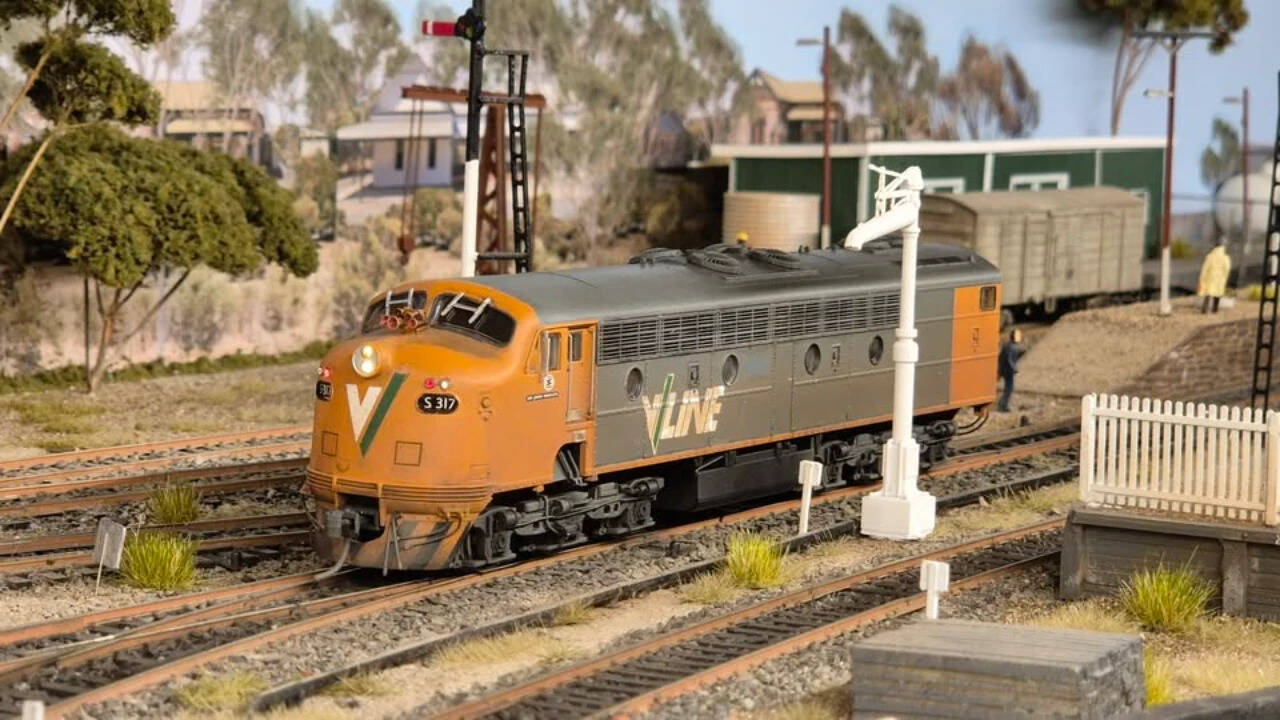
Most people watched the trains vanish, sighed into their tea, and moved on. One Australian railway enthusiast decided instead to become a cartographer of memory. Over thirteen years, armed with magnifying glasses, archival timetables, tins of matte enamel paint, and an almost terrifying patience, he built a miniature replica of a 315-kilometre railway route.
To dismiss this as a mere hobby—a quaint pastime for someone with too much spare time—is to miss the entire point of why human beings build worlds in miniature. When the real world erases the places that shaped us, building a smaller version is not an act of retreat. It is an act of defiance.
The Architecture of Obsession
Walk into the workshop of any serious railway modeller, and the first thing that hits you is not the sight of the trains, but the smell. It is a specific alchemy of soldering flux, static grass adhesive, cedar sawdust, and ozone from low-voltage transformers. It smells like creation on a micro-scale.
I have spent years reporting on heritage preservation and watching obsessive builders at work, and I will tell you a secret that casual observers never grasp: the trains are the easy part. You can buy a brass locomotive or a plastic carriage off a shelf, weather it with a bit of chalk dust, and put it on the track. The real agony—the reason a project stretches across thirteen calendar years—lies in the negative space between the stations.
Consider what 315 kilometres actually looks like in Australia. It is not a continuous string of charming Alpine villages. It is vast stretches of scrubland, dry creek beds, rusted corrugated-iron grain silos, and lonely level crossings where a dirt road meets two strips of steel in the middle of nowhere. If you compress 315 kilometres into a room, how do you preserve the feeling of distance without boring the viewer to tears?
This is the central puzzle of selective compression, a technique every scale builder has to master. Imagine trying to film a three-hour road trip across the Nullarbor Plain and edit it down to four minutes while still making the audience feel the crushing weight of the isolation. You cannot show every fence post. Instead, you have to choose the exact right fence post—the one leaning at twelve degrees with a wedge-tailed eagle perched on top—and place it so that the human brain fills in the missing miles.
To pull this off across a 315-kilometre route, our builder couldn't rely on guesswork. He had to become a forensic historian. That meant tracking down faded black-and-white photographs from local historical societies, reading old railway gazettes to find out what color the stationmaster’s office was painted in 1964, and studying topographical maps so the gradient of a miniature hill matched the exact incline where real steam locomotives once struggled for traction.
A Hypothetical Afternoon at the Workbench
To understand the sheer psychological weight of a thirteen-year build, let us step into a hypothetical scenario. Picture a Tuesday evening in year seven of the project. Outside, a winter gale is rattling the tin roof of the shed. Inside, under a harsh fluorescent tube, sits a section of plaster hillside measuring barely two feet wide.
In reality, this two-foot stretch represents a rocky cutting forty kilometres outside a regional town—a place where three generations of fettlers once swung pickaxes in forty-degree heat to carve a path for the iron horse. On the workbench sits a tiny, unpainted plastic figure, smaller than a fingernail, alongside a pot of khaki paint and a brush with three bristles left.
Why spend forty-five minutes painting the creases on a miniature railway worker’s trousers that nobody standing three feet away will ever notice?
Because the builder knows it is there. If you cut corners on the things nobody sees, the whole illusion rots from the inside out. One sloppy tree leads to a poorly laid turnout; a poorly laid turnout causes a derailment; a derailment shatters the spell. Perfectionism in miniature is not vanity. It is structural integrity.
Think about the sheer volume of micro-decisions buried inside thirteen years of labor:
- Track geometry: Hand-laying thousands of individual timber sleepers and spiking down nickel-silver rail so that a scale carriage glides over a bridge joint with the exact rhythmic clack-clack of the prototype.
- Botanical accuracy: Mixing different shades of flock and static grass to capture the exact, desaturated olive-green of eucalyptus leaves rather than the lush, emerald green of an English meadow.
- Atmospheric weathering: Mist-spraying thinned earth tones along the lower flanks of freight wagons to mimic the red bull-dust kicked up by summer winds.
Each task takes hours. Multiply those hours by weekends, public holidays, and late nights after the rest of the household has gone to bed, and thirteen years stops sounding like an eternity. It starts sounding like barely enough time to get the signals wired properly.
Why Scale Models Capture What Museums Miss
There is a legitimate question lurking behind every massive scale project, and it is worth asking honestly: why not just read a book about the railway, or visit a static museum where a real, full-sized locomotive sits behind a velvet rope?
Museums are wonderful, necessary institutions, yet they suffer from a fatal flaw. They preserve the artifact, but they amputate the context. When you stand next to a preserved steam engine inside a brick hall, you can admire the rivets and smell the cold grease, but you cannot see how that machine belonged to the land. You cannot see it threading through a gorge, or pausing beside a wooden water tank while a farmhand loads crates of cream onto the guard’s van.
A full-sized locomotive in a museum is a stuffed animal in a glass case. A 315-kilometre route rebuilt in miniature is an ecosystem brought back to life.
When you watch a scale train wind its way around a curve, disappear behind a ridge of plaster rocks, and emerge thirty seconds later crossing a timber trestle bridge, something shifts in your perception. Your brain stops measuring things in millimetres and starts registering scale miles. You begin to understand the economics of the region—why a siding was built right next to that particular creek, why the gradient forced the railway engineers to loop the track three times around a hill, and why the town grew on the western side of the line instead of the east.
It is the difference between reading a musical score and hearing a symphony orchestra play it in a wooden hall. The facts are identical, yet the emotional transmission is entirely different.
The Invisible Stakes of Regional Memory
We live in an era obsessed with speed, ephemerality, and digital abstraction. Entire industries vanish overnight; towns lose their post offices, their banks, and their railway stations in a single decade of cost-cutting. When physical infrastructure disappears, local memory quickly follows. A child growing up in a regional Australian town today might walk past a raised earthen embankment covered in weeds and have no idea that, within living memory, that mound of dirt was the lifeline connecting their community to the rest of the world.
This is where the work of an obsessive railway modeller crosses the line from private eccentricity into public service.
Consider the sheer vulnerability of committing thirteen years to a single creative vision. There is no venture capital backing a garage railway. Nobody hands out grants for hand-soldering brass semaphore signals at midnight. During those thirteen years, life happens—backs ache, eyes grow tired, tools break, and moments of profound doubt creep in. Any artist who has ever stared at an unfinished canvas or a half-written manuscript knows the particular terror of the middle years, when the initial excitement has evaporated and the finish line is still years away.
Yet he kept going. Piece by piece, baseboard by baseboard, the 315 kilometres took shape.
In doing so, he achieved something that urban planners and heritage committees rarely manage: he made history tactile. When visitors—especially older locals who rode those trains as schoolchildren—lean over the edge of the layout, they do not react with polite academic interest. They point. They lean in closer. They say, "That’s the crossing where my grandfather used to wait with the milk cans," or "Look at the pub opposite the station—the verandah leaned just like that."
In that moment, the miniature stops being small. It becomes enormous, carrying the full weight of a community’s lived past.
The Slow Rebellion
There is an unmistakable counter-cultural rebellion baked into spending thirteen years building anything by hand. Our modern economy trains us to crave instant gratification—two-day shipping, ten-second video clips, quarterly returns, and disposable appliances designed to fail after twenty-four months. Patience has become an endangered trait, almost an act of madness.
To look at a 315-kilometre railway reduced to scale over thirteen years is to confront a completely different philosophy of time. It is a reminder that deep mastery cannot be downloaded, rushed, or automated. Some things only reveal their beauty when you give them a decade of your life and refuse to hurry.
Eventually, the final section of scenery dries. The last tiny telegraph pole is planted beside the right-of-way, strung with gossamer thread that catches the overhead light just like copper wire in the late afternoon sun. The controller knob clicks forward. A faint hum rises from the rails, followed by the soft, rhythmic click of steel wheels rolling across joints spaced to mimic 315 kilometres of Australian heartland—proof that nothing is truly gone as long as someone cares enough to rebuild it, one millimetre at a time.