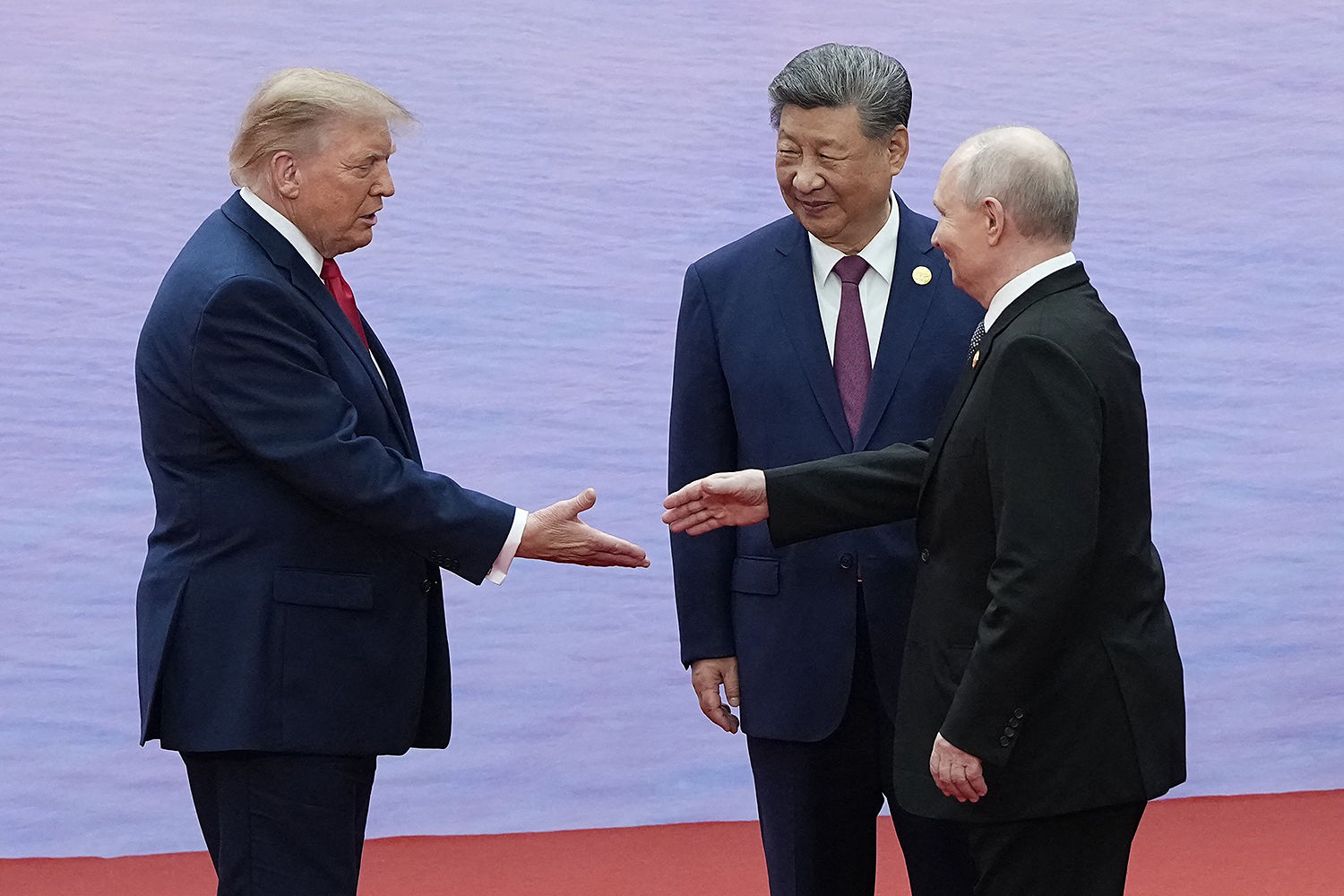
At four in the morning in a port city six thousand miles from any diplomatic briefing room, a freight dispatcher named Tomas stares at a glowing column of shipping manifests. He is not a diplomat. He has never shaken hands with Donald Trump, Xi Jinping, or Vladimir Putin. Yet when those three men sit down across from one another in a high-stakes summit, the air pressure in Tomas’s tiny glass office changes before the ink on any communique has dried.
Silence.
That is what precedes the shift. Before the cable news tickers turn red, before the currency traders in London and Singapore start hammering their keyboards, there is a strange, breathless pause across the supply lines of the world. Containers sit unbooked on docks in Rotterdam and Busan. Grain buyers in Cairo hold their bids. Energy brokers in Houston hover over screens, waiting to see whether a handshake in a distant capital will make a barrel of crude ten dollars cheaper or thirty dollars more expensive by Tuesday morning.
We tend to read about summits between the leaders of the United States, China, and Russia as if they were episodes of prestige television—a clash of outsized personalities, choreographed motorcades, and carefully leaked talking points. The headlines reduce the entire spectacle to winners, losers, and body language. Who blinked first? Who stood taller on the red carpet? Who walked out of the bilateral pull-aside looking grim?
But if you have ever watched a family business go under because a tariff jumped twenty percent overnight, or stood in a grocery aisle wondering why cooking oil doubled in price over a single winter, you know the truth. Summits are not theater. They are weather systems. And right now, the barometers across three continents are dropping fast.
The Architecture of a Three-Cornered Room
To understand why the world is holding its breath as Trump, Xi, and Putin prepare to meet, you have to stop thinking about diplomacy as a straight line between two rivals. A two-person negotiation is a tug-of-war; you pull, the other side pulls, and everyone in the crowd can see where the rope is moving.
A three-way dynamic is something else entirely. Think of it as three people standing on a floating wooden raft in open water. Every time one man shifts his weight to gain leverage over a second, the entire platform tilts beneath the third. Nobody can make a purely private move. Every whisper in one corner sends ripples across the whole surface.
Consider a hypothetical scenario—call it a composite of what happens behind closed doors when these three powers collide. Imagine the summit table not as a grand mahogany conference room, but as three separate agendas stacked on top of one another like fault lines.
In one chair sits Donald Trump, returning to the highest-stakes diplomatic arena with a transactional worldview sharpened by years of tariff battles and populist skepticism toward traditional alliances. His calculus is immediate, visible, and fiercely domestic. He wants wins he can point to before a crowd—factory orders coming back to the American Midwest, European allies paying more for their own defense, a rapid end to prolonged foreign entanglements that drain American treasuries, and hard concessions on trade imbalances that have hollowed out industrial towns from Ohio to Pennsylvania. To Trump, leverage is meant to be used openly, loudly, and right now.
Across from him sits Xi Jinping, a leader who measures time not in election cycles or news quarters, but in decades and dynasties. Xi arrives at the table carrying the weight of an economy caught between two eras—an aging manufacturing powerhouse trying to reinvent itself through green technology, artificial intelligence, and domestic consumption while grappling with a bruised property sector and youth unemployment. For Xi, stability is oxygen. He needs predictable access to global markets, relief from semiconductor export controls that choke China’s tech ambitions, and quiet assurance that Washington will not turn strategic competition into an outright economic blockade or an escalation over Taiwan.
And in the third chair sits Vladimir Putin, hardened by years of grinding war in Ukraine, sweeping Western sanctions, and the steady reorientation of Russia’s economy toward Eurasia. Putin does not come looking for a return to the pre-2022 world; he knows that door is welded shut. He comes seeking recognition of a new security reality on Russia’s western borders, relief from financial isolation, and the preservation of his deepening partnership with Beijing without becoming wholly subordinate to it.
Put those three sets of desires in the same room, and you immediately feel the friction. What Trump wants to resolve quickly, Xi prefers to manage slowly. What Putin demands as a non-negotiable security guarantee, Washington views as a dangerous precedent. What Xi needs in open trade corridors, Trump treats as a bargaining chip.
What History Whispers When Giants Meet
I remember sitting in a cramped newsroom during a previous round of major superpower talks, watching raw satellite feeds come in without commentary. What struck me then—and still stays with me whenever another summit approaches—was not the grandeur of the setting, but the sheer fragility of the human beings inside it. Behind the flags and the interpreters, major geopolitical shifts often hinge on exhaustion, misread tone, or a single unscripted remark over dinner.
History backs up that unease. In 1945, when Franklin Roosevelt, Winston Churchill, and Joseph Stalin met at Yalta, the maps they redrew over eight days determined where millions of ordinary people could live, worship, or travel for the next forty-five years. Most of those people never knew the names of the aides drafting the communiques in the Livadia Palace. They only knew that one morning, a border checkpoint stood at the end of their street where none had existed the week before.
Decades later, in 1972, Richard Nixon’s trip to Beijing altered the geometry of the Cold War overnight, splitting Moscow and Beijing and setting off a chain reaction that eventually turned southern China into the workshop of the world. Again, the immediate public statements were guarded, diplomatic, almost bland. The real earthquake happened beneath the surface, in the quiet realignment of trade, intelligence, and capital.
Today’s stakes carry that same subterranean force, complicated by a world far more tightly wired together than anything Nixon or Stalin ever navigated. In 1945, economies were largely walled off from one another. Today, a semiconductor designed in California is etched with Dutch machinery in Taiwan, packaged in Malaysia, and installed in a phone assembled in Shenzhen before shipping on a vessel insured in London and fueled by crude refined from Russian or Middle Eastern oil.
You cannot pull one thread from that weave without feeling the tug everywhere else.
The Invisible Ledger of Everyday Life
When pundits discuss why this summit matters, they usually reach for abstractions: multipolarity, strategic deterrence, spheres of influence, balance of power. Those words are accurate, and they are also anesthetizing. They make monumental risks sound like moves on a graduate-school chalkboard.
Let us translate those abstractions into the currency ordinary people actually spend.
First, there is the price of making and moving things. If Washington and Beijing use this meeting to establish even a fragile truce on tariffs and technology restrictions, manufacturers from Detroit to Munich can plan capital investments without fearing that their supply chains will be outlawed next quarter. If the talks sour into a fresh spiral of retaliatory duties, the cost does not stay locked in customs ledgers. It shows up in the sticker price of a family car, the cost of replacing a broken refrigerator, and the profit margins of a mid-sized soy farmer in Iowa whose harvest suddenly sits unsold in a grain elevator.
Second, there is the cost of keeping the lights on. Russia remains one of the world’s largest producers of oil, natural gas, fertilizer, and enriched uranium. China is the world’s largest importer of energy and the dominant refiner of critical minerals needed for batteries and power grids. The United States is the world’s top producer of oil and liquefied natural gas. When these three leaders discuss sanctions, energy caps, or ceasefire frameworks in Eastern Europe, they are effectively setting the floor and ceiling for global heating bills, airline fuel surcharges, and agricultural fertilizer costs across the developing world.
Third, and hardest to quantify, is the tax of uncertainty. Ask any small business owner, hospital administrator, or local mayor what hurts them most, and they will rarely say a known tax rate. They will say not knowing what the rules will be six months from now. Prolonged friction between Washington, Beijing, and Moscow forces governments everywhere to divert billions of dollars away from schools, bridges, and clinics and into defense budgets, redundant factories, and emergency stockpiles. Every dollar spent duplicating a supply chain out of fear is a dollar not spent curing a disease or building a home.
Why People Ask If This Meeting Can Actually Change Anything
Whenever a summit of this magnitude is announced, two opposing myths immediately take over the conversation. The first myth is naive optimism—the belief that three strong-willed leaders can lock themselves in a room for forty-eight hours and emerge with a grand bargain that solves every global crisis at once. The second myth is total cynicism—the assumption that the entire event is a hollow photo opportunity destined to produce nothing more than vague promises and broken commitments.
Both views miss how real diplomacy works.
Can one summit end entrenched wars, erase decades of mutual suspicion, or resolve fundamental clashes over trade and sovereignty? No. Anyone promising an instant, permanent settlement is selling fiction. The structural rivalries between the United States, China, and Russia run too deep—rooted in geography, political systems, and competing visions of international order—to vanish over a single weekend.
Yet dismissing the meeting as meaningless is equally dangerous. In high-stakes statecraft, the alternative to talking is not peace; it is guessing. And guessing with nuclear-armed states is how miscalculations turn into catastrophes.
Consider what happens when leaders stop speaking directly. Lower-level officials become terrified of showing flexibility, so they repeat rigid talking points. Military commanders on patrol in the South China Sea, the Black Sea, or the skies over the Baltic interpret every ambiguous radar blip through the lens of worst-case assumptions. Rumors replace intelligence. Pride replaces pragmatism.
Even a limited outcome from this summit—a direct hotline restored between military commands, a framework for de-escalating a regional conflict, an agreement to keep certain vital goods exempt from trade hostilities, or simply a clear understanding of where each side’s true red lines lie—changes the trajectory of the months that follow. Sometimes the greatest achievement of a summit is not the treaty signed at the podium, but the crisis that never happens six weeks later because two leaders heard the warning in each other’s voice firsthand.
The Vulnerability Behind the Podiums
It is easy to look at the portraits of Trump, Xi, and Putin and see only projection—strength, certainty, control. That is what state media and campaign teams are paid to manufacture.
Look closer, though, and you see three leaders navigating acute vulnerabilities at home.
In the United States, voters are weary of endless foreign crises and unforgiving of inflation. A leader who promises strength abroad must also deliver tangible relief at home, walking a tightrope between asserting American power and avoiding new economic shocks that punish consumers at the checkout counter.
In China, the social contract of the past forty years—quiet political compliance in exchange for relentlessly rising living standards—is being tested by slower growth, demographic decline, and local government debt. Beijing cannot afford a full-scale economic rupture with the West, even as it refuses to appear weak before its own nationalist public.
In Russia, years of wartime mobilization have reshaped the economy around military production while draining labor from civilian industries and straining long-term fiscal health. Sustaining confrontation indefinitely carries steep internal costs that no amount of state television can permanently mask.
Those domestic pressures are the hidden fourth presence at the table. None of these men is negotiating in a vacuum. Each is looking over his shoulder at the expectations, anxieties, and limits of his own population. That mutual vulnerability is frightening, because cornered leaders can act unpredictably. Yet it is also the only reason serious compromise ever becomes possible. Nobody makes a hard concession because they feel generous; they make it because the cost of walking away has grown heavier than the price of staying in the room.
Watching the Unscripted Moments
If you want to know what actually happens when the summit begins, ignore the first wave of triumphant spin from every capital. Every delegation has a press team whose job is to declare victory before the planes have even taxied down the runway.
Instead, watch the quiet signals in the days immediately afterward.
Watch whether trade negotiators schedule follow-up working sessions rather than canceling them. Watch whether shipping insurance rates in contested waters tick down by half a percentage point. Watch whether diplomatic language shifts from ideological condemnation to technical details—customs codes, verification mechanisms, phased timelines. Technical language is the telltale sign that adults are actually trying to build something rather than score points.
And think back to Tomas, the freight dispatcher staring at his manifests at four in the morning.
In a few days, the motorcades will disperse. The flags will be folded into velvet cases, the translators will finally get some sleep, and the pundits will move on to the next news cycle. Out on the water, though, thousands of steel hulls will keep cutting through the dark, carrying grain, microchips, medicine, and fuel from one hemisphere to another. Whether those ships arrive on time, and whether the families waiting at the end of the line can afford what is inside them, depends on whether three men in a quiet room remembered that the lines on their maps are drawn across real lives.