Jolt.
That is all it takes to remind four million people that they live on a restless skin of broken rock.
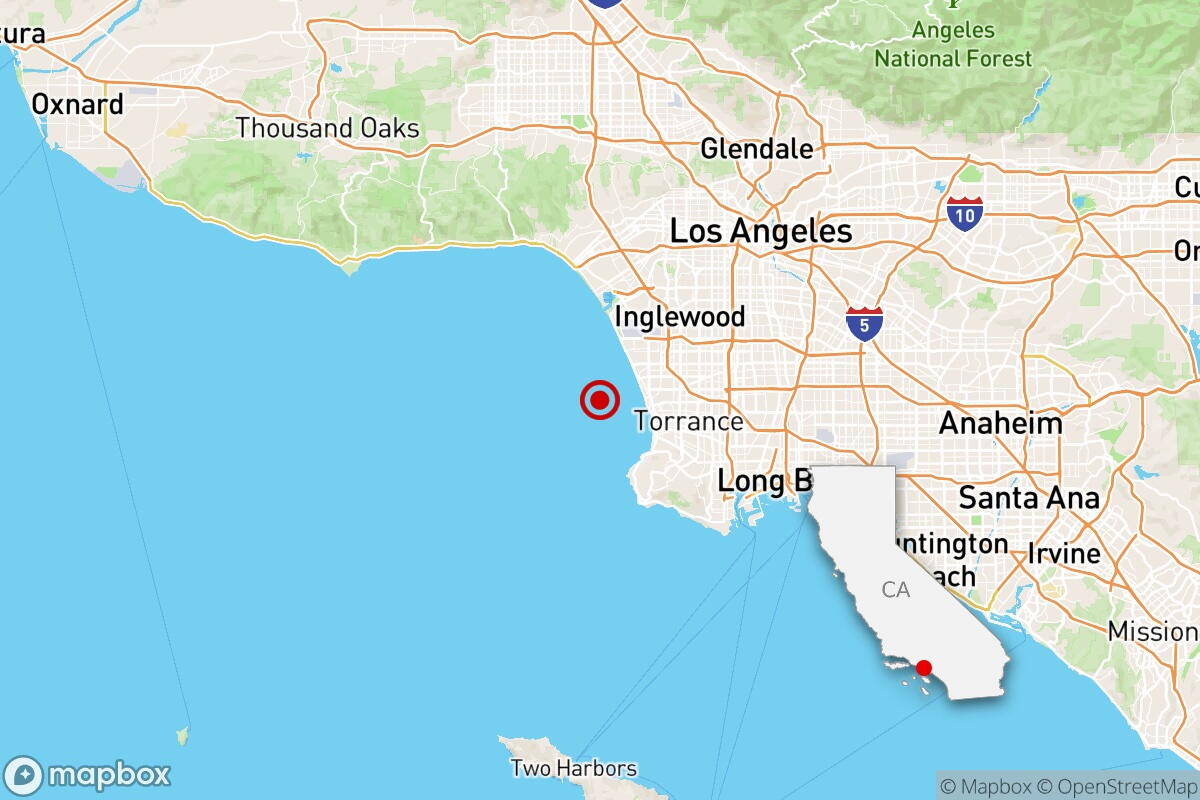
In El Segundo, a coastal industrial hub wedged between the roaring runways of Los Angeles International Airport and the gray swell of the Pacific Ocean, a magnitude 3.3 earthquake does not topple freeways or shatter glass towers. It arrives like a heavy freight train passing directly beneath your floorboards, a sudden vertical thump followed by a low, guttural groan that makes coffee mugs chatter against Formica countertops and sends dogs scrambling for doorways. By the time your brain registers the sound, the shaking has already stopped. You look at the ceiling fan. It is barely swaying. You check your phone, confirm the USGS alert, and go back to answering emails.
We have been trained to treat a 3.3 tremor as a non-event. A punchline. Southern California background noise.
That reaction is a dangerous illusion.
To understand why a minor tremor near El Segundo matters far more than its modest number suggests, consider a hypothetical resident—let us call her Elena—who works the night shift at an aerospace facility two miles east of Dockweiler Beach. When the ground snaps beneath the South Bay, Elena does not just feel a fleeting vibration. She sits atop one of the most densely industrialized, geologically complex corridors on the Pacific Rim, where refineries, aviation fuel lines, and aging coastal infrastructure rest directly over a web of blind thrust faults and the notorious Newport-Inglewood fault zone. For Elena, and for everyone living along Santa Monica Bay, a 3.3 earthquake is not a harmless quirk of local weather. It is a live diagnostic test of the earth beneath our feet—and a quiet warning about how fragile our daily routines truly are.
The Anatomy of a Small Shudder
Seismology is notoriously counterintuitive, mostly because human intuition is linear while earthquake physics is exponential. When you read that a magnitude 3.3 earthquake struck near El Segundo, your brain naturally compares it to a magnitude 6.6 and assumes the 3.3 is half as strong.
It is not half as strong. It is roughly ninety thousand times weaker in terms of released energy.
Think of the Richter and moment magnitude scales not as a ruler, but as a ladder where every step upward multiplies the explosive force by more than thirty times. A 3.3 tremor is the equivalent of detonating a few tons of TNT miles underground—enough to rattle windows across Manhattan Beach, Westchester, and Hawthorne, yet far too small to rupture the surface. Because the hypocenter sits miles below the coastal plain, the seismic waves lose most of their punch before they ever reach the asphalt of Sepulveda Boulevard.
Yet shallow coastal quakes in the Los Angeles Basin behave differently than tremors out in the Mojave Desert. The basin is essentially a giant bowl filled with miles of soft, compressed sediment washed down from the surrounding mountains over millions of years. If bedrock is a taut drumhead that transmits vibration cleanly and quickly, sedimentary basins are bowls of gelatin. When seismic energy enters that soft sediment, the waves slow down, pile up, and amplify.
I have lived through enough Southern California shakers to know the distinct signature of a local basin quake versus a distant desert one. A distant quake feels like a slow, nauseating roll, as if your living room has suddenly been placed on the deck of a ferry crossing choppy water. A local 3.3 near the coast is entirely different. There is no gentle buildup. You hear the primary wave—the P-wave—before you feel the shear wave. It sounds like a sonic boom muffled by dirt, a sharp crack that hits the soles of your feet first and leaves your nervous system flooded with adrenaline long after the chandelier stops trembling.
Living on the Faulted Edge
Why did the earth slip right here, right now?
El Segundo sits at the western margin of the Los Angeles Basin, a region squeezed relentlessly as the Pacific Plate grinds northwestward past the North American Plate at roughly two inches per year—about the speed your fingernails grow. That two-inch crawl sounds harmless until you realize the rock does not slide smoothly. It snags. It locks. Stress accumulates over decades and centuries until a patch of crust a few hundred yards wide finally gives way, snapping forward by a fraction of an inch.
That microscopic slip is a magnitude 3.3 earthquake.
Around El Segundo, the culprits are rarely simple, straight lines on a map. While everyone knows the San Andreas Fault fifty miles inland, the real hazards for coastal Los Angeles lurk directly underneath the suburbs. The Palos Verdes Fault runs just offshore, slicing beneath the seafloor of Santa Monica Bay before cutting across the peninsula to the south. Inland lies the Newport-Inglewood Fault, the same fracture responsible for the devastating 1933 Long Beach earthquake that killed more than a hundred people and rewrote California's building codes forever. Between them lies a labyrinth of smaller, unnamed thrust faults—angled cracks buried beneath miles of sand and shale, completely invisible from the surface.
Every time a 3.3 registers on seismographs near El Segundo, geologists pay close attention to its depth and focal mechanism—the exact angle at which the rock fractured. A cluster of small quakes can illuminate a hidden fault plane like tracer bullets in the dark, revealing structures that oil drillers and urban planners missed a century ago.
The Myth of the Pressure Valve
Whenever a minor earthquake hits the South Bay, the exact same comforting rumor circulates through neighborhood group chats and office breakrooms within minutes. People nod sagely and say it is a good thing the ground shook, because small earthquakes release pressure and prevent the Big One.
It is a soothing story. It is also completely false.
To understand why, picture trying to empty an Olympic swimming pool using a teaspoon. Because each whole number on the magnitude scale represents roughly thirty-two times more energy than the number below it, it would take more than thirty magnitude 3.3 earthquakes to equal a single magnitude 4.3. It would take over a thousand of them to equal a 5.3. To match the energy of a single magnitude 7.3 earthquake—the kind capable of reshaping the Los Angeles skyline—you would need roughly one million magnitude 3.3 tremors.
Small earthquakes do not prevent large ones; they simply prove that the tectonic engine is running. In fact, seismologists know that every earthquake slightly redistributes stress along neighboring faults. Most of the time, a 3.3 changes nothing beyond rattling a few picture frames. Roughly five percent of the time, however, a small tremor turns out to be a foreshock—the initial crack in a larger failure that unfolds hours or days later. You never know which category a tremor belongs to until the clock runs out.
That uncertainty is the hardest part of living in earthquake country. You cannot predict the exact hour a fault will break, and pretending a 3.3 makes you safer only breeds complacency.
What the Tremor Actually Tests
Step away from the geology for a moment and look at what happens in the thirty seconds after the shaking stops.
Consider another hypothetical scenario—this time involving Marcus, a father of two living in a 1960s stucco apartment building near Imperial Highway. When the 3.3 jolts his living room at dusk, his first instinct is to freeze. His second instinct is to run toward the front door. Both instincts are relics of evolutionary panic, and in a larger quake, both can get you killed. Running across a room while heavy furniture topples or glass shatters is the leading cause of injury in modern California earthquakes.
Marcus realizes something uncomfortable as the adrenaline fades. He has lived in El Segundo for six years, yet he does not know where his building's main gas shutoff valve is located. His water heater is strapped to the wall, though he has never checked whether the lag bolts are anchored into actual studs or just crumbling drywall. The emergency kit in his trunk contains three bottles of warm water and a flashlight with dead batteries.
This is the true utility of a magnitude 3.3 earthquake. It is a free rehearsal.
It exposes the gap between how prepared we think we are and how ready we actually stand when the floor drops out from under us. It reminds municipal engineers to check pressure gauges on coastal pipelines and prompts residents to secure the heavy bookshelf looming over their child's bed. If you ignore a 3.3 because nothing broke, you waste the only advance warning nature ever gives you.
Preparing Before the Next Jolt
You do not need an underground bunker to survive major seismic shaking in coastal Los Angeles, nor do you need to live in constant dread of the ground beneath your feet. Readiness comes down to a handful of unglamorous, deliberate habits practiced while the ground is still.
- Anchor what can fall. Heavy dressers, bookshelves, and flat-screen televisions kill and injure far more people than collapsing roofs. Use steel L-brackets and heavy-duty nylon straps anchored directly into wall studs.
- Train your muscle memory. When the sharp crack of a P-wave hits, do not run for a doorway—modern doorframes are no stronger than the rest of the wall, and swinging doors crush fingers. Drop to your hands and knees, cover your head and neck with your arms, and crawl under a sturdy table until the shaking stops.
- Activate early warning systems. Download the MyShake app or ensure Wireless Emergency Alerts are enabled on your phone. Even a three-to-five-second warning before the damaging shear waves arrive gives surgeons time to pause a scalpel, trains time to brake, and parents time to get under cover.
- Store water and shoes where you sleep. Broken glass covers floors within seconds of a severe quake. Keep a pair of sturdy sneakers, a flashlight, and a wrench for your gas meter tied to the leg of your bed frame.
Eventually, the seismic monitors at Caltech and the USGS will log this latest El Segundo tremor as just another tiny blue dot on a sprawling map of Southern California faults, another routine data point swallowed by the archive.
Down in the dark, six miles beneath the asphalt and the airport runways and the crashing Pacific surf, the rock settles back into silence, locked tight again, waiting for the next two inches of strain to build.