Wait.
That single word has defined the global semiconductor industry for the past decade, turning cleanrooms in Taiwan, boardrooms in Santa Clara, and ministries in Beijing into a high-stakes waiting room where nobody dares blink.
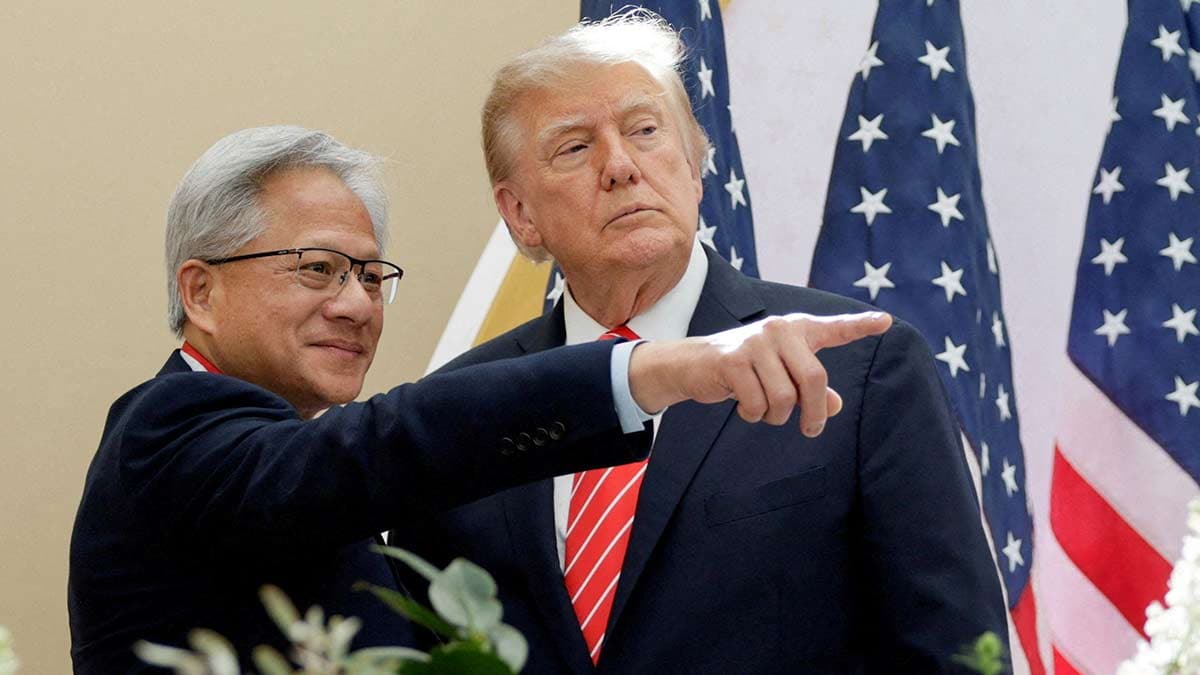
When President Donald Trump floated the possibility that Nvidia could be permitted to sell its flagship Blackwell artificial intelligence chips to China in three years—contingent on the pace of American innovation—the financial markets barely flinched, treating it like just another headline in an endless stream of trade rhetoric. To the uninitiated, a three-year timeline sounds like bureaucratic stalling, a polite way of saying no without slamming the door entirely. To anyone who has spent late nights staring at server rack schematics, tracking export control classifications, or watching supply chains fracture in real time, that three-year window is not a delay. It is an eternity, and it is a gamble that rests entirely on the fragile assumption that technological dominance can be kept on a predictable schedule.
The Architecture of a Moving Target
To understand what three years actually means in the world of high-performance computing, step away from Washington and picture a hypothetical hardware architect named Elena, working in a windowless lab in Northern California.
Elena’s job is measured in nanometers and thermal dissipation. Right now, her team is pushing the limits of the Blackwell architecture—a piece of silicon so dense, containing 208 billion transistors, that it ceases to be a mere component and becomes a miniature industrial plant. When Nvidia CEO Jensen Huang unveiled Blackwell, he wasn't just showing off faster graphics; he was introducing an engine capable of training trillion-parameter models at a fraction of the energy cost of its predecessor, Hopper. In the physical world, energy is the ultimate bottleneck. Data centers are already straining municipal power grids from Virginia to Ireland, and Blackwell is the pressure valve that allows artificial intelligence to keep scaling without melting the wires.
If you ask Elena where her work will be in thirty-six months, she won't give you a confident projection. She will laugh, rub her eyes, and tell you about the wall of physics.
For decades, the tech industry lived comfortably under Moore’s Law, the reliable cadence by which computing power doubled roughly every two years. That cadence is fracturing. Making transistors smaller now means wrestling with quantum tunneling, where electrons simply refuse to stay where they are told. Advancements no longer come from shrinking a single piece of silicon; they come from advanced packaging, stacking chiplets like microscopic skyscrapers, and inventing new ways to move data across copper and optical interconnects before heat destroys the system.
President Trump’s suggestion—that Blackwell could go to China once the United States has moved on to something vastly superior—treats technological progress like a conveyor belt. It assumes that by 2028 or 2029, America will be comfortably two generations ahead, perhaps running on Nvidia’s Rubin architecture or whatever comes after it, rendering Blackwell obsolete enough to export safely.
History suggests that conveyor belts break.
Consider the timeline of the recent past. Under the Biden administration, the Commerce Department drew a bright red line around advanced compute, banning the sale of Nvidia’s A100 and H100 chips to Chinese entities to prevent them from being used for military modernization, hypersonic weapons modeling, and mass surveillance. Nvidia responded by engineering downgraded versions—the A800 and H800—specifically designed to fall just beneath the export thresholds. Washington closed that loophole too. Each restriction was built on the premise that keeping China two steps behind would preserve an insurmountable American lead.
Yet technology does not sit still while lawyers draft export rules. While Washington debated bandwidth caps, Chinese engineers were forced into an intense, state-backed sprint toward self-sufficiency.
The Myth of the Permanent Moat
There is a comforting story told in Silicon Valley and on Capitol Hill: that American ingenuity is an inexhaustible natural resource, and that our lead in artificial intelligence is a permanent moat. Having watched multiple cycles of hardware standardization, I can tell you that moats do not just keep rivals out; they also trap the people inside them in a dangerous complacency.
Let’s look at what happens on the other side of that moat. Imagine a hypothetical AI researcher named Wei in Shenzhen. Three years ago, Wei’s lab ran on Nvidia hardware, written in CUDA—Nvidia’s proprietary software platform that acts as the nervous system for modern AI development. CUDA is the real reason Nvidia holds a near-monopoly; millions of developers know its quirks, libraries, and optimizations by heart. Switching away from CUDA is like asking an entire generation of neurosurgeons to suddenly operate with their non-dominant hand using unfamiliar instruments.
When the export bans hit, Wei didn't pack up his desk. He started rewriting code for Huawei’s Ascend 910B chips.
At first, the domestic alternatives were clunky, prone to overheating, and plagued by software bugs that turned a two-week training run into a two-month nightmare. Yields at China’s top foundry, SMIC, were low, hampered by the lack of extreme ultraviolet lithography machines from the Dutch firm ASML—another choke point enforced by Western allies. By every standard metric, China was falling behind.
But necessity is a brutal, effective teacher. Denied access to the best hardware, Chinese labs focused intensely on algorithmic efficiency, finding ways to squeeze more intelligence out of fewer flops. Meanwhile, Huawei poured billions into its CANN software ecosystem, slowly chipping away at CUDA’s dominance inside the mainland.
This is the invisible stake at the heart of the three-year proposal. The administration is trying to thread an impossible needle: protect national security without starving America’s most valuable tech company of a market that once accounted for roughly a fifth of its data center revenue. Jensen Huang has warned repeatedly that locking Nvidia out of China permanently doesn't stop China from getting AI; it simply hands the world’s second-largest economy—and half the world’s AI researchers—over to Huawei on a silver platter.
If Nvidia is allowed to sell Blackwell to China in three years, what market will it actually be walking back into?
If China’s domestic chip ecosystem fails to mature, then handing them Blackwell—even a three-year-old Blackwell—gives them a massive leap in compute capacity that they could not build themselves. On the other hand, if Huawei and SMIC succeed in building a competitive domestic alternative over the next thirty-six months, Beijing may no longer want Nvidia’s three-year-old leftovers. By 2029, Chinese regulators might treat Blackwell the same way they have begun treating Nvidia’s current compliance chips, like the H20: with deep suspicion, warning domestic tech giants like Alibaba, Tencent, and ByteDance to buy local instead.
The Human Toll of Geopolitical Whiplash
It is easy to talk about export controls in the abstract language of geopolitics, national security, and market capitalization. It is much harder when you look at the people caught in the gears of the machine.
Step onto the floor of a server assembly facility in Taiwan or Mexico, or walk through the procurement office of a mid-sized cloud provider in Texas. The uncertainty created by shifting policy timelines causes a quiet, exhausting paralysis. Companies cannot plan capital expenditures on a whim. Building a modern AI data center requires billions of dollars, years of permitting, custom liquid-cooling infrastructure, and long-term power purchase agreements.
When policy swings from strict containment to conditional, future-dated market access, every link in the supply chain has to hedge its bets. Engineers spend months designing compliance-friendly hardware variants that might be outlawed before the first silicon wafer even leaves the fabrication plant. Supply chain managers hoard inventory in bonded warehouses, waiting for signals from Washington and Beijing that can change overnight with a single press conference or social media post.
I remember talking to a logistics director during the height of the initial chip shortages, a man whose hair had visibly thinned over eighteen months of tracking cargo manifests across the Pacific. He didn't care about grand strategy or technological supremacy. He cared about whether the components sitting on a tarmac in Taipei would still be legal to ship by the time the customs paperwork cleared on Monday morning. That low-grade, constant anxiety is now a permanent feature of the global tech economy.
Why Three Years Is Both Too Long and Too Short
To appreciate the sheer risk of a three-year benchmark, we have to confront an uncomfortable truth: nobody actually knows what artificial intelligence will look like in three years.
Think back to late 2022. ChatGPT had just launched, astonishing the world with its ability to write coherent paragraphs and pass bar exams. At that time, the idea of multimodal reasoning models, autonomous coding agents, and synthetic data pipelines was still largely confined to research papers. In the span of roughly thirty-six months, the industry went from marveling at basic text generation to building massive clusters of tens of thousands of GPUs to train systems capable of PhD-level scientific reasoning.
Now project that same rate of change forward.
In three years, the bottleneck in AI might not even be raw training compute. The industry is already shifting heavily toward inference—the process of running trained models to answer queries and solve problems in real time—and test-time compute, where models spend extra seconds or minutes "thinking" through complex tasks before answering. If the paradigm of AI shifts away from brute-force pre-training toward specialized inference architectures, the strategic value of a Blackwell chip in 2029 could be completely different from what policymakers imagine today.
Furthermore, a policy built on a three-year clock assumes a level of stability in Washington that simply does not exist. Export control rules are written by the Bureau of Industry and Security, an agency that has become the de facto frontline of U.S.-China tech competition. Rules crafted today can be tightened, loosened, or rewritten entirely depending on the next diplomatic crisis in the South China Sea, a breakthrough in Chinese semiconductor manufacturing, or a change in congressional pressure.
For Nvidia, a promise of market access three years down the road is not a business plan; it is an option with an uncertain strike price. The company still has to navigate the immediate reality of losing billions in potential sales today while watching competitors try to eat into its software moat.
The Illusion of Control
There is a deeper psychological pattern at play here, one that goes far beyond semiconductors. Throughout history, dominant powers have consistently overestimated their ability to manage the diffusion of transformative technologies.
In the nineteenth century, Britain tried desperately to keep its textile machinery designs from leaving its shores, outlawing the export of blueprints and even forbidding skilled mechanics from emigrating to America. It worked for a little while. Then Samuel Slater memorized the schematics, boarded a ship to Rhode Island, and sparked the American Industrial Revolution.
Silicon is infinitely more complex than a spinning jenny. You cannot memorize the layout of a 3-nanometer chip or build an extreme ultraviolet lithography machine in a basement; it requires a global web of specialized optics from Germany, precision lasers, ultra-pure chemicals from Japan, and decades of institutional tacit knowledge. That complexity is precisely why the United States has been able to wield export controls with such devastating precision over the last few years.
Yet the fundamental human impulse remains the same. When you tell an ambitious, well-funded rival that they are forbidden from buying a critical tool, you do not extinguish their desire for the tool. You guarantee that they will spend every waking hour trying to build their own.
Watching the debate over Blackwell unfold feels like watching two chess players argue over the rules of the endgame while the board itself is quietly dissolving beneath their hands. Washington wants to preserve its military and economic edge while keeping American companies dominant globally. Nvidia wants to sell its products to every customer on Earth so it can fund the astronomical R&D costs required to stay ahead. Beijing wants to break free from Western technological dependence once and for all, no matter how painful or expensive the transition proves to be.
Three years is long enough for a startup to become a titan, for a supply chain to reroute across oceans, and for an entire generation of engineers to learn a new way of building the future. When the clock finally runs out, the world may discover that the chip everyone was fighting over is no longer the prize that matters.
Somewhere in a dimly lit data center, the cooling fans hum steadily, pulling heat away from racks of dark silicon while lights blink in silent, rhythmic pulses against the glass.