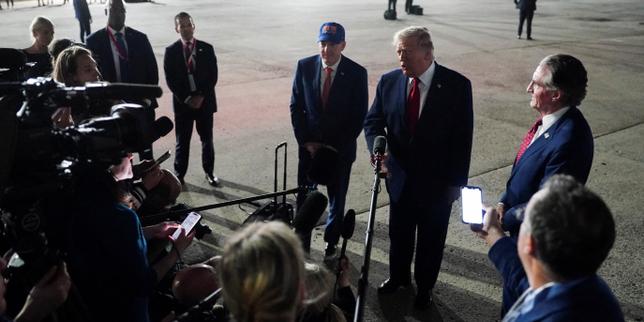
Donald Trump wants you to believe he’s the only man who can prevent a global conflagration. Standing outside Madison Square Garden last night after an NBA Finals game, he bragged to reporters that Iran and Israel stopped trading heavy missile fire because he personally told them to stop shooting. He claims a final peace deal is just two or three days away.
Don't buy the hype.
The weekend flare-up that brought fighter jets to the edge of the runway wasn’t solved by a sudden burst of master-class diplomacy. It’s a temporary pause in a brutal, multi-front war that the Trump administration helped ignite on February 28, 2026. By looking closely at the reality behind the phone calls to Benjamin Netanyahu and the frantic Truth Social posts, you see a much messier picture. This isn't a neutral mediator bringing rivals together. It’s an American president trying to manage a regional crisis that has spun wildly out of his control.
The Illusion of the Neutral American Broker
The biggest flaw in the current media narrative is the idea that Trump is stepping in as an independent third-party mediator. You can't start a war in February and claim to be the objective peacemaker in June.
Operation Epic Fury, launched jointly by the US and Israel, smashed Iranian air defenses, targeted nuclear infrastructure, and resulted in the death of Supreme Leader Ali Khamenei. When Iran struck back at US bases and closed the Strait of Hormuz, the global economy took a massive hit. Gas prices soared. Financial markets panicked.
Now, facing political pressure at home ahead of the November midterms, Trump needs an exit strategy. He is aggressively pushing the narrative that a historic agreement is in the final throes. According to leaks from recent phone calls, Trump’s leverage over Israel isn't gentle persuasion. It's an ultimatum. He flatly told Netanyahu that if Israel continued its planned massive retaliatory strike, it would find itself completely on its own in the battle.
Netanyahu blinkered. Israeli fighter jets were reportedly idling on the tarmac on Monday afternoon when the order came down to call off the operation. While Netanyahu publicly maintains that Israel and Washington are on the same page, sources inside the Israeli defense establishment reveal the truth. It was a direct order from the White House, not a mutual understanding.
Why the Regional Ceasefire Keeps Cracking
The temporary truce established on April 8 was never a solid foundation for peace. It’s a band-aid on a gaping wound. The structural issues driving the conflict remain completely unresolved, and the weekend violence proves how fragile this setup really is.
The immediate trigger for the latest exchange of fire was an intense Israeli airstrike on Beirut. Tehran had previously warned that any attack on the Lebanese capital would be treated as a direct violation of the ceasefire. When Israel hit Beirut anyway, Iran and its regional allies responded by launching a fresh wave of ballistic missiles at Israeli territory.
This highlights the fundamental disagreement blocking a real peace treaty: Lebanon.
- The Iranian Position: Tehran demands that any comprehensive peace agreement must include Lebanon and ensure safety for Hezbollah.
- The US-Israeli Position: Trump and Netanyahu want a bifurcated deal. They want a separate peace with Iran that secures the Persian Gulf and curbs Tehran's nuclear ambitions, while giving Israel a free hand to continue its military campaign against Hezbollah in Lebanon.
Trump explicitly confirmed this stance, telling NBC News that he isn't demanding Lebanon be part of the peace talks. This creates an impossible diplomatic knot. Hezbollah isn't a separate entity operating in a vacuum; it’s a core component of Iran’s Axis of Resistance. Expecting Iran to abandon its primary regional proxy while the US maintains a naval blockade on Iranian ports is entirely unrealistic.
The High Cost of Stalled Diplomacy
While the White House promises that oil prices will come tumbling down once a deal is signed, the economic reality on the ground is grim. The dual blockade in the Persian Gulf—where Iran restricts transit through the Strait of Hormuz and the US blockades Iranian shipping—has caused the largest supply disruption in the history of the global oil market.
The Pentagon has already burned through nearly $29 billion since the conflict began in late February, with a pending request for another $200 billion to sustain regional operations. Domestically, the war is turning into a political liability. The initial shock-and-awe phase of the campaign didn't result in a quick collapse of the Iranian state. Instead, a new leadership guard took over in Tehran, the fighting dragged on, and global supply chains cracked.
Trump's sudden urgency to mediate isn't born out of a newfound love for global harmony. It’s a pragmatic calculation to stop a financial hemorrhaging that could destroy his domestic agenda. He needs the shooting to stop because the economic fallout is hitting American voters directly at the grocery store and the gas pump.
What Happens Next
If you want to track whether this conflict is actually heading toward a resolution or just reloading for the next round, ignore the public boasts and watch three specific pressure points.
First, look at the status of the Strait of Hormuz. No peace agreement is worth the paper it’s written on if global shipping can't safely navigate this chokepoint. Watch for whether Pakistan-mediated talks can successfully negotiate a simultaneous lifting of the US naval blockade and the reopening of the strait.
Second, monitor Israeli operations in southern Lebanon. If Israel continues to push for permanent territorial control or launches further strikes on Beirut, Iran will be forced to respond to save face with its regional proxies, regardless of what Trump demands on Truth Social.
Finally, watch the internal political dynamics in Jerusalem. Netanyahu is under intense pressure from right-wing elements in his coalition to finish the job against Iran’s nuclear program. If he feels that Trump’s domestic political vulnerabilities prevent the US from actually enforcing its threats to leave Israel isolated, Netanyahu may decide to call Washington's bluff.