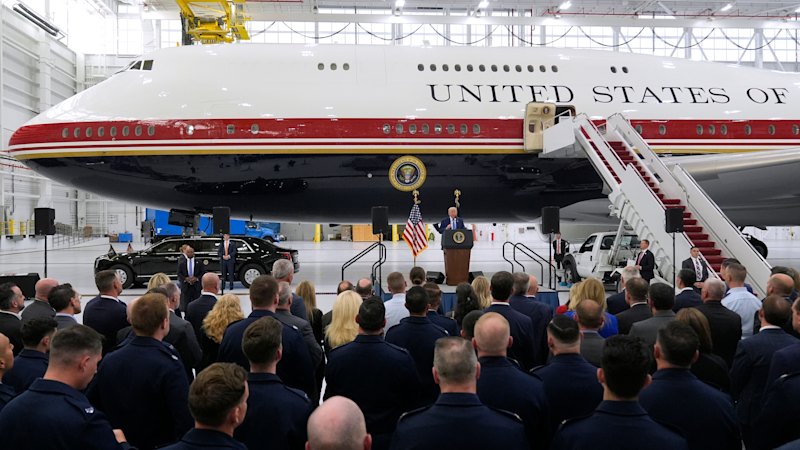
Donald Trump just stood inside a massive, specially built hangar at Joint Base Andrews and pumped his fist next to a jumbo jet that breaks sixty years of American military tradition. It isn't just the color scheme that has people talking, though ditching the classic Kennedy-era baby blue for a punchy red, white, dark blue, and gold design is a major statement. The real story is where this plane came from, how fast it got here, and why it bypasses the multi-billion-dollar bureaucratic nightmare that has plagued the official presidential aircraft upgrade for years.
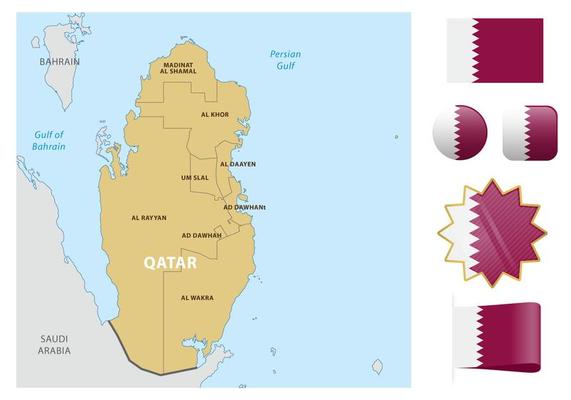
The aircraft is officially designated the VC-25B Bridge. It is a modified Boeing 747-8, but it didn't roll off a standard defense production line. It was a direct gift to the United States from the Gulf nation of Qatar. Valued at roughly $400 million, the jumbo jet formerly carried the Qatari royal family. Now, it is a highly secure, heavily modified flying command post designed to keep the president connected during an international crisis.
Accepting a massive piece of hardware from a foreign monarchy has ignited a fierce debate in Washington over ethics, protocol, and national security. But the reality of why this plane is entering service right now comes down to logistics, aging cold-war tech, and a defense contractor missing its deadlines.
Why the White House Accepted a Four Hundred Million Dollar Gift
You can't talk about this plane without addressing the giant elephant in the room. Federal rules generally limit unsolicited gifts to government employees to a tiny $50 valuation. A $400 million commercial widebody jet wildly blows past that boundary. Predictably, the deal drew intense legal and constitutional scrutiny the second it was proposed.
The administration brushed aside the uproar with typical bluntness. Trump argued on Truth Social that turning down a free, top-tier aircraft would be downright foolish, especially when it saves American taxpayers from eating massive upfront procurement costs. The Pentagon backed the move, with officials confirming the Secretary of Defense accepted the Boeing 747 in accordance with federal regulations by designating it a gift to the nation rather than an individual.
The underlying driver for this frantic pivot is simple. The existing Air Force One fleet, a pair of heavily modified Boeing 747-200s known as the VC-25A, is old. They have been flying since 1990 when George H.W. Bush was in office. Maintenance crews have to work overtime to keep those aging airframes airworthy, and sourcing parts for planes built over three decades ago is a logistical headache.
The official replacement program, run by Boeing, is trapped in a quagmire of production delays and skyrocketing costs. Frustrated by the wait, the administration jumped at the Qatari offer to build a temporary logistical bridge.
Ten Months to Build a Flying Command Post
Military aircraft acquisitions usually drag on for a decade. The fact that defense contractor L3Harris managed to pull this jet into a facility in Texas, rip out foreign components, install secure military tech, and paint the entire exterior in just ten months is an anomaly.
But don't mistake a fast timeline for a lack of safety. The Air Force didn't just slap a new coat of paint on a royal yacht and call it a day. Government specialists spent months meticulously scanning the airframe to detect and neutralize any potential technical hazards or surveillance risks linked to its past life with a foreign power.
The plane was packed with advanced security systems and hardened, secure communication networks. If a conflict breaks out while the president is mid-Atlantic, this plane functions exactly like the Pentagon's underground bunkers.
To get this plane moving quickly, the Air Force made deliberate tradeoffs. The Bridge aircraft features fewer integrated airstairs than the long-term Boeing models will eventually sport, and it has less onboard chiller space for food storage. It also lacks the specific protocols needed for the "Golden Eagle" mission, which is the military's designated task of transporting the remains of a deceased former president. This plane was built for speed, immediate operational pressure relief, and executive transport.
Inside the Lavish Flying White House
The Air Force explicitly stated that it prioritized immediate operational readiness over deep aesthetic overhauls, meaning the interior layout was left minimally changed. That is a polite way of saying the military left the royal luxury completely intact.
Instead of the standard, sterile office-style environments found on the older VC-25A planes, this jet retains the hyper-premium footprint designed for the Qatari House of Thani.
- Materials: High-end wood paneling, premium leather cabinetry, and gold accents dominate the visual layout.
- Accommodations: The double-deck aircraft features two full bathrooms, nine standard lavatories, a primary master bedroom, a dedicated guest bedroom, and multiple lounge spaces.
- Seating: Modern lay-flat seats fill the main cabins. This is a massive upgrade for the rotating staff, security details, and journalists who frequently endure long international flights stuck in older seats with limited recline.
- Custom Touches: The seatbelts are stamped with the presidential seal, and patriotic art blends with the existing tan and gold decor. One wall even features a framed print of a duck swimming in the Lincoln Memorial Reflecting Pool.
The Radical Departure From Sixty Years of Tradition
The most obvious change hits you before you even step on board. For more than six decades, Air Force One has been instantly recognizable by its luminous ultramarine blue, white, and polished aluminum livery. That iconic look was dreamed up in 1962 by industrial designer Raymond Loewy, who famously sat on the Oval Office floor sketching ideas with President John F. Kennedy and First Lady Jackie Kennedy.
This new plane completely ditches that legacy. The new look features a stark white top half, a deep navy blue belly, and sharp red and gold accent lines slicing down the center of the fuselage. A massive, stylized waving American flag is painted on both sides of the tail fin.
[Visual Layout of the VC-25B Bridge Paint Scheme]
-----------------------------------------------------------
Top Fuselage: Stark White with Bold "UNITED STATES OF AMERICA"
-----------------------------------------------------------
Mid-Section: Sharp Red and Gold Accent Lines
-----------------------------------------------------------
Belly/Underside: Deep Navy Blue
Tail Fin: Large Waving American Flag on Both Sides
-----------------------------------------------------------
It is a bold, aggressive look that mirrors the color scheme of Trump’s personal private Boeing 757. While critics mourn the loss of an aviation masterpiece, proponents argue it is time for a modern, powerful look that projects strength. The Air Force has already started rolling out this exact paint scheme across other VIP transport planes, including the C-32A jets used as Air Force Two.
What Happens Next Before Takeoff
The aircraft has safely arrived at Joint Base Andrews, but you won't see it flying the president immediately. The Air Force is moving straight into the commissioning flight phase. Think of this as the plane's final exam. Military pilots, navigators, and maintenance crews who have spent months training on standard 747-8 airframes will run the new jet through rigorous real-world tests to validate its communications, defense systems, and operational readiness.
Once those evaluations wrap up, the plane officially joins the active executive airlift fleet. The current goal is to showcase the new flying White House to the world during a massive military flyover on July 4, celebrating the nation's 250th Independence Day.
Meanwhile, one of the historic 1990s-era VC-25A jets has already flown its final mission and is headed straight toward a museum. Its sister ship will continue to fly alongside this new Qatari-gifted airframe, keeping the executive branch moving until Boeing finally delivers the permanent replacements later this decade.
To see an early look at how this dramatic paint scheme transition started rolling out across the wider executive fleet, you can watch this report detailing the Air Force One Color Scheme Shift. This video breaks down how the Pentagon began transition planning and provides a clear visual context for the design decisions that ultimately shaped the final look of the newly unveiled VC-25B Bridge jet.