Dawn arrives differently over Lake Ontario. The water does not merely reflect the morning sky; it absorbs it, shifting from slate grey to a bruised, luminous violet before settling into the deep, churning blue of an inland sea. For the people who built their lives along these shores—the fishermen hauling nets in the pre-dawn frost, the commuters watching the skyline emerge through a veil of diesel and mist—this shoreline is more than geography. It is an anchor.
Then, a sign appeared.
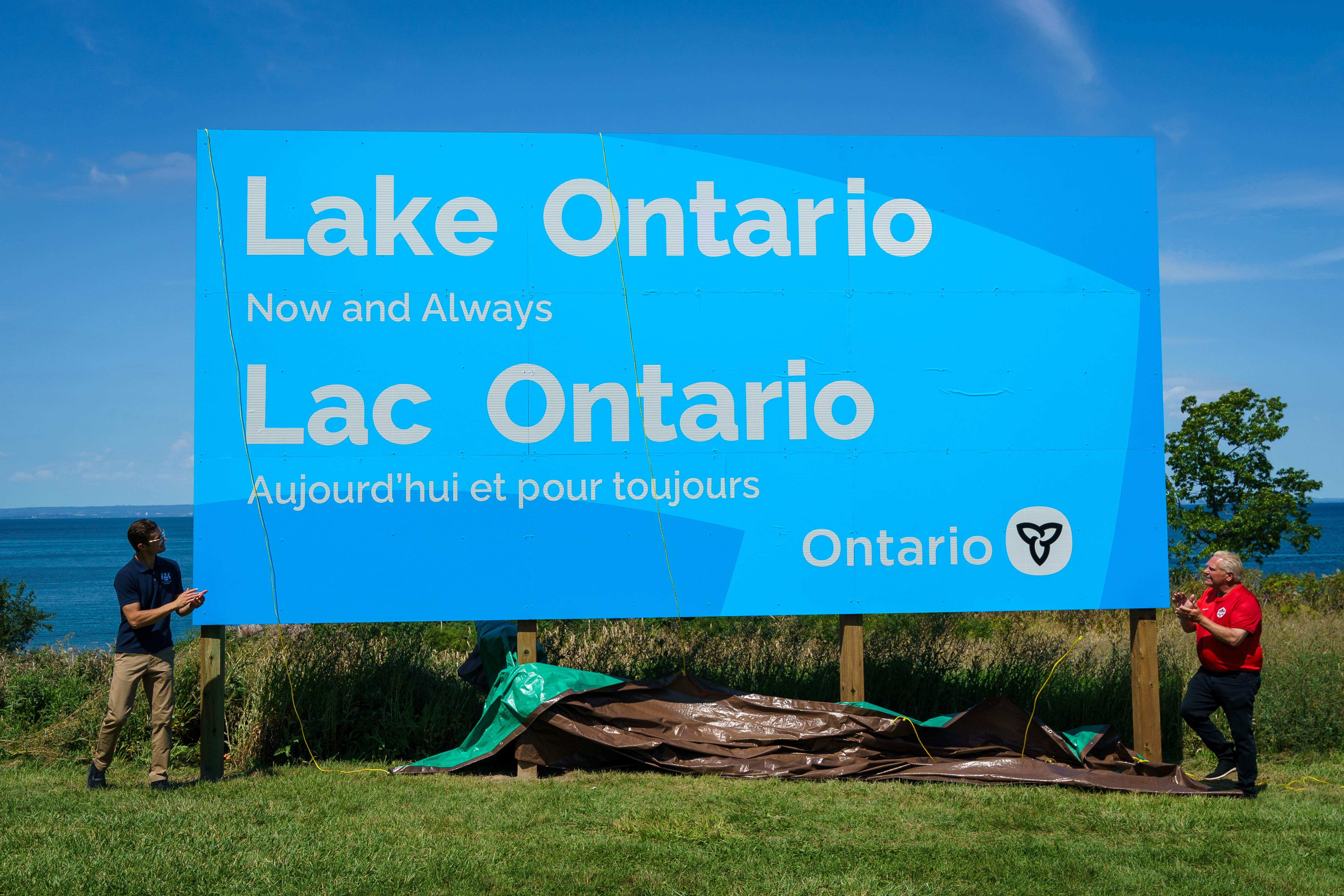
It was large. It was blue. It stood tall against the horizon, bearing a simple, assertive proclamation meant to signal arrival, identity, and intent. To some, it was a striking beacon of civic pride, a fresh coat of paint on a public square that had grown weather-beaten and tired. To others, it was an expensive vanity, a brightly lit monument to misplaced priorities stamped with a price tag that made taxpayers choke on their morning coffee: twenty-five thousand dollars.
When the invoice came to light, the political machinery stuttered. Questions flew like sparks from a grinder. Why twenty-five thousand dollars for a slab of aluminum and some vinyl lettering? Could local contractors not have done it for a fraction of the cost? Was this investment a stroke of visionary branding or an extravagant indulgence funded by people who measure wealth in numbers they never have to balance themselves?
Premier Doug Ford stood before the microphones, his posture rigid, his defense immediate and characteristically blunt. It was worth every penny. Beautiful, he called it. Necessary. A statement of permanence for a province that needed to remember how to build things and how to stand proud while doing it.
Listen closely to the debate, and you hear the eternal friction of public life. It is the clash between utility and aesthetics, between the accountant counting copper pennies and the visionary trying to paint a broader horizon.
Imagine standing on that windy stretch of waterfront on a Tuesday in November. The wind bites through heavy wool coats. The gulls wheel overhead, crying out against the roar of transport trucks barreling down the nearby highway. You look at the sign. Twenty-five thousand dollars. In the grand ledger of provincial budgets—billions spent on asphalt, hospitals, transit lines, and classrooms—that sum is a rounding error. It is a drop of rain in Lake Ontario. Yet, public fury is rarely calibrated to fiscal reality. It is calibrated to symbolism.
When a government spends money on a tangible object that people can see, touch, and mock, that object becomes a lightning rod. It absorbs every frustration about the price of groceries, the wait times in emergency rooms, the grinding anxiety of rent hikes. The sign is no longer just a sign. It is a proxy for every grievance.
Government communication often fails because it speaks in bureaucratic dialects while the public speaks the language of visceral experience. A bureaucrat sees a line item for promotional infrastructure, amortized over five years, designed to boost regional tourism and civic morale. A taxpayer sees twenty-five thousand dollars that could have bought winter coats for children, fixed potholes on secondary highways, or kept a community center open past five o'clock.
Ford understood the visceral nature of the symbol, even if he miscalculated the public's appetite for aesthetic vanity during hard times. He looked at the sign and saw confidence. Critics looked at the sign and saw tone-deafness.
Both things can be true at the same time.
Consider the psychology of civic markers. Throughout history, rulers and administrations have marked their territories with monuments. From ancient stone pillars carved with royal decrees to the sleek, minimalist corporate logos that anchor modern downtowns, humans have an insatiable urge to externalize their identity. We want travelers to know where they are. We want to signal that someone is in charge, that order has been imposed upon the chaos of nature and commerce.
A twenty-five thousand dollar sign on Lake Ontario is a micro-cosm of this ancient impulse. It says: We were here. We care about how this place looks.
But beauty under compulsion is a fragile thing. When an administration insists on the beauty of an expensive object while citizens struggle with the mundane mechanics of survival, the beauty sours. It stops looking like art or civic pride and starts looking like arrogance.
The controversy faded, as most political tempests do, swallowed by the next news cycle, the next crisis, the next scandal. The sign remains. The wind still whips off the lake, scouring its surface. The gulls ignore it entirely.
Walk past it today, and you will see commuters glancing at it with a mixture of familiarity and lingering cynicism. It has blended into the furniture of the city. It is just there.
Yet, the question it raised lingers in the damp air. How much are we willing to pay for the illusion of greatness? When the foundations are shaking, do we need a fresh coat of paint, or do we need someone to patch the concrete below the waterline?
The water keeps rising and falling against the shore, indifferent to the twenty-five thousand dollars spent to name it, indifferent to the arguments of politicians, indifferent to the people who walk beneath its shadow. It remains vast, cold, and ancient, waiting to see what we build next, and how much we are willing to pay for it.