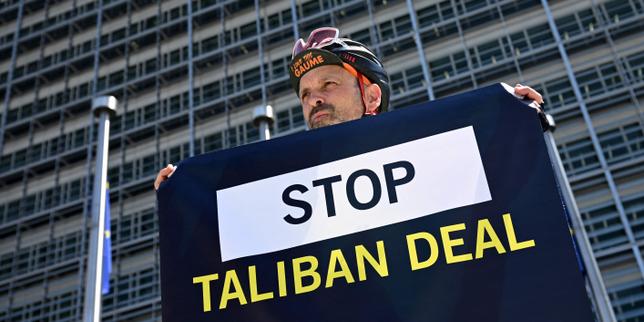
The paper felt unusually thick. When you hold a document that limits a human being's existence in a country to exactly twenty-four hours, you tend to notice the weight. It carries no luxury of extension. No loophole for a second night. Five sheets of paper, five names, five visas stamped with a terrifying precision by the Belgian state.
On Tuesday, five men carrying the official authority of Kabul stepped into Brussels. They did not arrive to admire the grand architecture of the Grand-Place, nor did they come to sign historic peace accords under the warm glow of television cameras. They arrived because twenty European nations, weary of the domestic political fires burning over immigration, signed a quiet letter demanding a clean way to send people back. Also making headlines recently: The 1500 Kilometer Shield (And Why the White House Blinked).
The transaction was cold, efficient, and hidden away from the public eye. No official photographs were taken. No handshakes were captured for the evening news. The European Commission co-chaired the meeting alongside Sweden, huddled in an undisclosed room far from the regular institutional buildings. To the world, the European Union maintains a fierce, unyielding wall of sanctions against the Taliban. We declare their treatment of women an ongoing crime against humanity. We listen to Nobel laureates like Malala Yousafzai speak of the systemic erasure of girls from schools with nodding, solemn agreement.
Then, we check the clock. We look at the domestic polling numbers. And we realize that to deport the thousands of Afghan nationals whose asylum claims have failed, or who have committed crimes on European soil, we have to talk to the men who hold the keys to the destination. Additional insights into this topic are explored by NPR.
Consider the strange theater of modern diplomacy. The European Union insists with absolute rigidity that this meeting does not constitute diplomatic recognition. The Belgian Foreign Ministry issued a statement carefully explaining that providing a room and twenty-four-hour visas is merely a matter of host-state policy, not a stamp of legitimacy. We use the word technical. If a conversation is technical, we tell ourselves, it is devoid of morality. It is just a matter of logistics. We discuss the landing capacity of the Kabul airport. We discuss the re-establishment of consular services so papers can be processed correctly.
But for Abdul Qahar Balkhi, the spokesperson leading the five-member Taliban delegation, the perspective was entirely different. To him, the meeting was historic. It was a bridge built into the heart of the West, a step toward ending international isolation, wrapped in the language of what he called a dignified return process.
The tension lies in what happens when those twenty-four hours expire and the delegates return home, leaving behind a new framework for cooperation.
Imagine a young woman named Zarmina. She does not exist in the official text of the Commission’s press releases, but she exists in the reality of the statistics. She arrived in Europe three years ago, fleeing a city where she could no longer hear her own voice in public without violating a decree. Her claim for asylum was caught in the massive, slow-moving gears of a European legal system handling hundreds of thousands of similar applications. Perhaps her paperwork lacked the specific, undeniable proof of individual targeting required by a skeptical immigration judge. Perhaps her file was simply marked for rejection.
Under the new terms discussed in that secret room, Zarmina’s name becomes part of a technical data exchange. The very authorities she fled are invited to verify her identity to facilitate her return. Migrant rights organizations are not being dramatic when they warn that these technical talks create a direct line of sight between a repressive regime and the people trying to escape it. To verify a person for deportation, you must hand over their details. You must tell the state exactly who they are and where their families still live.
The contradiction is dizzying. With one hand, European leaders stand at podiums to denounce a government that bans girls from education past the sixth grade. With the other hand, officials sit across a table from that same government to negotiate the logistics of putting people on planes back to Kabul.
We want clean borders, but clean borders require dirty compromises.
The numbers tell a story of desperation on both sides of the table. Between 2013 and 2024, roughly one million Afghans sought refuge within the borders of the European Union. Even through 2025, they remained the largest single group of asylum seekers arriving on the continent. Yet the actual rate of returns has been microscopic—barely two percent of those ordered to leave have actually been sent back. The political pressure inside Europe to fix that percentage is immense. Governments are falling, coalitions are fracturing, and public anger over perceived lawlessness is shaping the future of European democracy.
To the politician in Stockholm, Berlin, or Brussels, securing a technical agreement to deport individuals deemed a security risk is a matter of political survival. It is a shield against the populist tide.
But the room where the decisions are made has no windows to the aftermath. Over the past year alone, nearly three million Afghans have been forced out of Pakistan and Iran, pushed back into a homeland suffering from catastrophic food shortages and economic collapse. Adding European deportees to this fractured landscape is an exercise in human displacement that numbers alone cannot capture.
When the sun set on Tuesday, the five visas expired. The Taliban delegation moved back across the border of the Schengen zone, carrying the quiet validation of a closed-door meeting with the world’s wealthiest trading bloc. They left behind a city that prides itself on being the global capital of human rights, but which had spent the day proving that when the pressure rises, even the most sacred principles can be bartered for twenty-four hours of silence.