Cold.
That is the first thing you notice about Moscow in late winter, a dry, metallic chill that clings to the wool of an overcoat long after you step inside the gilded warmth of the Kremlin’s Senate Palace. For years, the corridors of that building have smelled of floor wax, stale tobacco, and the slow, grinding patience of a state that measures time in centuries rather than election cycles.
Now, picture two men walking down that carpet who measure time in square footage and closing dates.
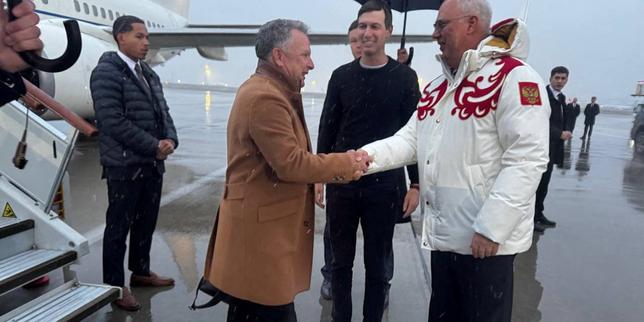
According to French media reports—specifically live coverage from outlets tracking the war in Ukraine—American envoys Steve Witkoff and Jared Kushner have arrived in Moscow to sit across the table from Russian President Vladimir Putin. On paper, it is a standard diplomatic dispatch, the kind of headline that scrolls past on a news ticker while you wait for your coffee. Two emissaries from Washington. One Russian leader. A war that has bled Eastern Europe since February 2022.
Look closer, though. Feel the friction in the room.
When a lifelong diplomat enters a negotiation, they carry a briefcase full of treaties, historical grievances, and the cautious vocabulary of the State Department. When two men forged in the cutthroat crucible of New York real estate walk into the Kremlin, they bring an entirely different instinct. They look at a map of the Donbas not as a sacred bloodland of Slavic history, nor as a test case for the post-1945 international rules-based order, but as a distressed asset with competing liens, a disputed title, and a bleeding balance sheet.
That collision of worldviews is the real story unfolding behind those closed doors in Moscow.
The Architecture of a High-Stakes Gamble
To understand why Steve Witkoff—a billionaire real estate developer and longtime confidant of Donald Trump—and Jared Kushner—Trump’s son-in-law and the architect of the first-term Abraham Accords—are the ones sitting opposite Vladimir Putin, you have to understand how transactional diplomacy works.
Traditional statecraft operates like a slow-moving cathedral construction. Every stone is laid with consensus; every ally is consulted; every phrase in a communiqué is vetted by dozens of desk officers so that no one loses face. Critics of this approach, including Trump’s inner circle, argue that it has produced years of trench warfare, hundreds of thousands of casualties, and a stalemate that drains Western treasuries without moving the front lines by more than a few kilometers a season.
Transactional diplomacy operates like a hostile takeover or a midnight restructuring. You bypass the layers of bureaucracy. You put the principals—or the people who speak with the absolute, unvarnished authority of the principal—in a single room. You strip away the moralizing speeches and ask a brutal, binary question: What is your walk-away number?
Consider a hypothetical scenario that illustrates the exact tension inside that Kremlin meeting room. Imagine two landlords arguing over a sprawling, half-burned apartment building in the middle of winter. One landlord, Putin, has occupied the east wing by force, poured concrete over the stairwells, and insists the deed belongs to his family going back three hundred years. The other landlord, Ukrainian President Volodymyr Zelenskyy, holds the legal title recognized by the city, refuses to sign away a single hallway, and is fighting floor by floor to push the intruder out. Now imagine two commercial brokers from Manhattan, Witkoff and Kushner, stepping into the lobby with a briefcase. They are not there to adjudicate who started the fire. They are there to tell both sides that the building is losing money every hour, the neighbors are tired of paying for the fire department, and someone is going to sign a settlement before the roof caves in.
It is a startlingly direct way to conduct foreign policy. And depending on where you stand, it is either the only pragmatic escape hatch from an endless meatgrinder or a terrifying willingness to trade away another nation’s sovereignty like a distressed mortgage.
Who Are the Men Across the Table?
The public often asks why career ambassadors are sidelined in moments like this. The answer lies in trust—not trust between nations, which barely exists between Washington and Moscow, but absolute trust between a president and his messengers.
When Vladimir Putin looks across a polished table at a standard diplomatic envoy, he calculates how much of what they say will survive six layers of congressional oversight and European consultation. When he looks at Steve Witkoff and Jared Kushner, he knows he is looking at direct conduits to the Oval Office.
Witkoff built his fortune in the unforgiving world of Manhattan commercial property, navigating bankruptcies, union standoffs, and financing collapses where a handshake meant everything and a miscalculation cost hundreds of millions. Over the past two years, his portfolio expanded rapidly from real estate into the world’s most intractable conflict zones, including high-stakes hostage negotiations in the Middle East. He speaks the language of leverage, timing, and face-saving exits.
Kushner brings a different, quieter pedigree. During the first Trump administration, skeptics mocked the idea that a thirty-something real estate heir with zero diplomatic training could broker normalization agreements between Israel and four Arab nations. Yet the Abraham Accords happened precisely because Kushner ignored the conventional wisdom that nothing could move until the core ideological dispute was resolved first. He focused on shared economic interests, security anxieties, and personal rapport with leaders who held unchecked power in their own capitals.
Now, that exact playbook is being tested against an adversary far more formidable, patient, and ruthless than any Middle Eastern monarch.
The Invisible Stakes in a Frozen Trench
While cameras capture motorcades gliding through snowy Moscow avenues, the true weight of this meeting is measured eight hundred miles to the southwest, in places whose names rarely make Western headlines anymore.
Let us ground this in human reality. Picture Olena, a composite character representing thousands of real Ukrainian mothers living in Kharkiv or Zaporizhzhia today. Her kitchen windows are taped in criss-cross patterns to keep glass from shattering during nighttime drone alerts. Her husband has been rotating through artillery positions near Pokrovsk for over two years. When Olena hears on the evening news that two American emissaries are in Moscow talking to Putin, she does not hear a geopolitical chess match. She hears a terrifying ambiguity.
Does a "deal" mean her husband comes home alive by spring? Or does it mean the town where her parents are buried is permanently ceded to the army that shelled it?
This is the moral razor’s edge of the Moscow talks. Every analyst, diplomat, and citizen watching this war struggles with the same agonizing contradiction:
- The Humanitarian Imperative: The war in Ukraine has become a brutal war of attrition. Hundreds of thousands of soldiers on both sides have been killed or wounded. Millions of Ukrainians remain displaced across Europe. Ukraine’s electrical grid faces relentless winter bombardment, and demographic collapse threatens the country’s future even if its borders hold. Every month the war continues, more graves are dug.
- The Sovereignty Imperative: Allowing an aggressor to redraw European borders by military force sets a precedent that echoes far beyond Kyiv. If Moscow walks away from the table keeping roughly a fifth of Ukrainian territory—Crimea and swathes of Donetsk, Luhansk, Zaporizhzhia, and Kherson—what stops the next border from being tested in the Baltics, the Caucasus, or the Taiwan Strait?
When I think back to the diplomatic crises of the twentieth century—from the Munich Agreement of 1938 to the Dayton Accords that ended the Bosnian War in 1995—the lesson is never clean. History shows us that almost every war eventually ends at a negotiating table, rarely with total victory, and almost always with bitter compromises that leave both sides feeling cheated. At Dayton, diplomats locked warring Balkan leaders in an Ohio air force base until they signed a map nobody loved, stopping the bloodshed at the cost of freezing a fractured political reality in place for decades.
Is Moscow a prelude to a modern Dayton, or something closer to a forced partition? Even seasoned intelligence officials admit they cannot be certain. The variables are too volatile, and the personalities at the table are too unpredictable.
What Putin Wants Versus What Washington Can Offer
To understand what actually happens when the doors close in the Kremlin, we have to strip away public rhetoric and look at the cold ledger of interests.
Vladimir Putin does not negotiate from a posture of urgency. Despite staggering battlefield losses, Western sanctions, and an economy warped around military production, the Russian president believes time is on his side. He watches political divisions in Washington and budget fatigue in European capitals. For Putin, sitting down with high-level American envoys is already a symbolic victory: it signals the end of Moscow’s diplomatic isolation by the West and treats Russia once again as an indispensable superpower deciding the fate of Europe alongside the United States.
His core demands have remained remarkably consistent, even as the front lines have shifted: formal recognition of Russian control over annexed Ukrainian territories, a permanent bar on Ukraine ever joining NATO, the lifting of sweeping economic sanctions, and strict limits on Ukraine’s future military capabilities.
Witkoff and Kushner, meanwhile, carry a very different set of pressures. Washington wants an end to a conflict that consumes billions in military aid and distracts American strategic focus from the Indo-Pacific. To get Putin to freeze the fighting, American negotiators have floated various concepts in recent months—ranging from demilitarized buffer zones patrolled by European peacekeepers to delaying Ukraine’s NATO aspirations for decades rather than permanently surrendering legal sovereignty.
Notice the fundamental mismatch in how both sides define a "win."
For real estate dealmakers, a deal is good when the bleeding stops, the cash flow stabilizes, and both parties walk away claiming they got something valuable. For Vladimir Putin, territory is not a line item on a balance sheet; it is legacy, empire, and regime survival. You cannot easily split the difference on a sacred historical myth, nor can you easily convince a Ukrainian population that has buried its children to accept a ceasefire line that leaves millions of their countrymen under Russian occupation without ironclad security guarantees.
Without real security guarantees—the kind that would deter Moscow from simply rearming for three years and invading again—a ceasefire is not peace. It is merely an intermission.
The Echo Beyond the Kremlin Walls
There is another layer to this visit that makes European leaders in Paris, Berlin, and Warsaw deeply uneasy, even when they express polite diplomatic support in public.
Notice who is not in that room in Moscow.
Ukrainian officials are not sitting at that table. European Union leaders are not sitting at that table. When American envoys fly directly to Moscow to test the waters with Vladimir Putin, it revives one of Europe’s oldest anxieties: that the great powers will decide the continent’s security architecture over the heads of the smaller nations that actually live there.
This is why every word leaked from the Kremlin after these talks will be scrutinized like an ancient scroll. European capitals are scrambling to ensure that whatever framework Witkoff and Kushner explore in Moscow does not become a fait accompli presented to Kyiv as an ultimatum—sign here, or lose American weapons and intelligence sharing overnight.
Yet, behind closed doors in those very same European capitals, exhaustion is real. Ammunition stockpiles are thin. Domestic voters are restless over inflation and energy costs. Privately, many officials acknowledge that Ukraine’s path to reclaiming every square inch of its 1991 borders by military force looks steeper today than at any point since the spring of 2022. That unspoken truth is the exact vacuum into which Witkoff and Kushner have stepped.
The Weight of a Signature
Diplomacy, when stripped of flags and motorcades, comes down to human psychology under unbearable pressure.
Imagine the quiet in that Kremlin room after the interpreters finish translating an opening statement. The heavy oak doors are shut. Outside, snow falls steadily over Red Square, muffling the sound of traffic. Across the table sits a former intelligence officer who has ruled Russia for a quarter-century, reading every micro-expression for signs of impatience or weakness. Opposite him sit two American businessmen who have spent their lives betting that every person in the world has a price, a fear, or an ambition that can be leveraged into a signature on a dotted line.
They are trying to price the unpriceable: the grief of shattered cities, the pride of a sovereign nation, and the imperial obsession of an aging autocrat.
If they succeed in finding a formula that halts the artillery fire without handing Moscow a license for future conquest, history will call their unconventional approach a stroke of daring pragmatism. If they misread the man across the table and trade away real security for the illusion of a quick handshake, the ink on that agreement will barely dry before the next crisis begins.
Somewhere near the front lines in eastern Ukraine tonight, a young soldier stands in a muddy dugout listening to the distant thud of outgoing shells, checking his watch, waiting to find out whether the men in warm suits a thousand miles away have just decided if he gets to see next summer.