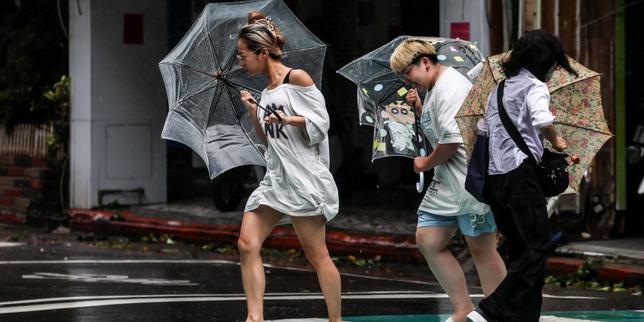
When a category 3 equivalent tropical cyclone barrels toward one of the most densely populated coastal regions on earth, the numbers lose their meaning. You hear about two million people packing up their lives in a matter of hours. It sounds like a statistic from a textbook. But when Typhoon Bavi hit the border region between China and North Korea, it wasn't just a weather event. It was a massive, brutal test of modern infrastructure and emergency logistics.
Most news outlets cover these storms with the same predictable formula. They show a video of trees bending in the wind, quote a government official, list the evacuation count, and move on. They miss the real story. The actual narrative lies in how a modern society manages to relocate millions of citizens without turning the entire operation into a chaotic disaster. It’s about the sheer friction of moving human beings out of the path of rising waters.
The Logistics Behind Relocating Millions in Hours
Moving people requires a plan that accounts for human stubbornness. You can't just send a text alert and expect millions of residents to walk away from their homes, crops, and businesses. During the response to Typhoon Bavi, emergency management teams faced the grim reality of securing Northeast China's industrial and agricultural heartland.
Local authorities had to coordinate across provinces including Liaoning, Jilin, and Heilongjiang. This wasn't just about opening gymnasiums and school buildings for refugees. It meant shutting down major railway networks, grounding hundreds of flights across regional hubs like Dalian and Shenyang, and ordering thousands of fishing boats back to port immediately.
If a single link breaks, people die. For instance, when fishing vessels ignore warnings to stay at sea just a few hours too long, rescue maritime crews have to risk their lives in ten-meter swells. During Bavi, the enforcement was absolute. Officials cleared the waters of the Yellow Sea and Bohai Sea completely before the first outer bands of the storm made impact. That kind of enforcement requires massive authority and boots on the ground.
Why Northeast China Bears a Unique Vulnerability
We usually associate typhoons with tropical southern zones like Guangdong or Hong Kong. When a storm tracks straight up north toward the Liaoning province, it creates a entirely different set of headaches. Northern infrastructure simply isn't built to take the same regular pounding as the south.
Southern cities feature sophisticated drainage networks, specialized building codes, and coastal defenses designed to absorb multiple typhoons every single year. The north doesn't. When Typhoon Bavi maintained its strength far longer than forecasters originally anticipated, it threatened areas that are crucial to food security.
The Northeast plains serve as a primary grain basket. Think about millions of acres of corn, rice, and soybeans right on the verge of harvest. A late-August typhoon doesn't just destroy houses. It drowns crops, saturates the soil, and causes long-term economic damage that impacts food prices across the continent for months. Farmers know this, which makes them incredibly hesitant to leave their land. Emergency workers spent hours convincing elderly residents to leave farms, sometimes physically carrying individuals out of low-lying valleys.
The Problem with High Rise Wind Tunnels
Modern Chinese urban centers present a unique hazard during extreme wind events. High-rise residential blocks create artificial wind tunnels. A storm that registers 130 kilometers per hour at sea can easily accelerate between narrow rows of thirty-story apartment buildings, turning loose objects into deadly projectiles.
During the height of the storm, structural integrity becomes less of an issue than flying debris. Glass windows blow inward. Air conditioning units rip from their brackets. City managers had to implement a total lockdown on outdoor movement in cities like Dandong, recognizing that the streets themselves become death traps even if the buildings remain standing.
Managing the Human Element in Mass Shelters
Evacuating two million individuals means finding a place for two million individuals to sleep, eat, and access medical care. This took place during a period where public health measures were already stretched thin due to global health anxieties. Managing crowded indoor spaces under those conditions is an absolute nightmare for local administrators.
They had to transform public infrastructure instantly. Schools, exhibition centers, and sports arenas became temporary cities within hours.
- Rationing resources: Supplying millions of clean water bottles and meals daily.
- Medical screening: Setting up triage tents at the entrance of every single shelter to prevent outbreaks of communicable diseases.
- Security protocols: Managing the intense psychological stress of families who don't know if their homes are currently being ripped apart.
When you look at the sheer scale, it becomes obvious that emergency management is actually a game of supply chain optimization. If the trucks carrying blankets get stuck in the flooding caused by the storm's outer bands, the shelter system fails.
What Outer Regions Get Wrong About Storm Warnings
People living outside active typhoon zones often look at evacuation orders and wonder why cities spend millions of dollars preparing for storms that sometimes weaken before landfall. They call it overreacting. That mindset is dangerous.
With a storm like Bavi, the track shifted constantly. Meteorological agencies in China, South Korea, and Japan kept adjusting their models. A slight jog to the west meant a direct hit on major industrial ports; a jog to the east meant hitting less populated mountainous terrain. You cannot wait for absolute certainty. By the time the path is 100% locked in, the roads are flooded, the winds are too high for buses to run, and your window for moving people safely shuts completely.
Taking a proactive loss of economic productivity by shutting down factories and evacuated cities is always better than counting bodies in the aftermath. The financial hit of stopping assembly lines for forty-eight hours is massive, but it's a predictable cost. The cost of a failed evacuation is chaotic and permanent.
Building Resilience for the Next Event
The lessons from Bavi show that emergency plans must evolve beyond simple rescue operations. True resilience means changing how we construct our world before the clouds even start to gather.
Cities must invest heavily in sponge city designs, utilizing permeable pavement and urban wetlands that can swallow millions of gallons of flash flooding without overflowing the main sewer lines. Coastal regions require massive mangrove restoration projects and engineered seawalls that break the energy of storm surges before they reach residential areas. Most importantly, local communication networks must remain decentralized so that even if the main power grid goes dark, neighborhood captains can still receive alerts and direct their communities to safety.
If you live in an area prone to severe weather, don't wait for a knock on your door to figure out your plan. Map out your evacuation routes today, identify the highest ground in your immediate vicinity, and keep a seventy-two-hour survival kit packed with fresh water, non-perishable food, and essential medical supplies. The next storm won't give you time to think.

.webp)