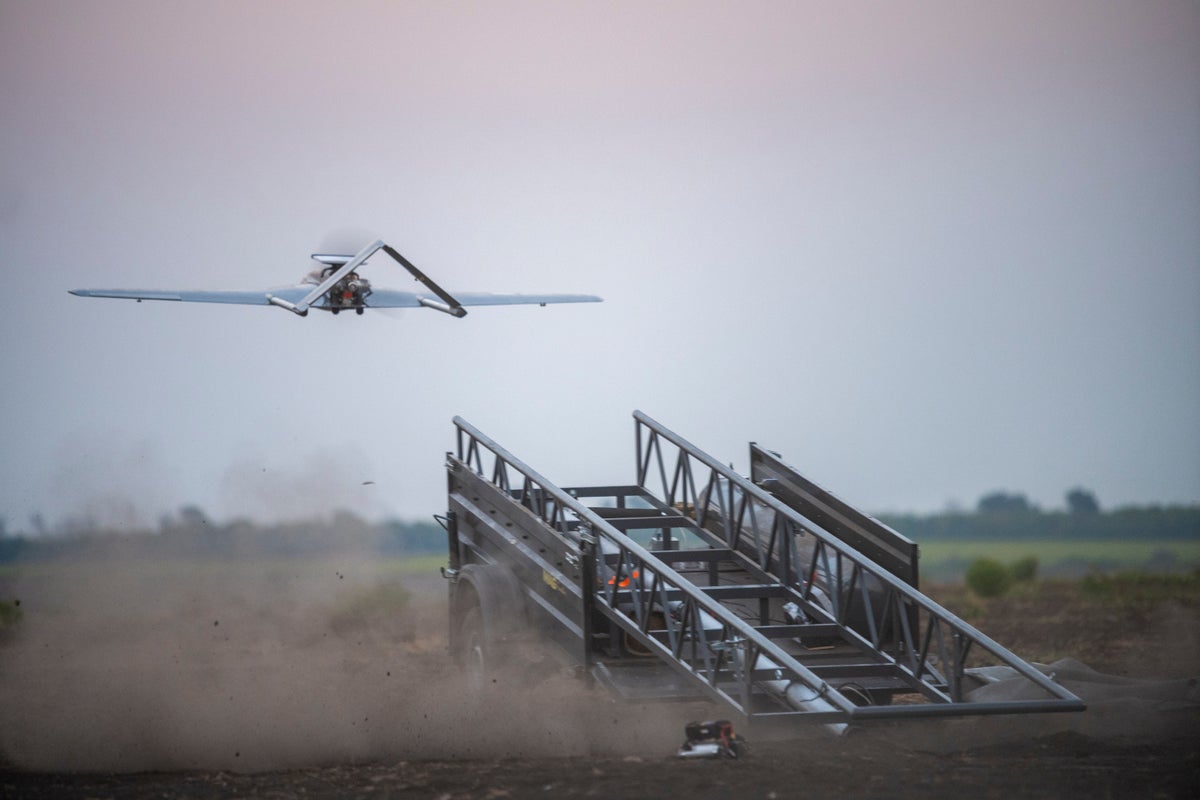
Everyone loves a David versus Goliath narrative. Give the underdog a few thousand cheap quadcopters, stitch together some front-line GoFundMe updates, and the armchair generals in Washington and London start drafting articles about how asymmetric innovation is rewriting the military textbooks. The lazy consensus says Ukraine is beating Russia at its own attrition game by scaling up mass-produced, long-range loitering munitions to strike deep inside Russian territory.
It is a comforting fairy tale. It is also entirely wrong. Meanwhile, you can find related events here: Monsoon Diplomacy Under Pressure Inside India and Nepal Border Infrastructure.
When you measure success by explosive fireballs on Telegram channels, you miss the structural mechanics of industrial warfare. Ukraine is not winning a drone war; it is burning its seed corn on tactical tactics that offer diminishing strategic returns. I have watched procurement programs implode from Washington to Kyiv because leaders confuse volume with velocity and visibility with impact.
Let us dismantle the prevailing delusion. To explore the complete picture, we recommend the recent analysis by Associated Press.
The Attrition Trap Nobody Wants to Talk About
The core premise of the current drone hype cycle relies on a simple cost-benefit fallacy. A one-thousand-dollar first-person view or long-range one-way attack drone can theoretically damage a multi-million-dollar oil refinery or radar installation. Therefore, the math works out in favor of the cheap strike.
Except modern war does not operate on a spreadsheet of isolated unit costs. It operates on industrial depth, supply chain resilience, and signal-to-noise ratios.
Russia adapted. That is what massive, clumsy autocracies do when punched in the nose repeatedly. They absorb the blow, decentralize their fuel storage, harden their grid nodes, and blanket the electromagnetic spectrum with dense electronic jamming. The initial wave of deep-strike drone successes relied on surprise and unprotected target sets. Those targets are gone.
Now, Ukraine faces a brutal reality. Scaling up thousands of long-range aluminum-and-fiberglass airframes does not break the Russian war machine. It forces Moscow to accelerate domestic production of electronic warfare suites and air defense layers that neutralize those exact platforms. Worse, every ruble and human resource diverted toward building improvised strike drones pulls engineering talent away from the software-defined autonomy, frequency-hopping guidance, and mesh-networking required to survive heavy jamming.
You cannot win a technological arms race by doubling down on hardware that relies on commercial GPS and consumer-grade microchips.
The Myth of Scale Without Software
Ask any defense analyst about the secret to modern drone warfare, and they will parrot buzzwords about swarming and mass manufacturing. They talk about factories churning out tens of thousands of units a month as if hardware volume equals combat power.
That is a dangerous misunderstanding of how signals and defenses interact.
In a contested electronic environment, raw numbers are a liability. If you launch five hundred manual or semi-autonomous drones against a defended sector saturated with radio frequency interference, and four hundred and fifty of them drop out of the sky because their links severed, you did not execute a mass strike. You just polluted the airspace and gave the enemy free telemetry data.
Real scaling requires terminal autonomy. It demands onboard computer vision that allows a drone to identify its target, ignore spoofed GPS coordinates, and guide itself through the final kilometers without human intervention or satellite tethering.
Ukraine's current strategy remains heavily anchored on human-in-the-loop piloting or fragile connection vectors. When Russian electronic warfare units blanket an approach corridor with noise, those long-range strikers become expensive paperweights. Russia is learning how to fight blind; Ukraine is trying to out-build a jamming problem with more targets instead of smarter code.
The Industrial Reality Check
Let us look at the structural asymmetry. Russia possesses a domestic defense-industrial base backed by state-directed capital, secure access to critical raw materials through compliant third-party intermediaries, and a population base nearly four times larger than Ukraine's.
When Ukraine trades blow for blow in a long-range strategic drone campaign, it plays an away game on Russia's home turf of resource endurance. Even with Western financial backing, Ukraine's manufacturing ecosystem is fragmented, vulnerable to kinetic missile strikes, and dependent on fragile supply lines for optics, motors, and microcontrollers sourced primarily from East Asia.
Every time a Ukrainian production facility gets hit by a Kalibr cruise missile, the replacement timeline measures in months. When a Russian assembly plant takes damage, state mechanisms relocate it behind the Ural mountains within a week.
Pretending that asymmetric drone strikes can substitute for deep industrial parity is a disservice to the soldiers on the ground. It creates a false sense of strategic momentum while the structural foundation erodes underneath.
What Actually Works
If the current trajectory leads to a dead end, what is the alternative? Stop measuring success by how far a drone flies or how large the resulting fire looks on social media.
Shift the focus from strategic irritation to tactical denial.
- Invest in Software Over Airframes: Stop prioritizing the physical construction of basic hulls. Redirect capital into edge-computing modules and machine-vision algorithms that render electronic warfare obsolete. A drone that does not need a radio link to find its target cannot be jammed.
- Decentralize Production Networks: Move away from fixed-site assembly warehouses toward micro-manufacturing nodes embedded within civilian infrastructure, making targeting economically unviable for enemy precision strikes.
- Integrate Air Defense and Counter-Drone Layers: The most effective use of domestic engineering talent right now is not hitting targets a thousand kilometers away while your own front line suffers from a lack of local airspace denial. Protect the force before trying to punish the enemy.
The harsh truth is that cheap drones are tactical tactical tools, not strategic game-winners. Until leadership stops believing their own press releases and confronts the cold math of industrial logistics and electronic warfare, the campaign will remain a high-visibility treadmill going nowhere fast.
Stop cheering for the spectacle. Look at the balance sheet.