The carpet in the Oval Office is thick enough to swallow the sound of footsteps, but it cannot muffle the weight of history. When Donald Trump and Luiz Inácio Lula da Silva sat across from one another, the air didn’t just feel heavy. It felt charged. This was not a meeting of two bureaucratic gears clicking into place. It was a collision of two distinct worlds, two different centuries of populist fervor, and two men who both believe they alone carry the soul of their respective nations.
Power has a specific scent. In that room, it smells like old paper, expensive wool, and the sharp, metallic tang of adrenaline.
To the casual observer scrolling through a news feed, this was a standard diplomatic junket—a "private meeting" intended to signal cooperation. But diplomacy is often the art of saying one thing while the body screams another. Look at the lean of a shoulder. Notice the way a hand rests on a chair arm. These are the real transcripts. For Trump and Lula, the "lingering strain" mentioned in official briefs wasn't just about trade tariffs or environmental policy. It was about the mirrors they saw when they looked at each other.
The Mirror and the Mask
Consider the trajectory of a comeback. Both men have walked the path of the political exile. One faced the wilderness of Mar-a-Lago; the other, the literal iron bars of a prison cell. To sit in the Oval Office after such journeys creates a specific kind of psychological armor. They are both survivors.
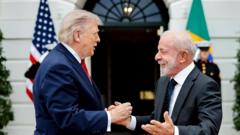
When they shook hands, it wasn't just a greeting between the United States and Brazil. It was a negotiation of ego. Trump, the quintessential disruptor of the Global North, meets Lula, the storied champion of the Global South.
The tension exists because they are operating on the same frequency but playing different tunes. They both speak the language of the "forgotten man." Trump’s version involves the rust-belt worker and the preservation of a specific American heritage. Lula’s version is rooted in the "povo"—the working class of the Brazilian favelas and the trade unions. They are competing for the title of the world’s ultimate populist, and the Oval Office is a very small stage for two such massive identities.
The Invisible Stakes
Why does a handshake in Washington matter to a farmer in Mato Grosso or a factory worker in Ohio? Because when these two titans experience "strain," the machinery of the Western Hemisphere grinds its gears.
Imagine a massive, invisible bridge spanning the Atlantic. Every time the rhetoric between Brasilia and D.C. sharpens, a plank on that bridge begins to rot. Brazil is not just another neighbor; it is the heartbeat of South America. If that heart beats out of sync with the U.S., the entire region feels the arrhythmia.
The facts of the meeting were dry: discussions on democracy, climate, and regional stability. But the human reality is far more volatile. Lula needs the U.S. to see Brazil as an equal, not a junior partner. Trump, meanwhile, views the world through the lens of strength and leverage. In this room, the "effort to avoid tension" was really an effort to find a common enemy.
Sometimes, the best way for two people who don't like each other to get along is to focus on a third person they like even less.
The Architecture of a Private Conversation
Privacy in the White House is an illusion. There are always note-takers, aides, and the haunting presence of those who sat in those chairs decades prior. Yet, when the doors close, the tone shifts.
The "strain" observers noted isn't just political; it's visceral. Lula represents a version of left-wing nationalism that traditionally views American influence with deep suspicion. Trump represents an "America First" doctrine that views international cooperation as a zero-sum game.
They are like two master chess players who have realized that, for this one hour, they are playing on the same side of the board against a rising tide of global instability. They don't have to be friends. They just have to be predictable.
Conflict often arises from a lack of clarity. In this meeting, the goal was to establish the boundaries of their respective territories. It’s like two silverback gorillas acknowledging each other’s presence in the forest. There is no need for a fight if both understand where the other's jungle begins.
The Ghost in the Room
We must also acknowledge the shadow of 2021 and 2023. The events at the U.S. Capitol and the Praça dos Três Poderes in Brasília serve as a grim backdrop to any conversation about "democratic resilience."
For Lula, the preservation of institutions is a matter of survival. For Trump, the narrative of the "stolen" or "rigged" system remains a core part of his political identity. To speak of democracy in that room is to walk through a minefield. One wrong word, one poorly timed smirk, and the fragile bridge collapses.
They avoided the mines. They stuck to the script of "mutual respect." But the strain was visible in the way they didn't talk about the past. They looked only at the ceiling or the floor when the conversation veered too close to the messy, populist uprisings that have defined both their recent histories.
The Cost of Silence
What happens when the meeting ends? The motorcade rolls away, the press core disperses, and the diplomats begin the long task of translating "maybe" into "policy."
The human element of this meeting is found in the uncertainty. We want our leaders to be steady, predictable hands on the tiller. But Trump and Lula are both weather-makers. They create the storms they then promise to protect us from.
The strain between them is a reflection of the strain in our own communities. We are divided, shouting across digital chasms, much like the ideological gap between these two presidents. Their attempt to "avoid tension" is a high-stakes performance of civility that we are all desperately trying to emulate in our own lives.
It is an exhausting way to govern. It is an exhausting way to live.
The Weight of the Chair
There is a specific photograph from the meeting. Lula is leaning forward, his face a map of decades of struggle, his eyes fixed on Trump. Trump is reclined slightly, his expression unreadable, a man who has spent his life gauging the "deal."
In that moment, they weren't heads of state. They were two elderly men burdened by the impossible expectations of millions. They are the avatars of our hopes and our rages.
The strain will never truly go away. It can’t. Their visions for the world are too different, their methods too distinct. But for a brief afternoon, they chose the quiet of the Oval Office over the roar of the rally.
They sat. They spoke. They survived each other.
The true test of the meeting isn't found in the joint communiqué issued by the press office. It’s found in the silence that follows. If the phones keep ringing between Washington and Brasília, the mission was a success. If the silence grows cold, then the strain was more than just a lingering shadow—it was the beginning of a total eclipse.
As the sun set over the Potomac, the two men went their separate ways, leaving behind a room that has seen it all before. The chairs remained. The carpet remained. And the world, as it always does, waited to see which of them would speak first once they were back in front of a microphone.
History isn't made by the facts on the page. It's made by the friction between the people who write them.