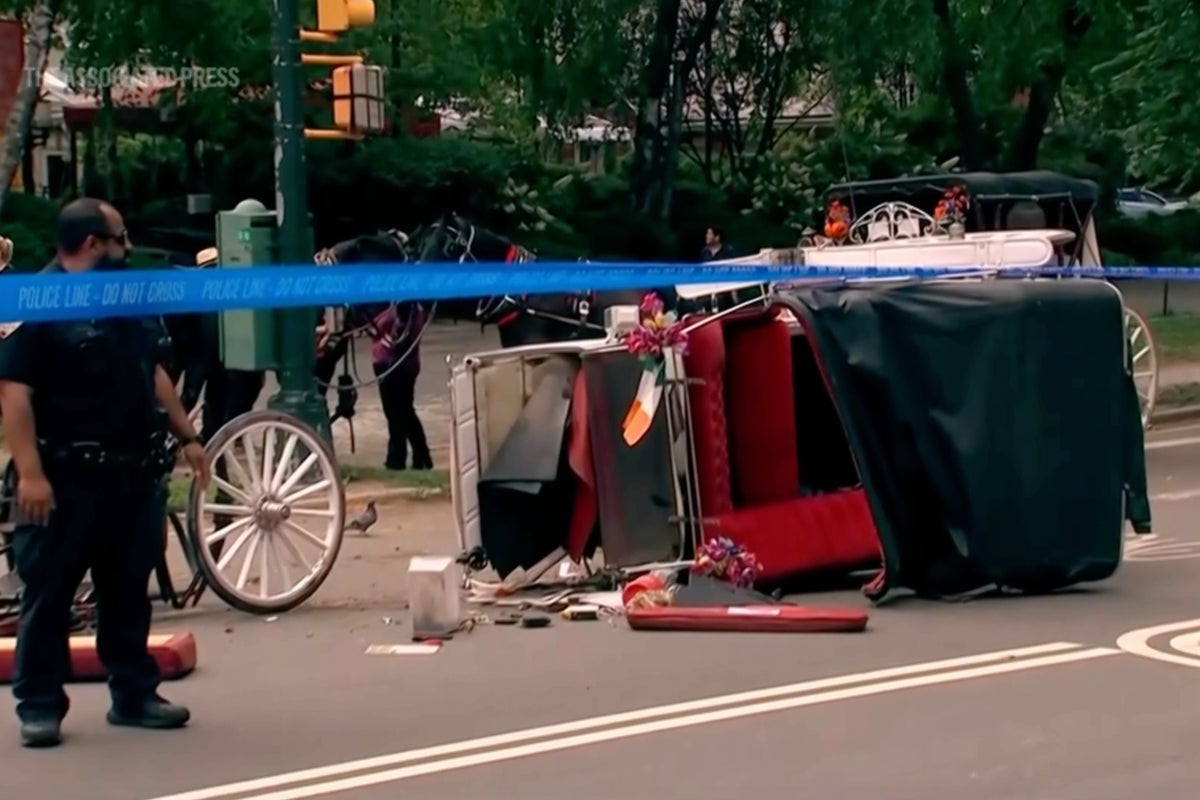
The debate over horse-drawn carriages in Central Park is treated as a simple moral conflict between animal welfare advocates and historical preservationists. This perspective misdiagnoses the problem. The recurring accidents and subsequent public outcries are symptoms of systemic infrastructure failure. Municipalities face an urban planning bottleneck: forcing large, mammalian transport systems to coexist with modern, high-density pedestrian and motorized traffic within a shared corridor.
When a tourist or animal is injured, public discourse focuses heavily on emotional appeals or outright bans. A rigorous operational analysis reveals that Central Park’s carriage system operates under an unsustainable risk profile driven by three structural variables: kinetic disparities, spatial compression, and physiological thermal stress. Resolving this friction requires moving past symbolic politics to evaluate the economic and physical constraints of managing large animals in a modern metropolis.
The Three Pillars of Carriage Infrastructure Friction
To quantify why Central Park presents a high-risk operating environment for horse-drawn transport, the system must be broken down into its fundamental operational hazards.
       [Kinetic Disparity]             [Spatial Compression]
     (Speed/Mass Mismatches)          (High-Density Bottlenecks)
               \                                 /
                \                               /
                 v                             v
             [Systemic Operational Risk Blueprint]
                             ^
                             |
                 [Physiological Stressors]
                (Thermal & Acoustic Loads)
1. Kinetic Disparities and Mass Mismatches
Urban transit networks rely on predictable acceleration, braking distances, and steering inputs. A standard horse-drawn carriage weighs between 1,000 and 1,500 pounds, excluding the weight of the horse (often a draft mix weighing an additional 1,400 to 1,800 pounds). This system operates adjacent to:
- Pedestrians moving at 3 to 4 mph.
- Electric micro-mobility devices (e-bikes, e-scooters) moving at 15 to 25 mph.
- Municipal and commercial motor vehicles moving at 25 to 35 mph.
The safety of this ecosystem breaks down because a horse operates on biological reflexes rather than mechanical inputs. When startled, an equine's flight response bypasses operator control, creating a unguided kinetic mass of nearly 3,000 pounds. The braking distance of a mechanical vehicle can be calculated precisely based on friction coefficients and velocity. The braking distance of a panicked horse is functionally infinite until physical containment or exhaustion occurs.
2. Spatial Compression and Mixed-Mode Bottlenecks
Central Park’s perimeter and interior loops are high-density corridors where multiple distinct transit modes intersect. The entry and exit points—particularly along Central Park South between Columbus Circle and Fifth Avenue—experience extreme spatial compression.
[Vehicle Infrastructure] \
[Micro-mobility Lanes]   ---->  [Spatial Bottleneck]  --> High Conflict Probability
[Pedestrian Walkways]    ---->  (Central Park South)
[Equine Transit Corridors]/
As the city increases the density of micro-mobility infrastructure, the physical lanes dedicated to traditional transit contract. Forcing horses to share narrow margins with fast, near-silent electric vehicles introduces a permanent acoustic and visual trigger for the animals. The infrastructure lacks physical barriers to isolate these modes, ensuring that any single operational anomaly cascades into a multi-vehicle or multi-pedestrian collision.
3. Physiological Stress and Thermal Cost Functions
The operational efficiency of a horse drops sharply when subjected to the microclimate of Midtown Manhattan. Asphalt surfaces retain heat, raising the ambient temperature at ground level up to 15 degrees Fahrenheit above the official atmospheric reading.
The thermodynamic cost function of a working draft horse involves massive metabolic heat generation. Unlike mechanical engines with radiators, a horse relies heavily on evaporative cooling (sweating) and respiratory heat exchange. In high-humidity, high-temperature urban environments, the efficiency of evaporative cooling plummets. When ambient temperatures reach statutory thresholds (such as the current 90-degree Fahrenheit regulatory limit), the animal's internal core temperature can rise dangerously fast, leading to heat exhaustion, muscle breakdown, and behavioral unpredictability.
The Economics of Local Regulation and Labor Retention
The continuation of the carriage industry is frequently attributed to historical tradition, but its survival is actually driven by concentrated economic incentives and labor dynamics.
The industry operates as a closed economic ecosystem protected by a fixed cap on medallion licenses. This regulatory scarcity creates artificial asset values for the medallions, mirroring the historical structure of New York City taxi medallions. The operators face high fixed overhead costs, including stable rent in premium West Side real estate, veterinary care, feed, and insurance premiums.
Because fixed costs are exceptionally high, operators face intense economic pressure to maximize daily utilization rates. This reality creates an inherent policy conflict:
- Regulatory Frameworks seek to limit operating hours based on weather extremes or peak traffic windows to minimize risk.
- Operator Economic Incentives push for maximum hours on the road to cover fixed overhead and yield a net profit.
This friction leads to systemic non-compliance or marginal compliance with safety regulations. Minor shifts in weather monitoring methods or enforcement consistency can mean the difference between a profitable week and an operational loss for a carriage owner. Consequently, self-reporting of safety violations or animal distress is structurally suppressed by the economic model itself.
Structural Limitations of Proposed Alternatives
When accidents occur, policymakers routinely propose two binary solutions: absolute bans or a complete transition to electric horseless carriages. Both approaches have clear structural limitations that decision-makers often ignore.
The Absolute Ban Disruption
Imposing an immediate ban solves the public safety hazard on city streets but creates a secondary economic and logistical crisis. A sudden ban immediately devalues the private capital invested in medallions and equipment. It also removes the primary income source for hundreds of drivers, stable hands, and support staff, triggering labor union resistance and prolonged litigation under the Takings Clause of the Fifth Amendment. Furthermore, an immediate ban creates an immediate welfare burden for the horses themselves, as sanctuary spaces require ongoing capital funding that the city is rarely prepared to subsidize long-term.
The Electric Vintage Carriage Alternative
Transitioning the workforce to electric replicas of vintage carriages is often presented as a perfect compromise. However, this strategy introduces new operational complexities:
- Weight and Subsurface Strain: Electric vintage carriages equipped with industrial-grade batteries to match a full day's runtime weigh significantly more than traditional wooden carriages. This introduces new weight loads on park pathways and subsurface infrastructure.
- Regulatory Classifications: These vehicles operate in a gray zone. If classified as motor vehicles, they face strict Federal Motor Vehicle Safety Standards (FMVSS), requiring crash testing, airbags, and crumple zones that destroy the historical aesthetic. If classified as low-speed vehicles (LSVs), they remain highly vulnerable in mixed traffic outside the park gates.
- Market Differentiation: The primary consumer demand for these rides is rooted in the novelty of animal interaction and historical romanticism. Removing the biological element fundamentally alters the product utility, potentially reducing consumer willingness to pay and rendering the business model unviable at current price points.
Systemic Risk Optimization Playbook
Rather than pursuing a politically gridlocked ban or relying on a flawed technological replacement, municipalities must use a phased infrastructure isolation strategy. If the industry is to continue, the goal must be the absolute separation of conflicting kinetic modes.
+-----------------------------------------------------------------------------+
| STAGE 1: SPATIAL ISOLATION                                                  |
| * Eliminate all mixed-traffic operations outside park boundaries.           |
| * Restrict carriage operations exclusively to designated interior loops.     |
+-----------------------------------------------------------------------------+
                                       |
                                       v
+-----------------------------------------------------------------------------+
| STAGE 2: REAL-TIME THERMAL MONITORING                                       |
| * Replace fixed station weather readings with mobile biometric sensors.      |
| * Automate operational halts based on real-time wet-bulb globe temperature. |
+-----------------------------------------------------------------------------+
                                       |
                                       v
+-----------------------------------------------------------------------------+
| STAGE 3: KINETIC SEGREGATION                                                |
| * Install physical barriers separating micro-mobility and carriage paths.   |
| * Enforce strict geo-fenced speed caps for electric devices near equines.    |
+-----------------------------------------------------------------------------+
First, eliminate all mixed-traffic operations outside the park boundaries. The practice of staging and driving carriages along major Midtown commercial avenues introduces unmanageable chaotic variables. The staging areas must be moved entirely inside the park perimeter, creating a physical buffer from heavy commercial vehicles, emergency sirens, and high-velocity traffic.
Second, upgrade the regulatory triggers from static, regional thermometer readings to real-time, localized Wet-Bulb Globe Temperature (WBGT) indexes measured directly at the staging zones. The WBGT factors in ambient temperature, humidity, wind speed, and solar radiation, providing an accurate metric of environmental heat stress on large mammals. The operational threshold should be programmatically enforced through digital medallions linked to city compliance dashboards, removing human bias and economic pressure from the suspension process.
Third, construct physically segregated lanes within the park interior. If a path is designated for equine transit, it must be completely isolated from electric micro-mobility options via grade separation or physical bollards. Reducing the cognitive and sensory load on the animals is the only reliable way to lower the probability of a flight response.
The current strategy of maintaining a shared, unseparated corridor while relying on the operator's skill to manage an animal's basic instincts guarantees future system failures. Mitigating this risk requires either funding the heavy infrastructure needed to truly isolate these animals, or accepting that modern urban density has structurally outgrown animal-powered transit.


