The fragile peace built on the April ceasefire just went up in smoke. Literally. If you think the current conflict in the Middle East is confined to localized borders, you're missing the bigger picture. The overnight exchange of ballistic missiles and explosive drones between Iran and the United States has shattered any illusion of a stable truce. Kuwait is now calling this a "dangerous escalation" and a "flagrant violation of its sovereignty," and frankly, they have every right to be furious.
This isn't just another routine skirmish in the Gulf. For the second time in less than 72 hours, Iranian projectiles targeted sovereign Gulf states hosting US forces, pulling neutral neighbors directly into the crossfire. Early morning sirens tore through Bahrain while the Kuwaiti military scrambled air defense systems to knock down incoming threats over populated areas. The damage is real, the casualties are mounting, and the economic fallout is ready to ripple across the globe.
The Night the Gulf Woke Up to Chaos
Residents in Kuwait and Bahrain didn't just hear the standard rumble of military exercises. They woke up to window-rattling detonations. Iran’s Islamic Revolutionary Guard Corps (IRGC) launched a synchronized wave of ballistic missiles and drones aimed squarely at US military hubs in the region. Specifically, they targeted the Ali al-Salem airbase in Kuwait and the sprawling headquarters of the US Navy’s Fifth Fleet in Bahrain.
While US Central Command (CENTCOM) claims that its defense umbrella intercepted the majority of the threats—stating that five to seven heavy missiles broke apart or were brought down—the story on the ground looks vastly different.
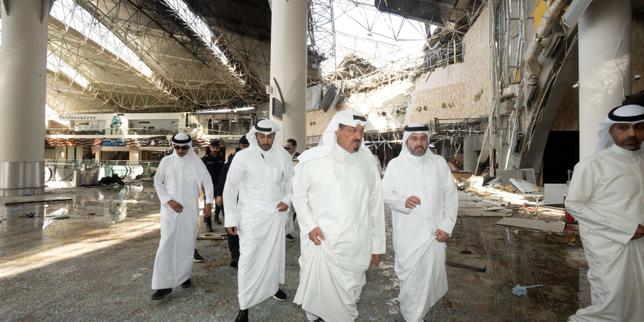
- Kuwait International Airport took a direct hit. Drones breached the local air defense grid, tearing a gaping hole through the passenger terminal ceiling. Smoke, fire, and shattered masonry transformed a civilian transit hub into a combat zone.
- The human toll is rising. Kuwaiti health officials confirmed that one person was killed and at least 63 others were wounded, with surgeons performing emergency procedures through the night to save those in critical condition.
- Civilian infrastructure is no longer out of bounds. Kuwait’s foreign ministry pointed out that diplomatic missions and local neighborhoods suffered structural damage from a mix of direct drone impacts and heavy, falling missile debris.
This massive volley didn't happen in a vacuum. Tehran insists this is direct retaliation. Hours earlier, the US military launched what it called "self-defense strikes" against Iranian coastal surveillance radar positions and a drone ground control station on Qeshm Island, a strategically vital outpost in the Strait of Hormuz.
The US is trying to contain the narrative by calling their operations preventive. Iran is calling its counter-strikes a fulfilled promise. The result? A complete breakdown in the back-channel negotiations that were supposed to turn April’s temporary truce into something permanent.
Why Kuwait and Bahrain Are Stuck in the Middle
Tehran’s defense ministry released a blunt statement that tells you everything you need to know about their current strategy. They stated that responsibility for the consequences lies with the parties that assist American forces by providing territory and resources.
Basically, Iran is telling the Gulf Cooperation Council (GCC) that hosting US troops makes them a legitimate target.
This puts countries like Kuwait in an impossible diplomatic and security vice. Kuwait has spent decades balancing its relationship with its massive neighbor across the Gulf while maintaining deep security alliances with Washington. Now, that balancing act is failing. Kuwaiti officials have made it clear that they reserve their "full and inherent right" to defend their territory. They aren't just issuing diplomatic complaints anymore; they are actively rearming.
In fact, the United States just fast-tracked a $1.98 billion arms sale to Kuwait. The package centers heavily on specialized counter-drone technology from Anduril, a direct response to the exact type of low-altitude, asymmetric threats that bypassed airport defenses this week. Gulf security is entirely interconnected. An attack on a terminal in Kuwait City sends shockwaves through markets in Riyadh and Abu Dhabi.
The Economic Toll No One Wants to Face
The real danger here isn't just localized destruction. The breakdown of this truce throws the global economy right back into chaos. The Strait of Hormuz remains a critical chokepoint for the world's energy supply. When maritime radar stations get blown up and missiles fly across the shipping lanes, insurance premiums for oil tankers skyrocket instantly.
We're already seeing the broader fallout. The World Food Programme (WFP) issued a stark warning following these strikes, pointing out that millions more people face immediate food insecurity and hunger. Why? Because when regional volatility spikes, energy costs surge, and shipping logistics fracture. That means the cost of moving basic food commodities climbs out of reach for developing nations. This isn't just a military crisis; it's a humanitarian accelerator.
What Happens Next
The immediate priority for the region is a rapid overhaul of civilian defense protocols and airspace management. If you are operating or managing supply chains, logistics, or corporate security in the Gulf, you need to adjust to this new reality immediately.
- De-risk transit routes through the Upper Gulf. Do not assume civilian corridors like international airports are safe zones during a flash escalation. Diversify logistics hubs toward the southern GCC ports where possible.
- Accelerate counter-UAS deployment. Corporate infrastructure, oil installations, and private logistics hubs must audit their low-altitude drone detection capabilities. Standard missile defense systems like Patriot batteries are built for high-altitude ballistic threats, not low-flying suicide drones.
- Prepare for prolonged energy market volatility. The diplomatic breakdown over whether regional proxy conflicts are covered under the broader ceasefire means these flashpoints will happen without warning. Hedging energy costs isn't optional anymore.
The diplomatic lines between Washington, Tehran, and Gulf capitals are completely frayed. Until both sides decide that a permanent truce is worth more than tactical retaliation, the skies over the Gulf will remain dangerous.