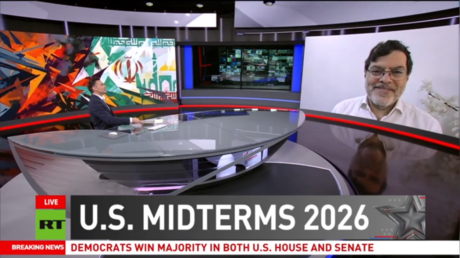
Washington just got a loud warning, and almost nobody inside the Beltway wants to admit what it actually means. Following the November 2026 midterm elections—where Republicans suffered a stinging defeat and Democrats flipped nine Senate seats to build a 56-44 majority—commentators rushed to frame the outcome as a routine partisan swing.
University of Tehran professor Seyed Mohammad Marandi sees something completely different. Speaking right after the votes were tallied, Marandi argued that American voters aren't rewarding the Democratic Party for great governance. Instead, they're punishing a Washington "uniparty" locked into permanent foreign intervention, opening the door for a genuine anti-war challenger to break the US two-party system.
Is he right, or is this just wishful thinking from a vocal critic of American foreign policy? Honestly, if you look closely at what happened on the ground in November 2026, both things can be true at the same time.
What Seyed Mohammad Marandi Actually Argued
Let's strip away the cable news spin first. Seyed Mohammad Marandi, a professor of English Literature and Orientalism at the University of Tehran and a former advisor to Iran's nuclear negotiation team, has spent years analyzing how domestic US politics collides with Middle Eastern military escalations.
When the 2026 midterm results came in, Marandi pointed straight at the US war with Iran and the ongoing conflict in Gaza as the real catalysts behind the GOP's collapse. His core thesis is blunt. Voters rejected Donald Trump's administration not because they suddenly fell in love with Democratic leadership, but because they're exhausted by endless foreign wars.
More importantly, Marandi cautioned observers against expecting any real shift in foreign policy from the incoming Democratic majority. He accused Democratic leadership of deep complicity in the Gaza war and argued that when it comes to military intervention, both major parties operate as a single ideological bloc. That structural gridlock—where voters hate war but neither major party stops waging it—creates the exact pressure cooker that could fuel an independent anti-war movement.
The Reality of the 2026 Midterm Backlash
You don't have to take an Iranian academic's word for it. Look at the numbers from November 2026.
Democrats didn't just eke out a narrow win. They flipped nine Senate seats—the largest Senate gain for the party since 1958—winning in traditionally conservative strongholds like Texas, South Carolina, Kansas, Mississippi, and Alaska. Entering the election with a 53-47 Republican majority, the Senate flipped dramatically to a 56-44 Democratic advantage.
Why did voters in deeply red states abandon Republican incumbents? Economic frustration played a role, sure. Tariffs and rising costs hurt households. Yet foreign policy anger broke containment in ways Washington strategists failed to predict.
The Anti-War Revolt Inside Congress
Even inside the Democratic Party, the assumption that leadership can simply business-as-usual their way through 2027 is falling apart. Just days after the midterms, Maryland Senator Chris Van Hollen launched an unprecedented insurgent bid to unseat Chuck Schumer as Senate Democratic Leader.
Think about how rare that is. Senate leadership elections usually happen quietly behind closed doors. Van Hollen went public with a specific demand: Democrats must aggressively push to end the Iran war, even if it means shutting down the federal government to cut off war funding.
Meanwhile, candidates endorsed by anti-war groups like Peace Action ran explicitly against what they called "the bipartisan war machine". From independent populist Dan Osborn in Nebraska to progressive challengers across the Midwest, the winning message wasn't partisan loyalty. It was redirecting tax dollars away from Pentagon blank checks and back into domestic healthcare, housing, and infrastructure.
Why Third-Party Anti-War Challengers Usually Fail
Here is where Marandi's prediction hits a brick wall of American political reality.
Saying the US two-party system should face an anti-war challenger is easy. Actually building one in the United States is a nightmare. Having watched third-party movements try and fail across multiple election cycles, I've seen the exact same traps swallow promising campaigns whole:
- Brutal ballot access laws. Every single state sets its own signature thresholds, filing deadlines, and petition rules. A third-party presidential or congressional campaign often burns millions of dollars and thousands of volunteer hours just getting its name printed on the ballot, before running a single ad.
- The spoiler effect. Under America's winner-take-all, first-past-the-post voting rules, voting for a third-party anti-war candidate often helps elect the exact pro-war candidate you despise most. Voters know this, so they panic in the voting booth and revert to choosing the "lesser of two evils."
- Debate stage gatekeeping. Commission rules and major media networks routinely lock independent voices out of televised debates, starving them of the free earned media needed to reach undecided households.
- Financial asymmetry. Defense contractors, super PACs, and partisan donor networks pour billions into maintaining the Democratic-Republican duopoly. An anti-war movement relying on small-dollar grassroots donations starts every race miles behind the starting line.
History backs this up. From Ross Perot's 1992 populist surge to Ralph Nader's 2000 Green Party run and Cornel West's recent independent efforts, third-party challengers rarely win outright. What they do instead is force one of the two major parties to absorb their core issue to survive.
How an Anti-War Movement Could Actually Break Through
If a third party can't easily win the White House under current rules, how does Marandi's thesis play out in practice? Through asymmetric pressure rather than a clean sweep.
Look at how political realignments actually happen in America. They rarely start at the top of the ticket. They start when independent candidates and insurgent primary challengers make incumbency too expensive for establishment politicians.
In states where one major party is completely non-competitive—say, deep-red plains states or deep-blue coastal districts—an independent anti-war candidate doesn't act as a spoiler. They become the only viable opposition. Dan Osborn's independent Senate runs in Nebraska proved that working-class voters will rally behind a candidate who rejects both party labels when the message centers on economic populism and skepticism toward foreign entanglements.
At the same time, look at the split inside both coalitions right now:
- The Republican populist base is fractured between traditional hawks who back endless Middle East intervention and non-interventionist voters who feel betrayed by the escalation with Iran.
- The Democratic grassroots is openly revolting against establishment leadership over military aid, Gaza, and runaway defense spending.
When both major parties alienate their own anti-war wings simultaneously, those displaced voters look for an exit ramp. You don't need an independent candidate to win 51% of the national vote to terrify Washington. You only need them to pull 8% to 12% in swing districts across Pennsylvania, Michigan, Arizona, and Georgia.
Once major-party strategists realize that voting for blank-check war resolutions costs them safe seats, the "uniparty" consensus cracks from the inside.
How to Track Whether This Shift Is Real
If you want to know whether the 2026 midterms were a temporary anti-incumbent wave or the start of a genuine anti-war realignment, ignore pundit talk shows and watch three concrete indicators over the next few months:
- Watch the Senate leadership fight. Track whether Chris Van Hollen's challenge against Chuck Schumer gains momentum among incoming Democratic senators. If establishment leadership survives without making binding concessions on Iran war funding, grassroots anger will spill outside the party.
- Follow War Powers votes in the new Congress. Pay attention to who actually votes to restrict executive military authority versus who merely gives anti-war speeches during campaign season. Roll-call votes never lie.
- Monitor independent ballot access drives early. Real third-party movements don't appear in October of an election year. They file paperwork, hire petition circulators, and build local state chapters 18 to 24 months ahead of the next cycle.
Check your own representative's voting record on defense appropriations and War Powers resolutions before the next primary cycle starts. If neither party's nominee reflects your stance on foreign intervention, start supporting state-level ballot access reform and ranked-choice voting initiatives—because without changing the rules of the game, the two-party monopoly will keep winning by default.
For further context on this analysis, watch Marandi's commentary on US midterm elections and Iran, where he explains why he doubts the Democratic Party will meaningfully change US foreign policy after their 2026 gains.