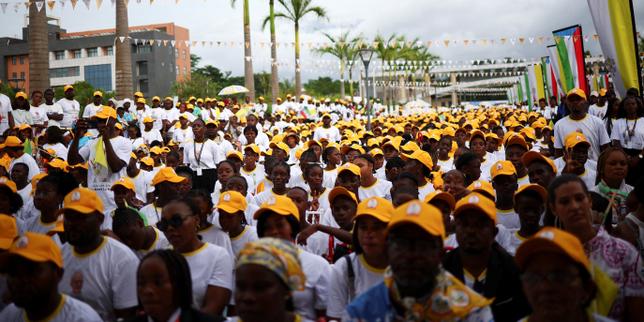
In the crowded cathedrals of Kinshasa and the sun-drenched parishes of Lagos, a singular hope has taken root among the pews. It is the belief that the moral weight of a Roman Pontiff can succeed where decades of civil activism and international sanctions have failed. As Pope Leo XIV navigates the complex political waters of the African continent, he isn't just acting as a shepherd of souls. He is being drafted as a de facto mediator for a generation of citizens who feel utterly abandoned by their own political class. The premise is simple: when a president ignores the street, the ballot box, and the World Bank, he might still take a phone call from the Holy See.
This reliance on the papacy reveals a desperate vacuum in African leadership. Faith is not just a spiritual refuge here; it is the last functional infrastructure in regions where the state has effectively retreated. When Leo XIV speaks, he does so with an audience of nearly 260 million African Catholics behind him. This is a demographic reality that even the most entrenched autocrat cannot ignore. However, the expectation that a religious figurehead can dismantle systemic corruption or force democratic transitions is a dangerous gamble that ignores the hardening of modern authoritarianism.
The Weight of the Ring in the Halls of Power
The influence of the Vatican in Africa has shifted from the missionary models of the past to a sophisticated diplomatic pressure campaign. Unlike Western NGOs or government agencies, the Church possesses a permanent, grassroots presence. A priest in a rural village often knows more about local grievances than a district governor. This intelligence network allows the Vatican to speak with a level of local authority that foreign diplomats lack.
When Leo XIV engages with heads of state, he is utilizing a form of "soft power" that is uniquely insulated from the usual accusations of neo-colonialism. Because the African Church is increasingly led by African clergy, the message feels internal rather than imposed. Yet, the mechanism of this influence is fragile. It relies on the personal conscience of leaders who have often spent their careers suppressing it.
The strategy usually involves a mixture of public "moral exhortations" and private, high-level negotiation. In the private quarters, the Pope can offer a face-saving exit for a leader under fire or act as a neutral guarantor for peace talks. This was seen in previous decades in Mozambique and more recently in the South Sudanese peace process. The current hope is that Leo XIV will apply this same pressure to the "eternal presidents" of Central Africa.
Why the Moral High Ground Often Slips
There is a cynical reality that journalists often overlook when covering papal visits. Autocrats love the optics of a Vatican blessing. For a leader accused of human rights abuses, a photo-op with a smiling Pope is a powerful tool for domestic and international rehabilitation. They trade a few days of listening to "pro-democracy" speeches for a lifetime of legitimacy.
The risk is that the Pope becomes a "useful idiot" for regimes that have no intention of changing. These leaders are masters of the "spiritual pivot." They attend the Mass, nod solemnly at the calls for justice, and then return to the presidential palace to sign arrest warrants for the opposition. The Vatican’s diplomacy is built on the assumption of good faith, a currency that is currently in short supply in many world capitals.
Furthermore, the Church itself is not a monolith. In many African nations, the local clergy are deeply intertwined with the political elite. Bishoprics often depend on government cooperation for land titles, school funding, and security. This creates a friction point between the Pope’s global message of social justice and the local Church’s need for survival. When the Vatican pushes too hard, it risks exposing local priests to state retaliation.
The Grassroots Disconnect
If you speak to the youth in Nairobi or Dakar, the perspective shifts. They are less interested in the theology of the papacy and more interested in the Pope as a "lobbyist" for the poor. To them, the Church is the only "NGO" that doesn't leave when the funding dries up.
- Healthcare: In many regions, Church-run clinics provide the only reliable maternal care.
- Education: Catholic schools often produce the very intellectuals who go on to lead protest movements.
- Sanctuary: During periods of electoral violence, the parish walls are the only line of defense against paramilitary groups.
This reliance creates an immense burden of expectation. If Leo XIV fails to secure concrete concessions—such as the release of political prisoners or the commitment to term limits—the disappointment among the faithful could lead to a broader secularization or a migration toward more radical, populist religious movements. The "hope" mentioned in competitor reports isn't a passive emotion; it is a high-stakes demand for results.
The Limits of Modern Papal Diplomacy
We must address the uncomfortable truth that the world has changed since the days of John Paul II and the fall of the Iron Curtain. In the 1980s, the Vatican was a central pillar of a bipolar world order. Today, African leaders have a menu of partners. If the Pope or the West becomes too critical of their human rights record, they simply turn to Beijing or Moscow, partners who famously ask no questions about the treatment of dissidents.
Leo XIV is competing in a marketplace of influence where "morality" is a low-value commodity. His primary lever is no longer the threat of excommunication—which holds little weight in a globalized, pluralistic political environment—but rather his ability to mobilize public opinion.
The real power lies in whether the Pope can convince the African middle class to align their faith with their political activism. If the message from the pulpit translates into pressure at the polling station, leaders will listen. If it remains a spiritual sentiment shared during a three-day apostolic visit, it will be forgotten before the papal plane clears the tarmac.
Hard Realities of the Apostolic Mandate
The Vatican’s "Africa Policy" is currently navigating a minefield of internal contradictions. On one hand, the continent is the future of the Catholic Church, representing the only region with explosive growth in vocations and attendance. On the other hand, the Church is desperate to maintain its status as a neutral mediator. You cannot be a neutral mediator and a vocal critic of a regime at the same time.
This tension leads to "softened" rhetoric that often frustrates the very people the Pope intends to help. While the faithful want a lion, the Vatican usually sends a diplomat. This diplomatic caution is often interpreted as complicity by those suffering under the boot of a dictatorship. The efficacy of the Pope's voice is therefore directly proportional to his willingness to risk the Church's institutional safety for the sake of political truth.
History shows that religious intervention works best when it is paired with external economic pressure. The Pope can provide the moral "permission" for the international community to act, but he cannot be the sole actor. Without a coordinated effort from the African Union and global financial institutions, the Pope’s words remain a beautiful, but ultimately hollow, resonance in a landscape defined by iron-fisted pragmatism.
The faithful in Africa are not looking for a miracle. They are looking for a witness who cannot be silenced. In a continent where the state has become a predator, the arrival of a global figure who speaks the language of dignity is a political event of the highest order. The success of Leo XIV will not be measured by the size of the crowds at his outdoor Masses, but by the number of political prisoners who are quietly released in the weeks following his departure. If the gates stay locked, the moral authority of the papacy will have met its limit against the cold reality of modern power.
Stop looking for the change in the speeches; look for it in the prison logs and the electoral commissions.


