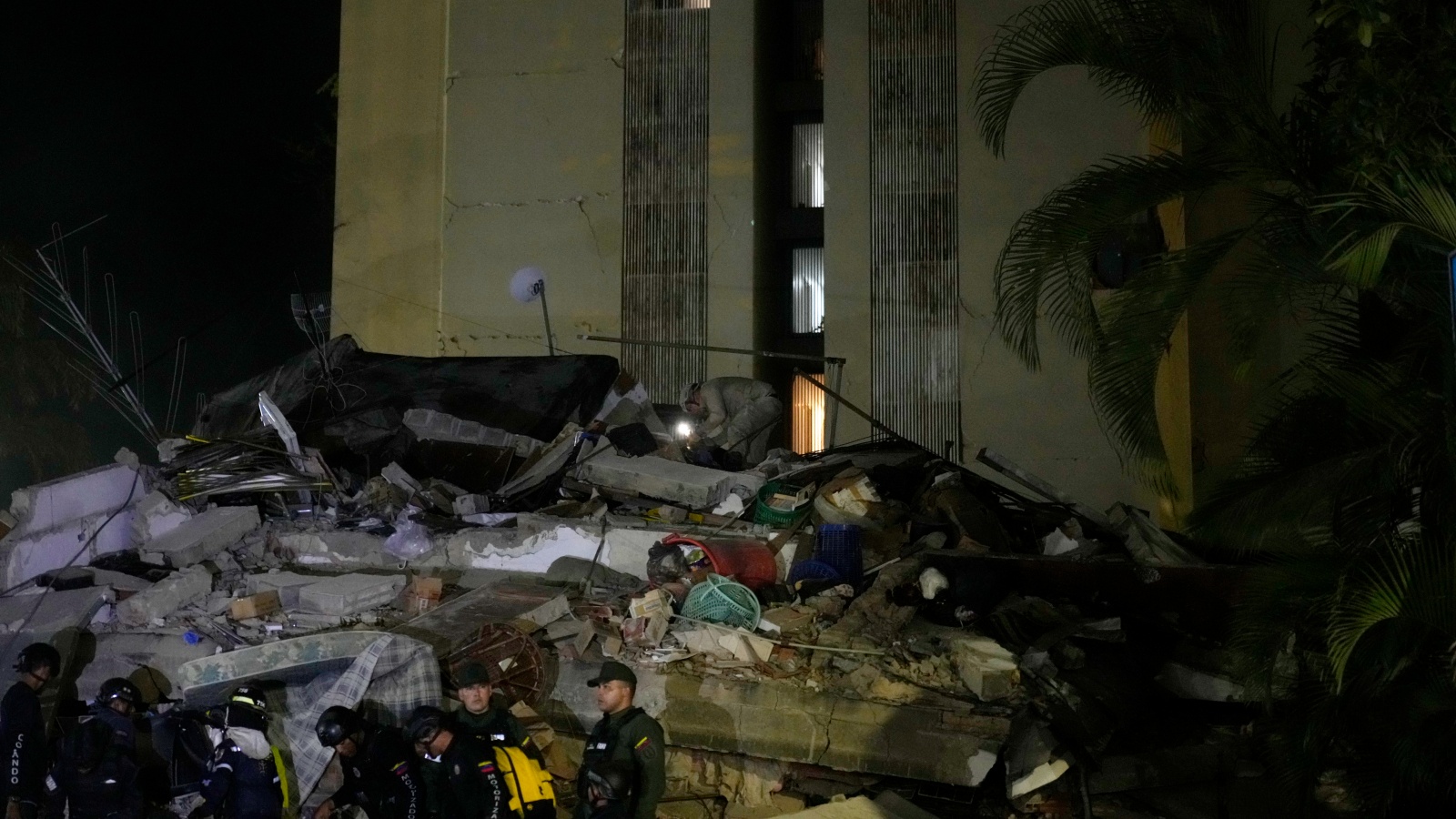
A 7.5 magnitude earthquake striking the northern coast of Venezuela represents a catastrophic convergence of geological stress release and structural vulnerability. Occurring on June 24, 2026, this event—compounded by a 7.2 magnitude precursor just 39 seconds earlier—is the most powerful seismic sequence to affect the country since 1900. The immediate physical impact includes the collapse of multiple high-rise structures in Caracas, severe damage to Simón Bolívar International Airport, and localized tsunami threats across the southern Caribbean. Evaluating this disaster requires moving past sensationalized reporting and analyzing the event through precise engineering frameworks, tectonic mechanics, and supply-chain risk functions.
The Mechanics of a Rare Seismic Doublet
The event near Morón cannot be classified as a standard mainshock-aftershock sequence. Instead, seismologists from the United States Geological Survey (USGS) classified it as a rare seismic doublet. A doublet occurs when two major earthquakes of comparable magnitude strike within an exceptionally short time window and in close geographic proximity. Recently making news recently: The Deadly Illusion of Foreign Disaster Aid.
The structural failure occurred along the highly active oblique-slip boundary where the Caribbean Plate meets the South American Plate. This boundary accommodates approximately 20 millimeters of relative motion per year through a combination of strike-slip faulting and subduction.
[Caribbean Plate] ---> Moving East relative to South American Plate
------------------------------------------------------------------
[Boconó-San Sebastián-El Pilar Fault System] -> Epicenter: Morón
------------------------------------------------------------------
[South American Plate] <--- Subducting / Oblique Stress Accumulation
The first rupture occurred at 6:04 PM local time, registering a magnitude of 7.2 at a depth of 22 kilometers. Rather than dissipating stress, this initial rupture immediately loaded adjacent fault segments to their failure thresholds. The second, more destructive rupture occurred at a depth of only 10 kilometers, registering at magnitude 7.5. Additional details into this topic are covered by NBC News.
Shallow focal depths significantly exacerbate ground acceleration. Because seismic waves have less distance to travel through the earth's crust, they lose less energy to geometric attenuation before reaching the surface. The Peak Ground Acceleration (PGA) generated by the 10-kilometer-deep 7.5 magnitude shock far exceeded the design tolerances of standard Venezuelan infrastructure.
Infrastructure Vulnerability and Kinetic Failure Modes
The severe structural degradation observed in Caracas and La Guaira stems from a compounding vulnerability model. The primary factors include aging reinforced concrete structures, informal construction expansion, and prolonged economic asset-neglect.
Fatigue Amplification from Back-to-Back Shock Waves
Structures exposed to the 7.2 magnitude foreshock suffered immediate micro-fissuring and foundational shifting. Reinforced concrete relies on the bond between steel rebar and concrete to resist tensile forces. The first shock fractured these interior bonds, destroying the elastic capacity of the buildings. When the 7.5 magnitude shock struck 39 seconds later, the buildings lacked the structural integrity to deform safely. Instead, they entered immediate kinetic failure.
The structural degradation followed three distinct mechanics:
- Soft-Story Collapse: Many mid-rise residential buildings in Caracas utilize open ground floors for parking or commercial space. These floors lack shear walls, creating a stiffness discontinuity. Under the lateral forces of the doublet, these soft stories collapsed entirely, pancaking the upper floors.
- Resonance Shaking in High-Rises: High-rise buildings in Chacao swayed violently for several prolonged seconds. The fundamental vibration period of a 15-to-20-story building matched the long-period seismic waves generated by the shallow 7.5 magnitude rupture. This resonance multiplied the lateral displacement of upper floors, tearing away concrete facades and snapping structural columns.
- Soil Liquefaction in Coastal Zones: In La Guaira and near the port infrastructure, the shallow water table combined with unconsolidated sandy soils created textbook liquefaction conditions. Under rapid cyclic loading, the water pressure inside the soil pores increased to the point where the soil lost all shear strength, acting as a liquid. Foundations shifted sideways, causing the total collapse of at least 15 major buildings in the state.
Strategic Supply Chain and Energy Sector Disruption
Venezuela's primary economic engine, its oil extraction and refining infrastructure, sits in direct proximity to the fault system. The epicenter near Morón puts major refining complexes and shipping terminals within the zone of violent shaking.
Refineries and Coastal Terminals
Refineries are highly sensitive chemical ecosystems that cannot tolerate abrupt ground displacement. Differential settlement—where one part of a heavy industrial foundation sinks faster than another—ruptures high-pressure piping, leading to explosive hydrocarbon leaks.
The critical risk points include:
- Distillation Tower Alignment: Even a fraction of a degree of tilt in fractionating columns halts the refining process entirely, requiring months of laser-alignment and structural reinforcement.
- Storage Tank Structural Integrity: Large floating-roof oil storage tanks are susceptible to "sloshing" during long-period seismic waves. The sloshing liquid exerts immense hydrodynamic pressure on the tank walls, causing buckling or tearing the floating roof from its seals, which presents an immediate fire hazard.
- Offshore Pipe Rupture: Submarine pipelines transporting oil from coastal hubs face high risk from underwater landslides triggered by the 7.5 magnitude shock. The USGS issued localized tsunami advisories across the Netherlands Antilles (Aruba, Curaçao, and Bonaire), confirming that underwater mass movements occurred.
Transportation Interdiction
The closure of Simón Bolívar International Airport in Maiquetía due to severe structural damage creates an immediate logistics bottleneck. The runway systems must undergo ground-penetrating radar scans to identify subterranean voids caused by liquefaction before heavy cargo aircraft can land.
The main highway connecting Caracas to the coast—the Autopista Caracas-La Guaira—is highly vulnerable to rockfalls and landslide blockages. If this single corridor is severed, moving heavy engineering equipment or massive humanitarian aid packages from the ports to the capital becomes logistically impossible.
Regional Geopolitical Aid Mobilization
Disaster diplomacy began immediately following the state of emergency declared by Acting President Delcy Rodríguez. Because the current geopolitical environment features a divided Venezuelan leadership landscape, international aid delivery requires navigating complex administrative channels.
The United States mobilized a disaster assistance team through the State Department, coordinated under Undersecretary Jeremy P. Lewin. Concurrently, regional neighbors including Brazil, Mexico, Colombia, and Ecuador pledged immediate search-and-rescue teams. The arrival of international personnel presents an operational challenge: coordinating different military and civilian rescue frameworks within a heavily damaged communication grid.
The initial USGS PAGER (Prompt Assessment of Global Earthquakes for Response) models estimated a high probability of widespread casualties, with initial projections indicating potential fatalities ranging from the hundreds into the thousands depending on structural collapse rates in high-density informal settlements (barrios). These communities feature self-built, unreinforced masonry homes stacked vertically on steep hillsides. The lateral forces of the doublet cause these hillsides to lose stability, triggering cascading landslides that bury entire municipal blocks.
Quantitative Seismic History Comparison
To understand the scale of the June 2026 event, it must be compared mathematically against historical benchmarks. The logarithmic scale of earthquake magnitude means that a 7.5 magnitude event releases substantially more energy than previous destructive quakes in the region.
The energy released by an earthquake scales by a factor of roughly 31.6 for each whole number increase in magnitude.
| Event | Date | Magnitude | Depth | Primary Failure Vector |
|---|---|---|---|---|
| San Narciso Earthquake | October 29, 1900 | 7.7 | Unknown | Widespread coastal destruction |
| Caracas Earthquake | July 29, 1967 | 6.6 | 15 km | Structural collapse of four high-rise buildings |
| Cariaco Earthquake | July 9, 1997 | 6.9 | 10 km | School and residential collapses due to poor concrete quality |
| Sucre Earthquake | August 21, 2018 | 7.3 | 146 km | Minimal surface damage due to extreme deep-focus energy dissipation |
| Morón Doublet (Mainshock) | June 24, 2026 | 7.5 | 10 km | Pre-fatigue from 7.2 foreshock, shallow resonance |
The 2018 event registered a high magnitude of 7.3 but caused negligible structural damage because its focal depth was 146 kilometers. The 2026 mainshock, at 10 kilometers depth, delivered nearly the entirety of its kinetic energy directly to the surface foundations of Venezuela's most densely populated economic corridor.
Immediate Engineering and Recovery Projections
The immediate recovery phase must bypass simple aesthetic repairs and focus entirely on structural stabilization and economic insulation. Emergency managers must implement an immediate three-stage operational protocol.
Structural Triage and Red-Tagging
Engineering teams must systematically evaluate every building over three stories in Caracas and La Guaira using laser scanning and ultrasonic pulse velocity testing to detect interior concrete voids. Buildings must be categorized into a strict three-tier system:
- Green (Accessible): Superficial cosmetic cracking only; structural frame remains sound.
- Yellow (Restricted Access): Minor structural damage to non-load-bearing walls; safe for temporary entry to salvage equipment or records, but requires shoring before re-occupancy.
- Red (Unsafe): Compromised columns, severe tilting, or foundation shear. These buildings must be cordoned off immediately to prevent catastrophic collapse during the inevitable 5.0+ magnitude aftershocks that will rattle the fault line over the next 90 days.
Port and Runway Stabilization
Simón Bolívar International Airport requires the immediate deployment of mobile military air traffic control towers and rapid-setting polyurethane resin injections to stabilize cracked runway sub-bases. Priority must be given to clearing a single 2,000-meter strip capable of handling C-17 and Antonov cargo aircraft carrying heavy shoring equipment and water purification plants.
Fault Zone Monitoring and Energy Allocation
Given that the doublet may not have fully relieved the accumulated strain along the San Sebastián fault system, real-time GPS telemetry networks must be deployed along the coast to measure ongoing crustal deformation. Power grids must isolate high-risk industrial zones—especially chemical storage tanks near Puerto Cabello—to prevent secondary industrial fires if an aftershock ruptures electrical transformers. The focus must remain on hard engineering realities: concrete strength, soil mechanics, and logistical throughput.