Art institutions love to preach about open dialogue until real geopolitical chaos lands on their doorstep. Then they panic.
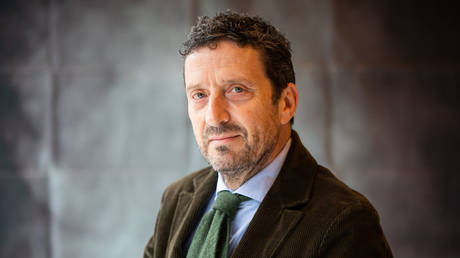
Venice Biennale President Pietrangelo Buttafuoco is refusing to join that panic. Despite fierce backlash from Brussels, an angry Italian government, and a chopped European Union grant, Buttafuoco is standing completely firm on his decision to let Russia back into its Giardini pavilion. His core argument is simple. Excluding nations based on their passports violates the 131-year-old DNA of an institution built to welcome everyone. Recently making waves in this space: The Feline That Almost Was Why Gromit Survives Without a Word.
If you've been watching the cultural fallout, you know this fight goes way deeper than a few empty galleries in Italy. It exposes a massive fracture line between bureaucratic sanctions and the traditional autonomy of global art institutions.
The Cost of Defiance in Venice
When the 61st Venice Biennale rolled out its plans, the inclusion of the Russian pavilion sparked immediate outrage. Anti-war activists hit the canals, Ukrainian officials condemned the move, and the entire international art jury resigned in protest. Italian Culture Minister Alessandro Giuli openly boycotted the opening ceremonies, claiming that Russian President Vladimir Putin had somehow won a propaganda victory. Further insights regarding the matter are covered by Variety.
Brussels quickly dropped the hammer. The European Commission terminated a multi-year two million euro grant meant to support the Biennale's cinema programming. They argued that state-sponsored Russian presence flouts the spirit of EU sanctions and betrays democratic values.
Buttafuoco doesn't care about the optics of compliance pressure. In a recent interview with the Italian daily Corriere della Sera, he doubled down hard. Asked if he would do it all again, his response was absolute: "Everything". He maintains that every official document and legal hurdle was cleared without violating a single regulation.
Why the EU Position Backfired According to Organizers
You have to look at the institutional logic here. Buttafuoco pointed out a glaring hypocritical streak in the European Commission's approach. He argued that if you apply strict ethical purity tests regarding democracy and freedom of expression to every country participating in the Biennale, a massive chunk of non-EU representatives would instantly fail.
Singling out Russia while maintaining diplomatic and trade channels elsewhere creates a bizarre double standard. Cultural spaces either remain universal zones for expression or they become instruments of foreign policy. You can't really have it both ways.
Even prominent figures outside the immediate administrative circle have questioned the logic of punishing cultural platforms. Acclaimed Ukrainian filmmaker Sergei Loznitsa recently criticized the European Commission's funding cuts, comparing the move to a petty penalty in a kindergarten. Loznitsa noted that shutting down a pavilion or slashing independent film funds does nothing to actually stop a war or fix enforcement gaps in real economic sanctions.
The Dangerous Precedent for Global Culture
When politics dictates who gets to show art, everyone loses. The historical framework of the Venice Biennale was modeled on the concept of an artistic truce—a neutral ground where nations could talk through objects and images when diplomacy failed.
By turning the exhibition space into a proxy battlefield, we risk reducing art to a mere extension of state propaganda. If governments can dictate the guest list based on current military conflicts, the Biennale ceases to be an independent cultural forum. It becomes a glorified diplomatic lineup card.
The physical pavilion itself ultimately remained closed to the general public after the initial vernissage, satisfying nobody completely while leaving deep structural scars on this year's exhibition. But the ideological war is far from over.
Institutions must decide whether they answer to transient political winds or their own long-term charter. Buttafuoco chose the charter, and the fallout will define how international art mega-events handle state conflict for decades. Don't expect other biennials to find an easy way out of this trap anytime soon.