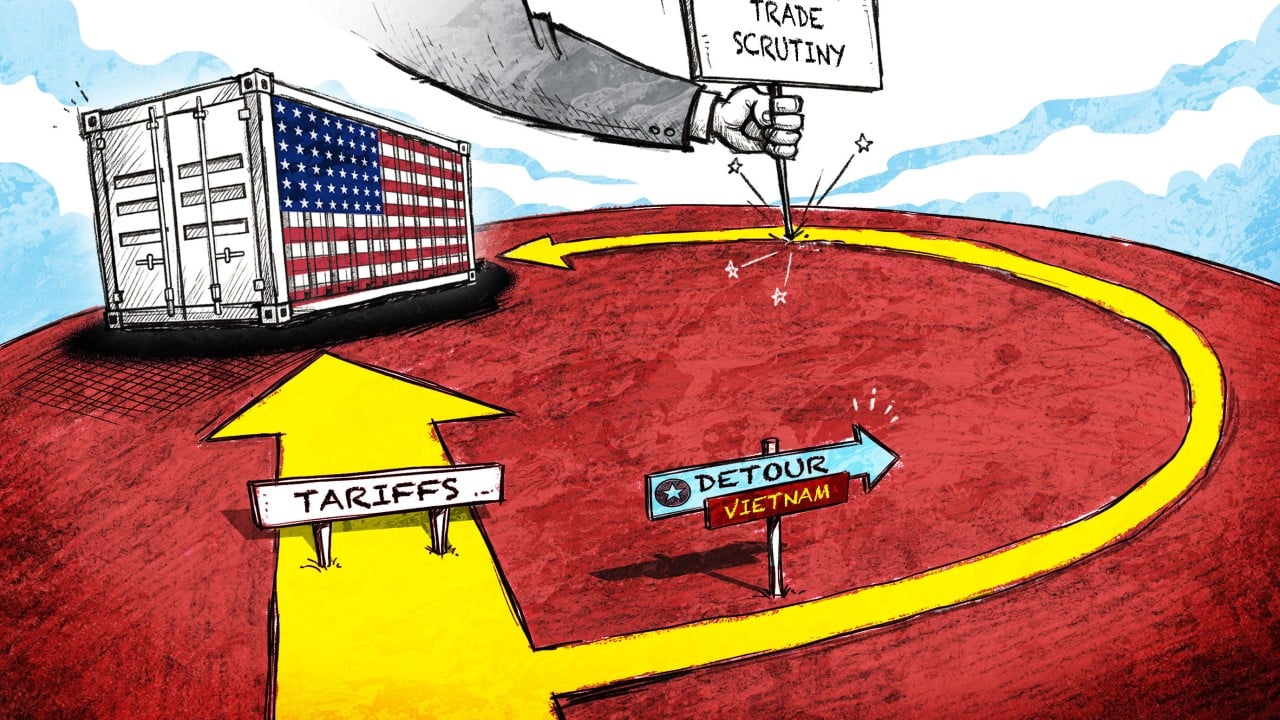
Moving your entire manufacturing base from the industrial hubs of eastern China to the rolling hills of northern Vietnam used to look like a stroke of genius. For years, the play was simple. You packed up your machinery, leased a plot in an industrial zone outside Hanoi, imported your components from Shenzhen, and slapped a "Made in Vietnam" label on the final box. Walmart got its cheap towels, and your profit margins stayed clear of Washington's tariff wrath.
That script is dead. The golden era of using Southeast Asia as a shallow detour to dodge American trade restrictions has officially hit a wall.
The immediate catalyst is the sweeping trade agreement struck between Washington and Hanoi. Under this framework, Vietnamese exports bound for the United States face a stiff 20 percent baseline tariff. But the real hammer is the creation of a 40 percent penalty tariff targeting any goods deemed to be "transshipped" from third countries like China. In exchange for escaping a threatened 46 percent reciprocal levy, Vietnam agreed to open its own domestic markets to American goods at zero tariff and launch an aggressive, domestic crackdown on rules-of-origin fraud.
For hundreds of Chinese manufacturers who viewed Vietnam as a permanent tariff safe haven, the math has fundamentally changed. The cheap assembly loophole didn't just narrow, it closed completely.
The Illusion of the Seamless Border Shift
When global trade tensions initially flared, corporate boards panicked. Textile heavyweights and electronics manufacturers scrambled for a haven, and Vietnam was the obvious winner. Its proximity to China meant supply chains wouldn't have to be completely uprooted. You could still source your raw chemicals, specialized yarns, or silicon wafers from the mainland, haul them across the northern border, and finish the job in a lower-cost environment.
It looked great on a stock exchange filing. Jasan Group, a massive textile exporter, built a 180 million yuan ($26.6 million) facility in Vietnam's Hung Yen province designed to churn out 60 million socks a year specifically for the American market. Solar giants like Jinko Solar poured money into manufacturing hubs in Quang Ninh province.
But these investments were built on a fragile assumption: that the US government would continue to define a product's origin based on where the final factory worker turned the screw.
Washington caught on to the imbalance. Economists noticed a glaring discrepancy in regional data. Vietnam's exports to the US were skyrocketing, and its trade deficit with China was ballooning simultaneously—surging roughly 68 percent to reach $83 billion. Yet, Vietnam's domestic manufacturing production index wasn't growing fast enough to justify that export boom. The data pointed to a clear conclusion: a massive portion of the trade was simple export deflection, where goods were routed through Vietnamese ports with minimal local value-add.
The Cost of Shallow Integration
The new 40 percent transshipment tariff relies on international trade norms regarding "substantial transformation." To legally claim Vietnamese origin, a product must undergo a fundamental shift in its name, character, and use. Simply importing a nearly complete solar panel or a pre-stitched garment and conducting final quality testing or basic packaging no longer cuts it.
The fallout was immediate. Jinko Solar, which had planned a massive $1.5 billion footprint in Vietnam, quietly axed its entire project after its local subsidiary faced anti-dumping allegations and punitive duties from the US Department of Commerce. Jasan Group similarly pulled back on its expansion plans, explicitly citing operational uncertainties and shifting export prospects.
When customs investigators start auditing the deep tiers of your supply chain, a lack of legitimate vertical integration becomes an immediate financial liability.
The Vietnamese government is caught in an uncomfortable vice between its two most critical economic partners. It relies on China for the vast majority of its industrial inputs, components, and raw materials. At the same time, the US is its primary destination for finished consumer exports. Hanoi cannot afford to ignore Washington's demands for traceability; Bloomberg Economics estimates that failing to secure a trade deal could have cost Vietnam a quarter of its US export volume, wiping out more than 2 percent of its annual economic output.
Consequently, Vietnamese customs authorities have stepped up enforcement, uncovering thousands of cases of fraudulent trade practices, illicit marine shipments, and counterfeit country-of-origin certificates at major ports like Haiphong.
What Real De-Risking Looks Like Now
If you are managing a manufacturing supply chain, the takeaway here is loud and clear: hunting for the next geographic loophole is a losing strategy. The days of treating Southeast Asia or Mexico as a quick labeling stop are over. Regulatory scrutiny is shifting away from the final port of departure and focusing squarely on the entire lifecycle of the product.
To survive this enforcement environment, your operational strategy must pivot toward deep local integration.
- Audit Your Sub-Tier Suppliers: You need absolute clarity on where your raw inputs originate. If your Vietnamese or Mexican facility relies on more than a minor threshold of Chinese-origin components, assume that a 40 percent transshipment tariff is a live risk.
- Build True Vertical Manufacturing: If you move production to a third country, you must commit to local sourcing. This means establishing regional supply chains for components, casting, or raw fabric rather than relying on kits shipped from the mainland.
- Prioritize Geographic Dispersion over Re-Routing: Instead of trying to funnel all US-bound production through a single proxy country, look at broader regional diversification and building genuine capacity aimed at regional consumer markets, not just the American consumer.
The trade map is being redrawn by strict compliance and verifiable logistics. Companies that invested heavily in building real local value and deep industrial roots inside Vietnam will likely weather this transition. Those that relied on a cheap detour are finding out that the shortcut leads straight to an expensive dead end.


